





Advanced Word Search Puzzle Game Strategies
Once you are past beginner habits, word search and word find puzzles reward a tighter system: pattern reads, ordered coverage, and deliberate direction switches on straight-line letter grids—not crossword clue work.
Advanced play is less about staring harder and more about cutting wasted passes on larger lists, dense filler, and boards where multiple orientations appear in the same solve.
Build a Structured Search Pattern
Strong solvers rarely hop at random. They repeat the same grid route puzzle after puzzle so every cell gets a fair look and duplicate sweeps drop away.
Approaches that scale
- Row scans in a fixed direction, then the next band in sequence
- Zigzag or block-based paths that avoid retracing the same cells
- Mental quarters: finish one zone before opening another
A structured pattern spends attention once per area instead of circling the same rows.
Prioritize High-Visibility Words
Not every list entry costs the same effort. Long spellings, rare letters, and unusually clean letter runs stand out against noisy filler.
Practical ordering
- Attack longer words while open straight paths are easy to trace
- Watch for Q, Z, X, and similar anchors that narrow a hunt quickly
- Clear obvious finds early so marked paths simplify what remains
Easier clears first shrink the grid your brain still has to search.
Use Directional Awareness Intentionally
At an advanced level you choose orientations before you drift into them. Horizontal, vertical, diagonal, and backward straight paths each deserve their own finished pass when rules allow—not one mixed scramble.
Deliberate habits
- Rotate through allowed directions on purpose instead of chasing the first hunch
- Train backward shapes so reversed list spellings register without slow decoding
- Finish one directional family before pivoting to the next
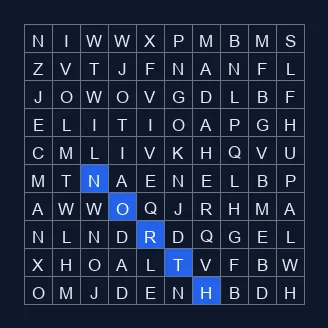
One word highlighted on a diagonal line shows the kind of non-row path advanced word search games expect you to own— deliberate direction work, not hoping a slant appears while you reread horizontal bands.
Timed and themed word search puzzle games especially punish solvers who only ever scan left to right.
Scan for Letter Clusters, Not Just Full Words
Hunting entire list entries at once is slow. Advanced players watch for fragments that many words share, then extend a short match along every allowed line.
Fragments worth noticing
- Common prefixes such as TR-, ST-, or RE-
- Frequent pairs like ER, ING, or TION
- Dense consonant–vowel bands that hint at more than one list word
Cluster reads surface hidden spellings that never pop as a whole word on the first pass.
Reduce Cognitive Load by Clearing Sections
Big grids overload working memory when attention jumps everywhere at once.
Zone discipline
- Treat one quadrant or band as “in progress” until it is cleared
- Track completed strips mentally—or with light marks on paper
- Resist leaping to a distant corner before the current section is done
Section-by-section work keeps long word find sessions accurate instead of exhausting.
Leverage Word Length Distribution
The word list is data. Length tells you where anchors live and which sweeps can wait.
List-first logic
- Place long entries early while they still dominate open space
- Use long finds to fence off large regions of the board
- Reserve very short words for a closing pass when clutter is lower
That progression moves from structure spotting to fine-detail cleanup.
Train Reverse Pattern Recognition
Backward placement on allowed straight paths is standard on harder boards. Advanced skill is recognizing reversed silhouettes at reading speed.
Reverse training
- Practice reading list endings first when backward paths are legal
- Notice symmetrical letter shapes that look familiar in either orientation
- Include backward checks in the same scheduled pass as forward, not as an afterthought
Reverse fluency removes the slowest reread passes on dense grids.
Use Peripheral Vision Effectively
Tunnel vision on one tight cluster wastes time on large boards. A slightly wider field lets promising letter bands register while the main scan line keeps moving.
Where periphery helps
- Double letters and rare consonants flag a second look without stopping the sweep
- Diagonal or vertical candidates can flash at the edge of attention during a row pass
- Full-grid coverage finishes in fewer total passes when you are not micro-staring at single cells
Peripheral cues complement structure; they do not replace a complete pass in each allowed direction.
Avoid Over-Fixation on One Area
Even advanced players stall when one stubborn word eats the clock.
Momentum rules
- Cap how long you stare at a single zone before moving on
- Return after other list entries shrink the grid
- Keep overall coverage moving so the board does not sit half-forgotten
Fresh context on a second visit often spots what obsession missed.
Develop Pattern Memory Over Time
Repeated play teaches how generators place vocabulary: overlap bands, corner habits, and typical diagonal density on themed lists.
What memory adds
- Faster reads of familiar word shapes on recurring topics
- Quicker guesses about where the last few words might hide
- Less mental effort on mechanics so attention stays on the list
Pattern memory is cumulative; it rewards regular practice across varied word search puzzle games.
Think in Terms of Elimination
Searching is only half the job. Advanced solvers also remove what cannot be true.
Elimination moves
- After a clean directional pass, treat that orientation in that zone as checked
- Mark mentally which rows or columns no longer need a given angle
- Narrow remaining candidates to strips where list fragments still fit
Elimination thinking turns a visual hunt into a calmer, more analytical solve without changing the rules of the puzzle.
Mastery Comes from Efficiency
Advanced strategy is not cheating the puzzle—it is trimming blind effort. Steady systems, list-smart ordering, direction discipline, and light elimination add up to faster, more consistent finishes.
With practice, word search and word find grids feel like structured observation exercises rather than endless random peering.
Frequently Asked Questions
How is advanced word search technique different from intermediate play?
Intermediate play builds repeatable full-grid passes and basic backward awareness. Advanced play layers list-driven ordering, cluster and elimination logic, directional scheduling, and zone discipline so large or dense boards stay under control.
Should I find long words or short words first on a hard grid?
Usually long or rare list entries first, while open straight paths are easy to trace. Very short words often survive a final cleanup sweep once marked paths reduce noise.
Do I need a separate pass for backward and diagonal words?
Yes, when rules allow those paths. Treat each orientation as its own completed sweep instead of mixing all directions in one chaotic reread.
Can peripheral vision replace detailed scanning?
No. Wide glimpses spot candidates; you still owe each allowed direction a finished pass. Periphery speeds hints; structure finds the last words.
Do these advanced strategies work on paper and on screen?
Yes. Straight-line list puzzles share the same skills. Adjust for glare, zoom, and breaks on devices, but scan order, clusters, and elimination habits transfer directly.