





Are All Word Search Puzzle Games Solvable?
Most published word search and word find puzzles are meant to be completable: every word on the list should already sit on a straight path inside the letter grid before you start. That is different from crossword-style fill-ins, where blank cells might not have a unique answer. When something feels impossible, it is usually density, direction rules, or scanning gaps—not a broken board. This guide explains fair design, what makes a grid only seem unsolvable, and the rare cases where a puzzle truly cannot be finished.
Short Answer
Yes, for quality puzzles: editors and generators that follow standard rules place each list word in the grid first, then scatter filler letters. If you follow the puzzle’s direction rules and mark off found entries, a fair word search is designed so a full clear exists.
Not always, in the wild: hand-made slips, outdated print files, or buggy generators can leave a word off the grid, truncate a spelling, or ship with a list that no longer matches the board. Those cases are uncommon on reviewed sites but worth knowing about.
Design Intent and Solvability
Fair word search design starts with the word list and works outward.
Builders typically:
- Place each list entry along an allowed straight line (row, column, or diagonal, including reverse if the rules say so)
- Allow shared letters where words cross—overlap is normal and does not block other words
- Fill leftover cells with random letters so decoy sequences look busy without removing real paths
- Re-run placement or resize the grid when a word will not fit, rather than publishing a short list on paper
A well-tested board gives you observation work, not a coin flip. Generators that respect placement limits usually fail loudly (retry, swap a word, or shrink the list) instead of silently shipping a grid missing an entry.
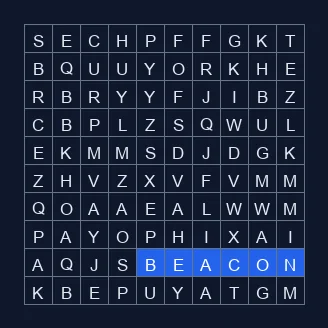
A single highlighted horizontal path shows what “solvable by design” means in practice: “BEACON” is already embedded on a straight line, sharing cells with filler like any fairly built puzzle. The challenge is finding every listed path—not wondering whether the word exists.
When a Puzzle Feels Unsolvable (But Is Not)
Difficulty and fairness are not the same thing. A dense or expert board can still be complete.
Common reasons solvers stall:
- Tight overlap: many words share letters, so short entries hide beside long ones
- Full direction sets: reverse, diagonal, and vertical paths need separate passes
- Unfamiliar vocabulary: the word is present but not on the tip of your tongue
- Visual camouflage: repeated letter clusters pull your eye to decoys
Patience and systematic scanning usually break these stalls. If the publisher labels the puzzle medium or hard, a long hunt for the last few words is part of the design—not proof the grid is broken.
Rare Cases That Can Be Truly Unsolvable
Actual “no solution” outcomes almost always trace to construction mistakes:
- A list word never placed in the grid
- A spelling on the list that does not match what was embedded
- A word clipped by grid bounds or truncated during export
- A rules mismatch (for example, diagonals allowed in the file but disabled in the app)
Professionally edited puzzles catch these in QA. Automated tools with weak validation are where players most often hit a dead end. If every strategy fails and you suspect an error, compare the remaining list against a fresh copy of the puzzle or contact the source.
What to Try Before Assuming a Broken Grid
When one entry will not appear, treat it as a search problem first:
- Sweep rows, then columns, then each allowed diagonal direction
- Re-read the list for reversals or alternate spellings the rules allow
- Anchor on rare letters in the stubborn word
- Mark found words and recount—sometimes the “missing” word was already highlighted under another path
These habits help on fair boards and quickly expose true list/grid mismatches when the last word never shows up.
Balancing Challenge and Fairness
Good word search design stretches attention without hiding words off-grid. Density, theme, and direction rules raise challenge; placement QA keeps the puzzle honest. Random filler adds replay texture, but the answer set should stay tied to the published list.
Once you know the difference between a tough grid and a faulty one, you can enjoy word search puzzles with more confidence—and know when to walk away from a bad file instead of blaming your scanning.
Frequently Asked Questions
Are all word search puzzles guaranteed solvable?
Every fair puzzle is built so each list word has a valid straight path. Guarantees apply to that contract—not to every homemade sheet or unverified download.
Can overlapping words make a puzzle impossible?
No. Overlap is deliberate. Words share cells; each list entry should still trace along its own straight line.
Why does my word search feel impossible on the last word?
Late-game words are often short, reversed, or buried in overlap. Slow down, rotate scanning directions, and check whether the entry might read backward along an allowed line.
Do generators always produce solvable grids?
Reliable generators place all words before filling blanks. Poor ones may skip failed placements or ship partial grids—treat mystery leftovers as a signal to verify the source.
Is word search the same as crossword solvability?
No. Crosswords depend on clue intersections and letter fills. Word search hides whole words you find and mark along lines; solvability means “every list word was placed,” not “every blank has one unique letter.”
What should I do if I think a puzzle is unsolvable?
Finish a disciplined pass on every allowed direction, then compare the list to a clean copy of the board. Persistent gaps after that often point to a publishing error, not player skill.