





How to Avoid Missing Words in Word Search Games
Finishing a word search or word find with one entry still on the list is a familiar annoyance. Large grids, dense filler letters, and tricky directions make it easy to overlook a word that was sitting in plain sight. The fix is not luck—it is coverage: a scan pattern you can repeat, rechecks you trust, and enough patience to run every allowed direction before you call the puzzle done.
Scan the Entire Grid Systematically
Most missed words trace back to gaps in coverage, not to words that were impossibly hidden. When you hop around the board or abandon a row halfway through, entire bands of letters never get a serious look.
Effective Scanning Habits
- Work across the grid row by row (or column by column) without skipping sections
- Repeat the same discipline vertically and diagonally when the puzzle rules allow those paths
- Finish one zone before jumping elsewhere; random hops leave holes between visited areas
A consistent pass gives every cell comparable attention, which is how you catch words that never popped on a quick first glance.
Slow Down When Needed
Speed helps only after accuracy is stable. Rushing near the end—or through a patch of repetitive letters—tends to hide the very words you are hunting for.
When to Slow Down
- When only a few list entries remain and each feels harder than the last
- When the board shows long runs of the same letter or repeated clusters
- When you feel stuck, tense, or tempted to declare an area “done” without proof
Deliberate pacing in word search puzzle games lets you notice subtle shapes instead of skimming past them.
Look for Reverse and Diagonal Words
Many players miss answers because they read in one habitual direction. If your eyes only trace left-to-right rows, backward and diagonal spellings on the same lines stay invisible.
Important Directions to Check
- Left to right and right to left along the same row
- Top to bottom and bottom to top along the same column
- All diagonal orientations the puzzle allows
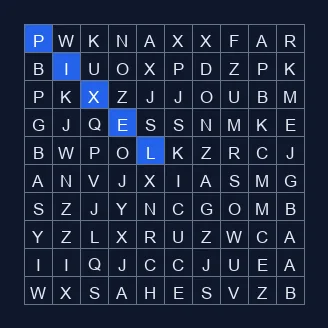
Diagonal paths are easy to skip when you scan in only one direction; the highlighted example shows a straight-line word tucked across the grid—a shape worth a dedicated diagonal pass.
Training yourself to trace each allowed line in both orientations closes a large share of “mystery” misses in word search games.
Re-Scan in Layers
One sweep is rarely enough on a full list. Layered passes split the job by difficulty so short or backward entries get their own round of attention.
Layered Approach
- First pass: obvious long words and clear anchors
- Second pass: medium-length entries and overlapping regions
- Final pass: short words, reversals, and any cell still ambiguous
This structure keeps you from quitting after the easy finds while three stubborn three-letter answers remain.
Focus on Unusual Letter Patterns
Some words hide because they visually merge with filler. Rare letters and distinctive clusters stand out once you look for them on purpose.
What to Watch For
- Letters like Q, X, or Z that appear less often in random fill
- Repeated letter pairs or triples that might belong to a list word
- Uncommon beginnings or endings that break up uniform texture
Using these as anchors does not replace systematic scanning, but it speeds up where to aim the next careful pass.
Double-Check Completed Areas
Declaring a section finished too early is a common source of leftover list items. Overlaps and backward paths often sit inside zones you already “cleared” mentally.
Why Rechecking Helps
- First passes favor expected shapes; second passes catch exceptions
- Overlapping words share letters that can fake a complete solve
- A slight shift in start point or direction reveals paths you skipped before
A brief revisit—especially on large word search puzzle grids—costs little time and prevents embarrassing one-word finishes.
Keep a Clear Mental Map
Without tracking where you have been, you either rescan the same rows or never return to suspicious gaps.
Techniques for Better Tracking
- Divide the board into mental quadrants or bands
- Note which zones received a full directional pass
- Mark found words on the grid or list so overlaps stay visible
An honest map stops duplicate work and highlights the regions that still deserve a methodical pass.
Practice Careful Observation
Misses shrink as your eye learns what straight-line words look like in noise. Observation is trainable the same way scanning rhythm is.
- Practice reading letter-by-letter on easier boards before chasing speed
- Run dedicated drills for reversals and diagonals on puzzles that include them
- Build patience for a final list pass instead of rushing to close the tab
Over time, word search puzzle games feel more predictable because you trust the process, not because every word leaps off the screen.
Combining systematic coverage, layered rechecks, and direction-aware habits turns “almost done” into a clean solve far more often. Treat every grid as a chance to tighten your scan—not as a test of how fast you can guess.
Frequently Asked Questions
Why do I keep finishing with exactly one word left?
That pattern usually means a single blind spot—a skipped diagonal, a backward spelling, or a corner you marked done too early. Run a final pass that checks only the directions you tend to ignore.
Should I search for long words or short words first?
Either order can work if you stay systematic. Many players clear long anchors first for confidence, then dedicate a slow final pass to short entries and reversals.
Is it better to scan randomly or row by row?
Row-by-row (or column-by-column) coverage reduces gaps. Random searching feels lively but often revisits easy zones while leaving whole bands untouched.
Do word search puzzles hide words backward by default?
Rules vary by puzzle. Check whether backward and diagonal paths are allowed, then scan those orientations on every pass where they apply—assuming “forward only” is a fast route to missed words.
Are word search games the same as crosswords?
No. Crosswords use clues and blanks to fill in answers. Word search puzzles place whole words along straight paths in a letter grid for you to find and mark.