





What Is a Backward Word Search Puzzle Game?
A backward word search puzzle game is a word find variant built around reversed reading order along straight lines in the letter grid. List words still follow normal spelling—you cross them off as written—but they may sit on a path you read from the opposite end, such as right to left on a row or bottom to top in a column. Some titles lean heavily on reverse placements; others mix forward and backward words on the same board.
The twist is simple to state and harder to play: your eyes must work in both orientations on every allowed direction, not only the way you read a sentence.
How Backward Word Search Works
Classic word search is not crossword fill-in. You trace one continuous straight line of cells—horizontal, vertical, or diagonal when diagonals are on—and match that path to an entry in the word list.
In a backward-friendly puzzle, each hidden word uses the same placement rules. Only the sequence you read along the path can reverse. APPLE might appear as the letters E-L-P-P-A if you trace that row from right to left. The letters are still neighbors on one line; you are not hunting anagrams scattered through the grid.
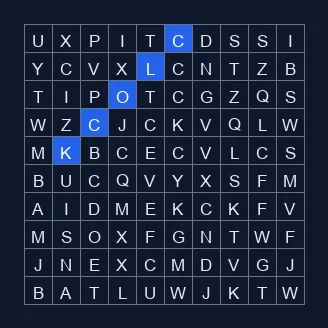
A single highlighted path shows how one list word sits on a straight line of cells. On backward puzzles, the same idea applies—you may need to read that line from either end when reverse spellings count.
What counts as “backward”
- Backward along the line — reverse letter order on an otherwise normal straight path
- Not letter scrambling — the word does not hop between unrelated rows
- Rule-driven — the puzzle (or app mode) says which directions allow reverse reading
If the instructions say “forward only,” a reversed string does not count even when the letters are visible backward.
Directions You May See
Backward word search puzzles usually inherit the same direction families as standard word find boards. Reverse placement can appear on any direction the rules allow—not only horizontal rows.
Typical combinations:
- Horizontal — left to right and right to left
- Vertical — top to bottom and bottom to top
- Diagonal — forward and reverse along each permitted slope
On harder setups, designers enable several orientations at once. That increases valid placements without changing how you highlight a found word.
How This Differs From a Standard Word Search
| Standard word search (forward emphasis) | Backward word search emphasis |
|---|---|
| Often defaults to habitual reading direction | Expects reverse passes on the same lines |
| Easier first pass for many readers | Rewards bidirectional row/column sweeps |
| May limit reverse on “easy” labels | Often advertises reverse as a core challenge |
Grid size alone does not define the mode. A compact 8×8 board can allow reverse text; a large grid can remain forward-only. Read the direction set on the puzzle before you assume which scans count.
Why Backward Puzzles Feel Harder
Reverse entries slow habit-driven scanning:
- Many readers anchor on word beginnings; backward paths highlight endings first
- A quick left-to-right row pass can miss a valid right-to-left answer
- Diagonal reverse lines are easy to skip after a forward-only diagonal sweep
The extra effort is mostly attention and habit, not memorizing new rules. Same list, same straight highlights—more orientations to verify.
Skills the Mode Trains
Players who practice backward word find puzzles often strengthen:
- Pattern recognition when letter order flips
- Steady scanning instead of darting randomly
- Spelling checks along the full path, not just the first two letters
- Patience on dense boards with overlapping lines
Treat it as a focus drill layered onto familiar word search mechanics.
Practical Strategies
Tactics that transfer well from reverse-friendly FAQ boards to dedicated backward modes:
- Scan rows and columns both ways whenever reverse is allowed
- Start from the last letter of stubborn list items, then trace the line
- Mentally reverse short words you know by heart before looking at the grid
- Finish one direction family at a time (all horizontals, then verticals, then diagonals) so you do not repeat the same forward-only habit
On themed or timed runs, pair those passes with your usual list-first routine so easy forward words do not eat the clock.
Difficulty Knobs Designers Use
Backward placement interacts with other difficulty levers:
Usually easier
- Few words that require reverse reading, mixed with forward entries
- Shorter word lists and more open grid space
- Limited direction set (for example, horizontal reverse only)
Usually harder
- Many reverse entries and tighter letter density
- Long words with similar prefixes on the list
- Full direction sets with several reverse diagonals active
Check the puzzle label, but treat “backward” as a sign you need systematic bidirectional sweeps, not one fast read pass.
Why Players Choose This Variant
Backward word search puzzle games stay popular because they:
- Add challenge without replacing the core “find words in a grid” loop
- Refresh familiar word find sessions for players who breeze through forward-only boards
- Encourage calmer, line-by-line coverage instead of random stabbing
- Make “found it backward” moments feel like a small discovery bonus
It is the same pencil-or-tap satisfaction as classic word search—just with more angles to respect.
Frequently Asked Questions
Is a backward word search the same as allowing “words backwards” on a normal puzzle?
Often yes in practice. Many apps use “backward mode” to mean reverse reading is allowed on standard straight paths. Some print books label an entire section as backward word search when most answers on those pages are reversed. The mechanics are the same: list spelling, straight path, optional reverse read.
Do I highlight ELPPA or APPLE on the grid?
Highlight the cells that form the word along the path. Cross off APPLE from the list—the bank keeps normal spelling even when you read the line backward.
Can every word on the list be backward?
Sometimes. Dedicated backward puzzles may skew toward reverse placements. Mixed puzzles usually still include forward words so the board does not feel monotonous. The word list does not always tell you which entries are reversed; scanning both ways is safer.
Are backward word search puzzles always harder?
Not automatically. A small grid with a handful of reverse entries can feel gentler than a huge forward-only board packed with overlapping words. Difficulty comes from density, list length, and how many directions are active—backward is one factor, not the whole story.
Is this variant related to snake or hidden-message word search?
No. Snake-style puzzles use chained paths that may bend; hidden-message puzzles often extract letters after the find phase. Backward word search stays on single straight lines with optional reverse reading—standard word find rules.
Final Thoughts
A backward word search puzzle game stretches the familiar word find template by making reverse reading part of the hunt. Learn the published direction rules, sweep each allowed line in both orientations when reverse counts, and cross off list spellings—not the reversed text you traced. Once bidirectional scanning becomes routine, backward entries stop feeling like tricks and start feeling like one more straight path through the grid.