





Can Words Go Backwards in Word Search Games?
Often, yes. On many word search and word find puzzles, list entries may read backward along an allowed straight line—not only in the usual left-to-right or top-to-bottom direction. Whether reverse spellings count is a rule on the puzzle, not a universal law of every grid.
Understanding that split matters: if you only scan “the way you read a sentence,” you will miss valid answers on boards that allow reverse paths.
Short Answer
When backward words are allowed, a listed word still occupies one continuous line of cells. Only the reading order along that line flips. For example, APPLE can appear as ELPPA along a row you trace from right to left. The letters stay adjacent; you highlight the same straight path you would for a forward word—just read it the other way.
Classic word search is not crossword fill-in: you locate existing strings in a letter grid along permitted directions.
What “Backwards” Means in the Grid
A backward word is the normal spelling placed so you read it in reverse along the path:
- The letters form a real word from the list
- They sit on one unbroken horizontal, vertical, or diagonal line (when diagonals are allowed)
- You match the list by tracing that line and confirming the reversed spelling
Reverse placement is about orientation along the line, not scrambled letters that jump between rows.
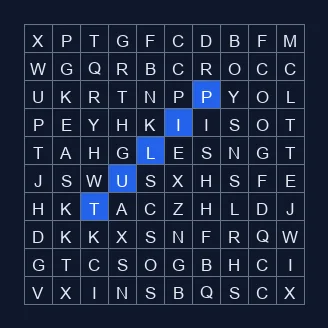
Highlighted paths show how answers embed in the letter grid: “TULIP” sits on one straight line of cells. On puzzles that allow reverse reading, the same idea applies—your job is to read the allowed line in both directions when rules say so.
Are Backward Words Allowed on Every Puzzle?
No. Difficulty labels, print traditions, and app settings all differ.
Common setups:
- Forward only — often “easy” or classroom sheets
- Forward and backward — common on apps and newspapers once you leave beginner mode
- Backward plus full direction sets — diagonals and vertical reverse paths on harder boards
Always check the puzzle instructions. A grid that looks “missing” a familiar word may simply require a reverse pass along that row or column.
Why Designers Include Backward Words
Reverse entries add challenge without enlarging the grid:
- They break the habit of only scanning left to right
- They spread answers across more orientations on the same board
- They reward systematic line-by-line checks instead of guessing
That variety keeps word search puzzles engaging for players who already spot forward horizontal words quickly.
Directions a Backward Word Can Use
Backward placement follows the same direction families as forward words; only the read order changes.
Examples players should consider when rules allow reverse text:
- Horizontal — right to left along a row
- Vertical — bottom to top along a column
- Diagonal — reverse along any diagonal slope the rules permit
On many modern puzzles, “eight directions” means the four straights plus four diagonals, each readable forward or backward along that same line. Easier puzzles may limit which of those eight are active.
How to Spot Backward Words Faster
Reverse entries feel slow until scanning habits catch up. Tactics that help:
- Read each row and column in both directions when reverse is allowed—not only your natural reading side
- Anchor on word endings on the list; long words read oddly backward but endings (like -ING, -TION) can pop out
- Mentally flip shorter list items you know by heart before scanning
- Mark directions tried so you do not repeat the same forward-only pass
With repetition, reverse paths register about as quickly as forward ones.
Common Mistakes
Most missed backward words come from assumption, not poor eyesight:
- Scanning rows only left to right
- Checking word starts on the list but not the same letters running backward
- Ignoring vertical or diagonal reverse lines after finishing forward sweeps
- Assuming “not found” means the word is missing instead of reversed on an allowed line
Fixing those habits improves accuracy more than rushing a second random pass.
Difficulty and Backward Words
Backward placement often scales with labeled difficulty:
| Typical label | Reverse words |
|---|---|
| Easy | Often forward-only, sometimes limited directions |
| Medium | Frequently mixes forward and backward on horizontal and vertical |
| Hard | Often all permitted directions, including diagonal reverse |
Treat the label as a hint about how many orientations deserve their own scan pass.
Frequently Asked Questions
Can words go backwards in word search games?
On many puzzles, yes—if the rules say reverse spellings along straight lines count. Always read the puzzle’s direction set first.
Is a backward word still one straight line?
Yes. Reverse reading does not mean letters skip around the grid. One word, one continuous path.
Do I cross off the normal spelling or the reversed letters?
Cross off the listed spelling from the word bank. You found it if the reversed sequence along a valid line matches that entry.
Why did I find “ELPPA” but the list says APPLE?
That is normal when backward words are allowed: ELPPA along a row is still APPLE on the list. Trace the path and match to the bank entry.
Are backward words the same as harder grid size?
Not necessarily. A small grid can allow reverse text; a large grid can still be forward-only. Size and direction rules are separate knobs.
Final Thoughts
Words can go backward on a large share of word search puzzles, but only when the published rules allow it. Learn the direction set, scan each allowed line in both orientations when reverse is on, and treat missed reversals as a scanning habit—not a broken grid. Once backward paths are part of your routine, they stop feeling like hidden tricks and start feeling like one more straight line to read.