





Can Words Go Diagonally in Word Search Games?
Usually, yes. On most classic word search and word find puzzles, answers may sit along diagonal straight lines as well as horizontal and vertical rows—not every edition, but diagonal placement is standard on many newspapers, apps, and classroom sheets.
Whether diagonals count is always a puzzle rule, not a guess. If you only scan rows and columns, you will overlook valid answers on boards that include slanted paths.
Short Answer
When diagonals are allowed, a listed word still occupies one continuous line of adjacent cells. The letters step from cell to cell along a slope—up-left to down-right, down-right to up-left, and the other two diagonal directions when the full set is active.
Classic word search is line-and-list play, not crossword fill-in: you trace permitted straight paths through a letter grid and match what you find to the word bank.
Diagonal Words in Standard Word Searches
Traditional formats often combine straight and slanted placement.
Directions players usually see
- Left to right and right to left along rows (when reverse is allowed)
- Top to bottom and bottom to top along columns (when allowed)
- Four diagonal slopes on puzzles that use the full direction set
- Sometimes forward-only subsets on easier labels
Slanted words add visual variety without changing the core rule: one word, one unbroken line.
What Diagonal Placement Means on the Grid
A diagonal word runs across the grid at an angle instead of parallel to a row or column.
What to look for
- Each letter touches the next on a diagonal neighbor (corner-adjacent cells)
- The path stays straight—no bends or jumps
- The same list spelling appears whether you read down-slope or up-slope along that line
For example, a word might start near the top-left and run toward the bottom-right, one letter per diagonal step.
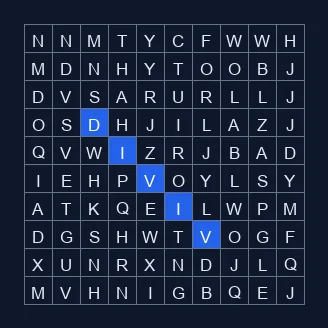
A highlighted example shows how diagonal answers embed in the letter grid: “VIVID” follows one straight slanted line through the cells. Your puzzle’s rules decide whether all four diagonals—and reverse reading along each—are in play.
Why Designers Include Diagonal Words
Diagonal paths raise challenge without always making the grid bigger.
Common design goals
- Break the habit of row-only scanning
- Spread answers across more orientations on the same board
- Reward flexible eye movement and pattern recognition
- Keep medium and hard puzzles from feeling like “easy mode with more words”
On many products, diagonals are what separates a relaxing horizontal-only sheet from a full eight-direction board.
Not Every Word Search Uses Diagonals
Diagonal placement is common, not guaranteed.
Rule variations to check
- Horizontal and vertical only — frequent on beginner or kids’ editions
- Diagonals on harder tiers only — easy levels stay straight; medium and up add slants
- Overlapping words allowed or forbidden — affects how dense diagonals look
- Partial direction sets — for example, diagonals forward but not backward along the same line
Read the puzzle instructions or difficulty blurb before you assume every slanted spelling is fair game.
How to Spot Diagonal Words Faster
Slanted paths feel slower until scanning habits catch up.
Tactics that help
- After row and column passes, sweep each diagonal family the rules allow
- Anchor on distinctive letters in the list (Q, X, Z, rare doubles) and search along slopes from those cells
- Follow imaginary lines through the grid instead of only horizontal bands
- Track word length: long entries stand out as a slanted “stripe” once your eye expects diagonals
With repetition, diagonal shapes register almost as quickly as horizontal ones.
Common Mistakes
Most missed diagonal words come from direction habits, not from the grid hiding tricks.
Typical errors
- Scanning rows left to right and stopping there
- Ignoring upward diagonal slopes after checking downward ones
- Treating a partial diagonal match as final without reading the full line
- Assuming “not on a row or column” means the word is absent
Adjusting those habits improves accuracy more than a rushed second pass at random.
Difficulty and Diagonal Usage
Labels often hint how many orientations deserve their own scan.
| Typical label | Diagonal words |
|---|---|
| Easy | Often horizontal and vertical only |
| Medium | Frequently mixes in one or more diagonal families |
| Hard | Often full permitted directions, including all four slants |
Treat the label as a guide—not a law. A small grid can allow every diagonal; a large one can still be straight-line only.
Frequently Asked Questions
Can words go diagonally in word search games?
On many puzzles, yes—when the rules include diagonal straight lines. Check the puzzle’s direction set before you hunt.
Are diagonal words still one straight line?
Yes. Diagonal does not mean hopping around the grid. One list entry, one continuous slanted path.
How many diagonal directions exist?
On a full eight-direction board, four diagonal slopes are common (northeast, southeast, southwest, northwest along the grid), each sometimes readable forward or backward when reverse rules apply. Easier puzzles may use only a subset.
Why do I see letters on a slant but the word is not on the list?
Random filler letters often look like short diagonals. A valid find must match a whole list word along an allowed line—same spelling and length as the bank entry.
Are diagonals harder than backward horizontal words?
Not always. Diagonals challenge eye path; backward words challenge reading direction along a familiar row. Hard puzzles may combine both.
Final Thoughts
Words can go diagonally on a large share of word search puzzles, but only when the published rules allow slanted lines. Learn the direction set, give diagonals their own scan pass, and treat missed slants as a habit—not a broken grid. Once diagonal paths are part of your routine, they stop feeling like hidden tricks and start feeling like one more straight line to trace.