





Common Mistakes in Word Search Puzzle Games
Word search and word find puzzles look simple on the surface, yet most players hit the same avoidable habits: jumping around the grid, skipping whole directions, or treating the word list like a script instead of a map. Those choices slow you down and leave answers sitting in plain sight.
Once you know which mistakes show up again and again, you can swap them for steadier scanning, clearer marking, and a pace that actually finds words.
Skipping Grid Scanning Strategy
The most common error in word search games is scanning at random—no rows, no columns, no rule for when to switch direction.
Typical habits that create gaps:
- Leaping from one corner to another without finishing a band
- Hunting in only horizontal lines while the list may hide vertical paths
- Abandoning a row halfway because nothing “popped” on the first pass
A better default is to cover the grid band by band: row by row, column by column, or in fixed sections you mark mentally as done. Without that structure, obvious words slip past simply because no pass ever gave their cells full attention.
Ignoring Reverse Words
On many word search puzzle grids, entries can run backward along an allowed straight line. Players who only read left-to-right or top-to-bottom keep searching for “missing” words that were already spelled in reverse.
What that costs you:
- Time spent re-checking areas where the answer was never forward-oriented
- False certainty that a list word “is not in the puzzle”
- Extra frustration near the end when one backward path stays invisible
When the rules allow it, trace each row and column in both orientations before you call a zone finished.
Focusing Only on the Word List
Another trap is staring at the vocabulary list while the letter grid waits unread. Memorizing spellings does not replace seeing how those letters actually sit among filler.
List-only habits include:
- Reciting words mentally instead of matching letter shapes on the board
- Expecting whole words to appear as clean blocks rather than broken across directions
- Ignoring partial sequences that could anchor a longer entry
In word find puzzles, pattern awareness on the grid usually beats list rehearsal alone.
Not Recognizing Letter Patterns
Designers overlap list words and mix directions, so answers rarely look like isolated islands. Beginners often hunt for perfect rectangles of letters instead of the shorter runs that signal a real path.
Common pattern misses:
- Stopping after half a word because the next letters bend diagonally
- Treating dense clusters as noise instead of possible intersections
- Overlooking shared letters between two list entries
Training yourself to notice two- and three-letter anchors speeds up every later pass.
Rushing Through the Puzzle
Timed word search games reward speed only after accuracy holds. Pushing too hard scatters attention and invites the same skips a careful first pass would catch.
Rushing often leads to:
- Walking past obvious words you would see at half speed
- Re-scanning the same comfortable zone while harder regions stay untouched
- Losing the thread of which rows already received a full directional check
A steady rhythm—fast enough to stay engaged, slow enough to read—usually beats frantic hopping.
Overlooking Already Found Areas
Without clear marks, players mentally “solve” regions that still hide overlapping or reversed entries. That produces duplicate work in easy zones and blind spots elsewhere.
This shows up when:
- Found words are not highlighted on the grid or crossed off visibly on the list
- You forget which quadrants received a backward or diagonal pass
- Visual memory blur makes two separate sweeps feel like one
Mark every find as you go. It trims repeated scanning and makes gaps obvious.
Ignoring Diagonal Words
Diagonal placement is the direction many players practice least. If your eyes live on horizontal and vertical lines, slanted spellings stay camouflaged in the same noise.
Typical fallout:
- List words that exist only on a diagonal remain until the last desperate sweep
- Slower finishes on puzzles that lean on angled paths
- A completed-looking board that is still missing one or two slanted answers
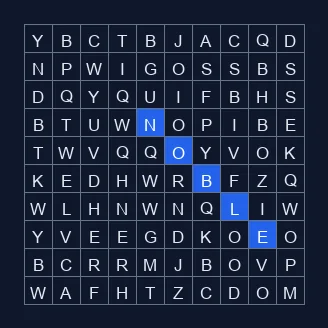
Diagonal words are a frequent blind spot when you never train on angled paths; the highlighted example shows how a straight-line entry can sit across the grid while horizontal-only scanning walks right past it.
Building a dedicated diagonal pass—after rows and columns—closes one of the largest mistake categories in word search puzzle games.
Misreading Similar Letter Shapes
Dense filler makes some glyphs blend: round letters, tall stems, and repeated consonants all invite misreads when you skim.
Watch for:
- O versus Q (or C) in tight clusters
- Identical consonants stacked vertically that fake a false start
- Vowel runs that look like one shape until you read cell by cell
When a zone feels noisy, slow down and trace letter by letter instead of guessing from silhouette.
Not Using a Consistent Starting Point
Starting in a different corner every session feels flexible but makes coverage hard to track. You may unknowingly skip the same edge twice.
Stronger habits:
- Open from a fixed corner or edge and advance in the same order each puzzle
- Complete one orientation (for example, all rows left-to-right) before switching
- Keep a mental or physical note of which bands are “closed” for each direction
Consistency turns scanning into a checklist instead of a lottery.
Underestimating Simple Words
Short entries hide because they occupy fewer cells and tuck inside longer words. A three-letter answer can sit inside a cluster you already “cleared” for a six-letter anchor.
Players often overlook:
- Two- and three-letter list words saved for a “final pass” that never happens
- Common short terms buried inside dense diagonal or backward paths
- Repeated tiny patterns that match multiple list items
Give short words their own slow round—after long anchors, not instead of systematic coverage.
Improving Through Awareness
Most word search mistakes come from process, not from puzzle difficulty. Random jumps, ignored directions, weak marking, and rushed endings are all fixable once you name them.
Replace them with band-by-band coverage, explicit reverse and diagonal checks, visible marks for found words, and a closing pass for short or tricky entries. Word find grids reward calm repetition more than heroic guessing.
Frequently Asked Questions
What is the biggest mistake beginners make in word search games?
Unstructured scanning—hopping around without finishing rows, columns, or sections. A simple row-by-row or column-by-column pass catches more words than random searching.
Why do I miss diagonal words so often?
Many players build muscle memory for horizontal and vertical lines only. Add a deliberate diagonal sweep when the puzzle allows angled paths, especially before you declare the grid done.
Should I read the word list or stare at the grid first?
Use both, but let the grid drive discovery. Read list entries to know targets, then hunt letter patterns on the board instead of memorizing spellings in isolation.
Does rushing help in timed word search puzzles?
Only after your scan pattern is reliable. Speed without coverage revisits easy areas and skips entire directions—exactly the mistakes timed modes punish.
Are word search puzzles the same as crosswords?
No. Crosswords fill blanks from clues. Word search puzzle games hide whole words along straight paths in a letter grid for you to find and mark—no clue-driven fill-ins.