





Different Types of Word Search Puzzles
Word search and word find puzzles share one mechanic—trace hidden spellings along straight paths in a letter grid—but publishers vary the rules, layout, and pacing until each version feels distinct. Knowing the main types of word search puzzles helps you pick a grid that matches your mood, spot why one session feels rushed while another feels calm, and avoid mistaking optional twists for a different game entirely.
All standard variants still hide whole words on lines (horizontal, vertical, and diagonal when allowed). They are not crossword fill-ins where clues replace hidden paths.
Classic Word Search Puzzle Games
The classic format is still the baseline most players meet first: a rectangular grid, a printed or on-screen word list, and every answer tucked along allowed straight directions. Extra rules are rare; the puzzle is mostly about steady scanning.
Classic word search puzzle games suit casual play, classrooms, and anyone learning row-by-row coverage without timers or surprise constraints. Difficulty usually comes from grid size, word count, and how many directions are enabled—not from exotic layouts.
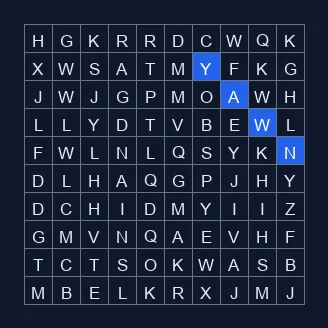
A classic board looks like any standard word find: random fill letters plus one straight spelling path (here “YAWN” on a diagonal). Variants below change lists, pressure, or shape—but this straight-line hunt stays the core.
Themed Word Search Puzzle Games
Themed word search games anchor the word list to one topic—animals, food, sports, travel, holidays, science, or pop culture. Every entry should belong to that label, so you can guess likely words before your eyes confirm them.
Themes make puzzles more engaging because context narrows the search space. They also reinforce vocabulary in a structured way: a “kitchen” list repeats ingredient spellings; a “space” list leans on planet and craft names. The rules do not change; only the list and branding do.
Timed Word Search Puzzle Games
Timed word search puzzles add a clock or countdown to the same grid. You still mark words along straight paths, but the session rewards pace—find everything before time expires, or beat a personal best.
That pressure sharpens focus and encourages faster sweeps, which can make you skim past short words if you are not careful. Timed modes are popular for challenges and quick mobile sessions; untimed cousins favor accuracy and relaxation. Pick based on whether you want adrenaline or a calmer scan.
Free-Form Word Search Puzzle Games
In free-form or “discovery” versions, you may receive a grid without a fixed answer list—or with a goal like “find as many valid words as possible.” You decide what counts, often under length or dictionary rules set by the puzzle maker.
These word find variants lean on vocabulary breadth and pattern spotting instead of checklist chasing. They feel closer to word games on letter tiles than to a school handout with fifteen marked answers, but the grid mechanics usually remain line-based when a hidden target word is the unit of success.
Circular or Irregular Grid Word Search Games
Some word search games shape the playable cells into circles, hexagons, masks, or custom silhouettes instead of a plain rectangle. Letters still line up on straight paths within whatever geometry the designer allows.
Irregular outlines break predictable row habits: your eyes cannot rely on perfect horizontal bands, so you adapt scan paths to the shape. Under the hood, most digital versions still test straight segments; the visual frame is what changes.
Backward and Multi-Direction Word Search Puzzle Games
Many labeled “hard” or advanced word search puzzles permit reversed spellings, fuller diagonal use, and overlapping paths where two words share letters. Each tweak multiplies the directions worth checking from any anchor cell.
Backward and multi-direction settings increase difficulty without altering the core loop—you still highlight a contiguous straight spelling. They do demand slower confirmation so you do not dismiss a reversed chain or miss a word that crosses another on the board.
Picture-Based Word Search Puzzle Games
Picture-based formats pair the grid with icons, photos, or comic panels that hint at theme words. Visual cues can help beginners connect list entries to meaning, especially in kids’ apps or language-learning packs.
The letter hunt stays the same; images reduce abstract guessing when a word is unfamiliar. Accessibility-minded designs sometimes enlarge taps or pair audio with the picture list.
Educational Word Search Puzzle Games
Educational word search puzzle games target classrooms, language study, or exam glossaries. Lists are curated for spelling goals—sight words, science terms, history timelines, or second-language vocabulary.
Because learning lists can include longer or rarer terms, these puzzles may feel harder than a generic animal theme even at the same grid size. The payoff is deliberate repetition of words you are meant to retain.
Progressive Word Search Puzzle Games
Progressive structures ramp challenge inside one session or campaign: early grids stay small with short lists; later rounds add size, direction options, or denser overlap. Some apps unlock tiers only after you clear the prior set.
That stepwise climb supports skill building without throwing new players into an expert board on the first tap. It is a design pattern you will see in mobile packs and classroom worksheet series alike.
Why There Are So Many Types
Variety exists because word search players want different payoffs—quiet focus, vocabulary drills, speed tests, kid-friendly visuals, or tougher direction rules. Publishers mix timers, themes, and shapes so the same core habit (find straight spellings, mark the list) stays fresh across audiences.
None of these labels replace the basic contract: hidden words on allowed lines in a letter grid. When a format adds odd constraints, check whether it is still line-tracing or has slipped into another puzzle family entirely.
One Core Idea, Many Variations
Formats differ in list, clock, shape, and direction set, yet honest word search puzzle games keep locating whole words along straight paths as the win condition. What changes is how much guidance, pressure, and topic framing you get around that hunt.
Exploring types helps you rotate between relaxing themed boards and deliberate challenge runs without burning out on one feel. When a variant clicks, note whether it was the theme, the timer, or the grid geometry that did the work—then seek more puzzles built the same way.
Frequently Asked Questions
What is the most common type of word search puzzle?
The classic rectangular grid with a supplied word list and horizontal, vertical, and (often) diagonal paths. No timer and no irregular mask—just scan and mark.
Do themed word search games use different rules?
Usually not. The topic changes the list and art; you still find listed words along straight allowed lines. Themed packs are not crosswords.
How does a timed word search differ from untimed play?
Same grid rules; a clock or score cap rewards speed. Untimed puzzles favor thoroughness and lower eye strain for long sessions.
What is free-form word search?
Variants with no fixed answer list or with “find valid words” goals. Success depends on dictionary rules the designer sets; some apps blend this with Boggle-style discovery.
Why add backward or extra directions?
They multiply readable orientations from each cell, raising difficulty without new mechanics. You still highlight one straight spelling at a time.
Are circular or shaped grids a different game?
The outline changes how you scan, but legitimate entries are still typically straight paths through adjacent cells. Always read that puzzle’s direction rules before you start.