





Do Word Search Puzzle Games Improve Memory?
Word search and word find puzzles look like light entertainment, yet they still ask you to hold a word list in mind, compare letter runs on a grid, and recognize shapes faster over time. That is not medical memory therapy or a guaranteed brain-training protocol—and it is not crossword-style fill-ins—but regular play can still touch working memory, visual recall, and pattern familiarity in modest, realistic ways.
This guide maps which memory-related skills word search puzzle games actually use during a solve, where small gains may appear, and what no casual grid can replace.
How Memory Is Used in Word Search Games
Every solve mixes brief storage, visual matching, and on-the-fly updating: you remember what is left on the list while your eyes hunt straight paths through filler letters.
Mental Processes Involved
- Short-term memory to keep the word list available while you scan
- Visual memory to notice letter clusters and repeat shapes
- Working memory to hold a candidate spelling while you trace a path on the grid
Those pieces together make word search puzzle games mentally engaging even when the rules feel simple.
Visual Memory Gets Light Exercise
Visual memory is one of the clearest links between word search play and “memory” talk: you repeatedly see where letters sit and which paths might spell a list word.
What Happens During Play
- You scan and mentally note letter positions along rows, columns, and diagonals
- Repeated patterns become easier to spot on later passes
- Familiar word shapes need fewer full re-reads of the list
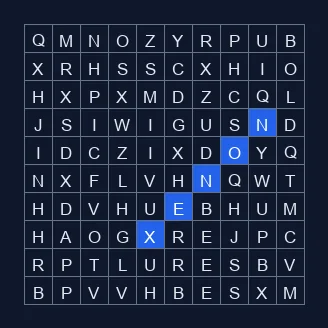
A highlighted diagonal path illustrates light visual recall: you match letters on a straight line to a list entry (“XENON” here), remember where you already searched, and update your mental map of the grid—without memorizing the whole board.
That repeated exposure can support everyday visual recall skills, not photographic memory of every cell.
Working Memory Is Continuously Active
Working memory holds the information you need right now: which words remain, which path you are testing, and whether a partial match still fits the list.
Why It Matters
- You keep several list words “live” while your eyes move
- You compare multiple possible start points before committing to a trace
- You adjust strategy when a promising cluster fails the spelling check
That juggling lightly exercises working-memory capacity—the same system used when you follow steps while cooking or hold directions in mind while driving.
Pattern Recognition Supports Recall
Improvements in word search often show up as faster pattern recognition rather than rote memorization of the grid.
Key Improvements
- Quicker spotting of common letter groups and prefixes
- Better sense of how long words “look” in a dense field of letters
- Less need to re-open the list for spellings you already checked
As those checks smooth out, the brain spends less effort re-learning the same visual clues puzzle after puzzle.
Repetition Strengthens Familiarity
Like many low-pressure cognitive hobbies, repetition matters more than a single marathon session.
What Repetition Does
- Reinforces familiar word shapes and scanning rhythms
- Builds comfort with multi-direction straight paths
- Speeds recognition so memory load feels lighter on the same grid size
Frequent, enjoyable play can make some search habits feel automatic—without claiming deep long-term memory restructuring.
Limits of Memory Improvement
Keep expectations grounded: word search games support mental activity, not clinical memory programs.
What They Do Not Provide
- Intensive long-term memory training or spaced-repetition curricula
- Complex reasoning drills beyond list-and-grid matching
- Full cognitive enhancement across every domain of memory
Treat them as light mental exercise—pleasant and repeatable—not a prescription or a lab-grade training tool.
Age and Cognitive Engagement
Word search puzzle games stay accessible across ages because the core task stays the same even when themes or grid sizes change.
Benefits by Age Group
- Younger players: early practice linking letters, spellings, and visual search
- Adults: focus-friendly breaks with mild mental stimulation
- Older adults: gentle engagement and visual tracking without steep rule learning
Adjustable difficulty and familiar themes help many players keep the habit going.
Attention and Focus Play a Bigger Role
Memory performance on a grid is tightly tied to attention: distracted scanning forgets list words faster than the puzzle forgets you.
How Focus Helps Memory
- Stronger attention means better recall of which words remain
- Fewer interruptions improve accurate path tracing
- Steady focus supports mentally “marking” regions you already cleared
In practice, the concentration habits you build while solving often matter as much as any narrow “memory boost” headline.
Realistic Cognitive Value
Word search games fit into a wider set of brain-engaging activities—reading, languages, strategy hobbies, and structured learning—not as a lone silver bullet.
Practical Understanding
- They encourage active scanning and letter-pattern recognition
- They offer light, in-the-moment memory engagement
- They stay enjoyable enough for regular, low-stakes practice
Pair them with varied challenges when you want breadth; use them on their own when you want a calm, familiar mental warm-up.
Final Thoughts
Word search puzzle games may contribute mild support for visual memory, working memory during scanning, pattern familiarity, and the attention that holds list words in mind. They are not a substitute for comprehensive memory training or professional care, but they can still offer meaningful, everyday mental engagement. Short, regular sessions often beat rare marathons when the goal is steady—not dramatic—cognitive practice.