





Easy vs Medium vs Hard Word Search Puzzle Games
Word search and word find puzzles usually ship in easy, medium, and hard tiers so both newcomers and veterans get a fair fit. The core task never changes—trace whole words along straight paths in a letter grid—but grid size, word lists, allowed directions, and overlap stack up to very different experiences. This guide compares what each tier tends to look like, how scanning load shifts, and how to move from relaxed boards to dense ones without guessing your way through crossword-style fill-ins.
Easy Word Search Puzzle Games
Easy puzzles target beginners, kids, or anyone who wants a low-friction session.
Typical design
- Compact grids with readable spacing
- Short, high-frequency words from everyday vocabulary
- Words often limited to horizontal and vertical lines
- Light overlap so paths stay visually distinct
The point is familiarity: you learn how a list maps to the grid, build scanning rhythm, and finish without fatigue. Easy boards are where row-and-column habits start to stick.
Medium Word Search Puzzle Games
Medium difficulty sits between comfort and strain. You still recognize most list words, but the board asks for steadier attention.
Typical design
- Mid-sized grids with more letters per pass
- A mix of short entries and moderately long themed words
- Diagonal placement appears alongside rows and columns
- Moderate overlap—shared letters without a fully packed feel
Casual eyeballing stops working as often. Many players shift to sectioned sweeps, marking found words on the list, and alternating horizontal passes with vertical or diagonal coverage.
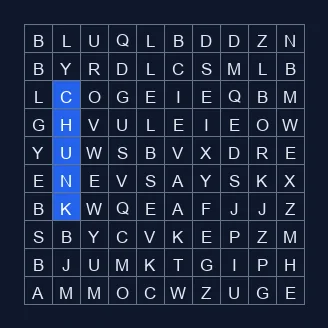
One highlighted straight path on a medium-style board illustrates what changes after easy play: you confirm a full word line on purpose instead of spotting only the first pair of letters. “CHUNK” here is a stand-in for checking a complete vertical path before you move on.
Hard Word Search Puzzle Games
Hard puzzles are for solvers who want long focus blocks and less obvious layouts.
Typical design
- Large, dense letter fields
- Longer, rarer, or specialist vocabulary
- Full direction sets, including reverse spellings along a line
- Heavy overlap and minimal empty-looking zones
Hard grids reward pattern discipline: you track partial matches carefully, ignore decoy clusters, and recheck corners and edges where reverse paths hide.
Key Differences in Grid Design
Grid construction is the clearest gap between tiers.
- Easy: open layout, quick full-board scans
- Medium: tighter packing, more shared cells
- Hard: crowded fields where few columns look “quiet”
As density rises, telling one valid path from nearby noise takes more deliberate passes.
Word Complexity Across Levels
List design matters as much as geometry.
- Easy: common nouns and verbs you read daily
- Medium: themed or slightly longer entries that still feel fair
- Hard: abstract, technical, or uncommon spellings that slow instant recognition
Familiar words shorten search time even on a big grid; unfamiliar ones make every direction worth checking.
Direction Rules and Their Impact
Allowed directions are a silent difficulty slider.
- Easy: often two axes—horizontal and vertical only
- Medium: diagonals join the mix
- Hard: all straight directions, including reversed letter order along a line
More freedom multiplies where a given spelling can hide, which is why hard puzzles feel mentally busier even when the list length looks similar.
Visual Density and Cognitive Load
Visual clutter tracks closely with perceived difficulty.
- Easy: breathable spacing, fewer competing shapes
- Medium: more letters per glance, more overlapping stems
- Hard: dense filler, easy to misread a near-match
Higher load does not mean unfair design—it means your eyes need systematic coverage instead of lucky jumps.
Strategy Differences Between Levels
Solid habits scale with the tier.
- Easy: light scanning, quick wins, building confidence
- Medium: structured passes, list tracking, diagonal awareness
- Hard: full-grid plans, anchor letters, careful verification before marking
What felt optional on an easy board—rechecking a quadrant, sweeping diagonals last—becomes default on hard ones.
Choosing the Right Difficulty Level
Match the board to your goal for that session.
- New or returning players: easy grids to learn pacing
- Skill builders: medium boards that stretch focus without burnout
- Veterans: hard layouts when you want a longer solve
Step up one notch at a time. Jumping from tiny warm-up grids to the densest preset usually hurts accuracy more than it trains speed.
Difficulty as a Learning Path
Difficulty labels are not just bragging rights—they outline a learning curve.
Moving easy → medium → hard typically improves:
- Scan coverage and fewer missed pockets
- Attention to letter order along a line
- Pattern recognition under overlap
- Steady solve pace without rushing
That progression is what keeps word find puzzles engaging after the first few clears.
Final Thoughts
Easy, medium, and hard word search puzzle games differ in grid size, vocabulary, directions, overlap, and the discipline your eyes need—not in the basic rule of tracing words along allowed straight paths. Pick the tier that matches today’s energy, then nudge harder when clean solves feel routine. To try labelled easy, medium, and hard boards in one place, open themed categories on word-search-puzzles.com and compare how the same habits feel when density steps up.
Frequently Asked Questions
Is hard mode just a bigger grid?
Not only. Hard puzzles often add diagonals, reverse paths, longer lists, and denser overlap. Size is one lever; direction rules and vocabulary are the others.
Should beginners skip straight to medium?
You can, but easy boards teach list-and-grid mechanics with less frustration. A few easy clears make medium diagonals feel predictable instead of chaotic.
Why do I miss more words on hard puzzles?
Dense overlap creates many almost-matches. Hard tiers punish skipping a full pass along one direction or rushing the final count.
Are diagonal words considered harder than reverse words?
Both raise difficulty. Diagonals stretch visual scanning; reverse spellings stretch how you read order along a line. Many hard presets use both.
Can the same theme feel easy or hard?
Yes. A “nature” list on a small grid with two directions plays very differently from the same theme on a large board with every direction enabled.
Is word search the same as a crossword?
No. Crosswords fill blanks from clues. Word search hides whole words along straight paths in a letter grid for you to find and mark.