





How to Find Short Words Quickly in Word Search Games
Short answers in word search and word find puzzles are easy to underestimate. A two- or three-letter entry can hide in any allowed direction, tuck inside a longer cluster, or sit on a diagonal you already skimmed. Clearing those small targets early frees mental space for longer spellings and keeps the word list from ballooning near the end.
The payoff is rhythm: knock out short list words with steady scans, familiar letter pairs, and deliberate edge passes before the board feels crowded.
Start with the Smallest Words First
When the rules allow, experienced solvers often work short entries on the list before they chase six- and seven-letter anchors.
Why This Works
- Fewer cells mean faster confirmation once you spot a plausible path
- Short words appear often and overlap with longer ones—finding them early reduces false “already cleared” zones
- Quick wins build momentum so you do not park tiny answers for a final pass that never comes
Treat two- and three-letter targets as first-class jobs, not leftovers.
Look for Common Letter Pairs
Many short English list words are built from high-frequency bigrams you already know from reading.
Examples of Useful Patterns
- Function words and prepositions: to, in, on, at
- Pronouns and copulas: he, it, is, as
- Compact syllables: up, us, by
When your puzzle uses another language, swap in the equivalent one- and two-syllable staples for that vocabulary. Recognizing those shapes on the grid is faster than spelling every path from scratch.
Scan in Straight Lines First
Short words often hide in the simplest placements—straight horizontal or vertical lines before trickier diagonals.
Best Approach
- Run horizontal rows in a fixed direction, finishing each band before you jump
- Follow with vertical columns when the list favors tall shapes or rows feel stale
- Add diagonal passes last when the puzzle permits angled paths
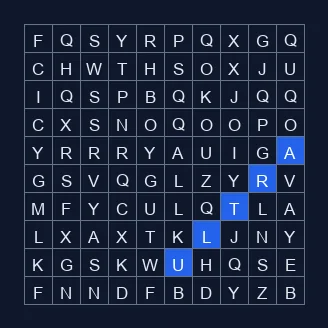
A single highlighted path on the board shows what systematic scanning is after: one coherent line of letters you can verify in a few cells. Short words reward the same discipline—rows and columns first, then angles.
This order matches how most word search puzzle grids hide filler: straight runs are the default; diagonals are the extra layer.
Train Your Eye to Spot Word Shapes
Compact entries read as small visual signatures rather than full dictionary words.
What to Focus On
- Two- and three-letter clusters that break the surrounding noise
- Even spacing along a line instead of random consonant piles
- Compact silhouettes that stand out against longer diagonal runs
Shape spotting matters especially when several short answers share letters in the same zone.
Use Edge Scanning Techniques
Borders and corners often hold short words because overlapping list entries thin out near the rim.
Why Edges Matter
- Fewer crossed paths mean fewer false partial matches in the center
- Edge bands are quicker to finish in one orientation
- Short answers tucked against a border are less likely to hide inside a six-letter anchor
Give the outer rows and columns their own pass before you declare the middle “done.”
Avoid Over-Focusing on Long Words
Long entries feel satisfying, but they can monopolize attention while three-letter answers stay unchecked.
Better Strategy
- Budget a dedicated short-word round after a first long-word sweep—or split the list by length up front
- Park half-finished long hunts instead of circling the same empty corridor
- Balance the word list so no length group waits until frustration sets in
Efficiency in word find puzzles usually means alternating length, not finishing all the giants first by default.
Use Repetitive Scanning Patterns
The brain spots tiny patterns faster when your eyes move on a repeatable path.
Recommended Pattern
- Move left to right across each row, or top to bottom down each column—pick one and stick to it per pass
- Repeat the same orientation for edge bands and center blocks separately
- Keep a steady rhythm instead of resetting your start corner every few seconds
Consistency trims the “did I already scan this?” doubt that makes short words easy to miss.
Pay Attention to High-Frequency Letters
Vowels and common consonants show up constantly in short English answers and in filler alike.
Key Letters
- Vowels: A, E, I, O, U (and sometimes Y when the list allows)
- Frequent consonants: T, N, S, R, L, and H in tight pairs
- Simple frames built around those letters, such as ST, TH, or ER endings
Use them as anchors: spot the cluster, then verify the straight path the rules allow—forward or backward if permitted.
Develop Peripheral Awareness
Short words sometimes pop at the corner of your vision while your focus chases a longer spelling elsewhere.
How It Helps
- A quick glance can register a two-letter run without a full stop
- Peripheral cues speed row passes when you keep moving instead of staring at one cell
- You still confirm every find on a straight path—peripheral sighting is a lead, not a substitute for tracing letters
The skill grows with practice on denser boards where filler never quite settles.
Practice Speed Over Perfection
Chasing short words is about continuous motion and light verification, not freezing on every maybe-cluster.
Important Mindset
- Do not camp on one area hoping a short word will appear—finish the band and move
- Sweep the grid with the scan order you chose; return only for a labeled second pass
- Prefer a short check (“does this three-letter path match the list?”) over rereading an entire row twice in one sitting
Flow beats perfectionism when the list still holds a dozen two- and three-letter entries.
Final Thoughts
Finding short words quickly in word search games comes down to pattern memory, disciplined scan order, and respect for how little space those answers occupy. Lean on familiar letter pairs, finish straight lines before diagonals, skim edges with intent, and keep a repeatable rhythm across the grid. Over time, small spellings stop feeling like traps and start feeling like the fastest points on the board.