





Future Trends in Word Search Puzzle Games
Word search and word find puzzles have stayed popular for decades, shifting from newsprint and classroom handouts to browsers and apps. Technology will keep reshaping packaging—themes, timers, social layers—but the honest core is unlikely to change: locate whole words along allowed straight paths in a letter grid. This guide looks ahead at adaptive design, personalization, AI-assisted generation, richer UX, social play, and cross-device flow without treating the format as crossword clue fill-ins.
Smarter and More Adaptive Puzzle Design
A major trend is skill-aware word search that adjusts difficulty from how you actually play. Instead of one fixed density for everyone, future systems may track solve pace, hint use, and miss patterns, then tune grid size, word count, or direction rules.
Likely adjustments include:
- Grid size and list length scaled to comfort, not only a menu label
- Themed word lists aligned with language goals, hobbies, or classroom units
- In-session tweaks—a few more short words after a rough stretch, or tighter density after a clean run
The point is engagement without boredom or overwhelm. Adaptive layers should still hide listed spellings on straight allowed lines; they change load, not the hunt itself.
Personalized Word Search Experiences
Personalization is already normal in casual games, and word find is catching up. Players may choose vocabulary buckets, visual themes, or pacing modes, then get grids built from the same placement rules as classic print puzzles.
Common directions:
- Custom categories—travel, science, sports, or user-built lists
- Seasonal or event packs that refresh lists without new rule sheets
- On-demand generation so repeat visitors see fresh filler letters, not clones
When personalization works, each session feels relevant while the interaction stays familiar: scan, trace one spelling, clear one list entry.
Integration of AI-Generated Content
AI-assisted generation can produce balanced letter grids and themed lists faster than hand layout. For word search, that means more variety, quicker seasonal drops, and easier checks that every answer sits on a valid straight path.
Benefits when designers use AI carefully:
- Higher puzzle throughput with less manual grid tuning
- Theme experiments—educational, multilingual, or niche lists—without weeks of typesetting
- Difficulty spreading across a library so “medium” feels consistent
AI should support verification, not guesswork: players still deserve puzzles where every listed word is findable on allowed lines. Generation speed is a production win, not a substitute for fair placement.
Enhanced Interactivity and Visual Design
Future word search games will lean harder into feedback that print could not offer—smooth highlights, restrained hints, layouts tuned for thumb reach—while keeping the same line-tracing mechanic.
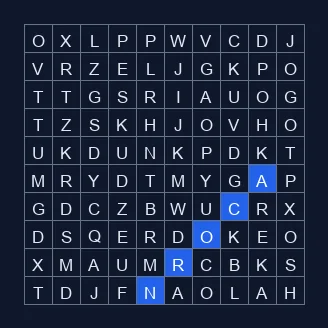
Smoother highlight and hint UX sits on top of the same job: one straight spelling in the fill (“ACORN” here on a diagonal). Motion and polish should clarify tracing, not replace list-and-grid word find.
Enhancements worth watching:
- Drag-to-highlight that feels crisp on phones and tablets
- Tiered hints—first letter, orientation nudge—not full-board reveals
- Responsive grids that stay readable without shrinking letters into noise
Flashy presentation helps only when it supports scanning; gimmicks that hide the grid behind unrelated mini-games drift away from word search identity.
Social and Competitive Expansion
Word find is often solo, yet social layers are growing: shared dailies, light races, cooperative boards where friends split the list. These modes add replay without rewriting core rules.
Examples on the horizon:
- Timed head-to-head matches on identical boards
- Co-op solves where teammates cover different regions of the grid
- Community submissions with moderation so lists stay fair and on-theme
Social features succeed when they still reward straight-line finds. Leaderboards on distorted rulesets confuse players who learned classic word search first.
Cross-Platform Accessibility
Connected accounts make cross-platform word search practical: start on a phone, finish on a tablet, keep streaks and saved packs aligned.
That trend supports:
- Cloud saves for partial progress and completed lists
- Sync across mobile, tablet, and desktop with one library
- Consistent UX so switching devices does not mean relearning controls
Convenience matters for casual play. The underlying puzzle—listed words on straight paths—should feel the same everywhere.
The Future Balance Between Simplicity and Innovation
Most successful next-gen word search puzzle games will innovate around access, variety, and feedback, not around abandoning the grid. Simplicity is why the format relaxes people; heavy meta-systems or unrelated gameplay loops risk drowning the scan.
Strong futures tend to share traits:
- Optional challenge beside untimed calm boards
- Clear rule labels when a variant allows backward lines or bonus steps
- Respect for the straight-line hunt as the default contract
Technology can personalize and refresh content; it should not quietly turn word find into another puzzle genre.
Frequently Asked Questions
Will future word search games drop straight-line rules?
Unlikely as the default. Variants may add options, but classic word search still means finding whole words on allowed straight paths in a letter grid.
How might AI change word search without ruining fairness?
AI can speed up grid and list creation, but fair play still requires every answer to be placed on valid lines and listed explicitly. Speed helps producers; players still need verifiable puzzles.
Are multiplayer word search modes the same as solo play?
Usually the board rules match solo word find; multiplayer adds timing, teams, or shared dailies. Check whether direction rules or word sets differ before you compete.
Will mobile design replace printable word search?
Print remains fine for classrooms and offline calm. Mobile adds checking, themes, and portability. Both rely on the same list-and-grid hunt when rules are honest.
Can personalization make word search too complex?
It can if menus overwhelm. Good personalization offers defaults plus optional depth—theme picks, list sources—without forcing players through unrelated systems before they scan.
Closing Perspective
Looking ahead, word search puzzle games will likely grow more adaptive, social, and device-friendly while keeping the recognizable loop: read the list, scan the grid, trace spellings on straight allowed lines. Innovations that respect that loop should feel like better packaging, not a different puzzle wearing word-search branding.