





History of Word Search Puzzles
Word search and word find grids are everywhere today—in puzzle books, classroom handouts, and phone apps—yet the format is younger than many classic brainteasers. It grew from mid-century print pages into a global casual habit without changing its basic bargain: read a word list, then locate each spelling along a straight path in a letter grid. This is line-tracing word find, not crossword clue fill-ins.
Knowing how that format spread helps explain why it still feels familiar after decades of tech change.
Early Origins of Word-Based Puzzles
Long before the modern word search grid appeared, people played with letters in other ways. Anagrams, word squares, and rearrangement puzzles showed up in newspapers, magazines, and school texts. Those games trained vocabulary and pattern spotting, even when no hidden-word board was involved.
They also established an idea that would matter later: letters alone could carry a game, without definitions or blanks to fill.
The Birth of the Modern Word Search Puzzle
The recognizable word search puzzle is generally traced to the mid-20th century. Publishers paired a word list with a square of letters; solvers hunted each listed spelling along horizontal, vertical, or (when rules allowed) diagonal straight lines. Filler letters made the grid look busy, but every answer was a contiguous path—not a crossword-style interlock of clues and definitions.
The appeal was immediate. Rules fit on a caption line, children and adults could share the same page, and editors could theme a grid around animals, holidays, or geography without rewriting the mechanics.
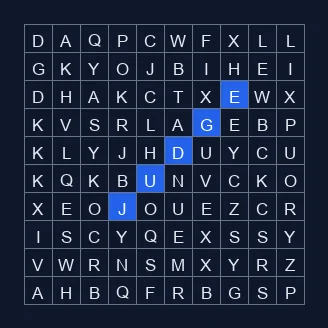
Mid-century print set the template that digital play still echoes: one listed spelling (“JUDGE” here) already sits on a straight path inside the fill. The job is observation and marking, not guessing missing letters.
Expansion Through Print Media
After that debut, word find spread quickly through print. Newspapers tucked word search blocks beside crosswords and number puzzles; dedicated puzzle books devoted whole sections to themed grids; magazines used them as light filler that readers could finish in one sitting.
Several practical advantages fueled the boom:
- Cheap to typeset and reprint
- Easy to scale for kids or adults by word count and grid size
- Flexible themes without new rule sheets
- Readable across languages once you know the script
Themed lists—sports, food, travel, classroom units—made the same mechanics feel fresh week after week. Editors marketed word search as both amusement and a gentle vocabulary workout.
Educational Use and Global Spread
Schools adopted word search early. Teachers used grids to reinforce spelling, preview unit terms, or offer a low-stakes review activity that still required reading the list carefully. Because construction is straightforward, educators could build custom boards around any lesson topic.
The same simplicity helped the format travel. Any language written in a familiar alphabet could host a grid; only the word list changed. That portability, plus low production cost, kept word find present in classrooms and community papers on several continents.
Transition to Digital Word Search Games
Computers, then phones, did not replace the letter grid—they delivered it faster. Early software and handheld titles could generate new boards, highlight a found word instantly, and store partially finished lists between sessions.
Typical digital additions included:
- Touch or mouse highlighting instead of pen strokes
- Optional timers, streaks, or score summaries
- Adjustable grid density and direction rules
- On-demand generation from themed word pools
The experience felt snappier, but the honest contract stayed the same: each list word should exist on an allowed straight line somewhere in the fill.
Modern Word Search Puzzle Games
Today’s catalogs mix calm untimed boards, daily challenges, large themed libraries, and occasional variants (hidden messages, shaped masks, backward entries when labeled). Innovation mostly wraps presentation and pacing around the classic hunt.
What still defines mainstream word search:
- A letter grid with filler characters
- A published word list
- Straight-path placement rules made clear to the player
When a product stops tracing whole spellings in the grid, it has usually borrowed word-search branding for a different puzzle type.
Why the Format Has Lasted So Long
Word find endured because it balances effort and reward without a steep rules lecture:
- Accessibility: open the list and start scanning
- Flexibility: themes and difficulty ride on the same placement idea
- Replayability: new filler letters and lists refresh the same habit
- Calm focus: engaging enough to hold attention, light enough for short breaks
Those traits explain why both first-time players and longtime fans still reach for a grid.
From Paper to Interactive Play
What began as newsprint entertainment became a default casual game on screens. Paper taught generations to circle letters patiently; apps and browsers added convenience, contrast control, and instant checking. Through each platform shift, the core loop stayed recognizable: match list to path, mark the word, move on.
That mix of simplicity and small challenge is why word search puzzles still sit comfortably between hardcore strategy games and passive scrolling—and why historians of puzzles treat the mid-century grid as a format that aged well rather than a fad that vanished.