





Holiday Word Search Puzzle Games
Holiday word search and word find puzzles swap a straight-line letter grid and word list for vocabulary tied to celebrations—Christmas, Halloween, Easter, Thanksgiving, Diwali, Hanukkah, and dozens of other observances. The rules stay the same as any themed word search puzzle game: trace whole listed spellings along allowed straight paths; the holiday label only changes which words you expect and how familiar they feel.
Embracing the Festive Spirit
Each holiday brings its own lexicon. A Christmas word search might hide tree, ornament, and sleigh, while a Halloween board favors pumpkin, witch, and costume. Designers often mix symbols, foods, greetings, and ritual objects so the list echoes what people already hear that season.
That shared cultural context is the point: solvers connect the grid to traditions and mood, not just random letters. Familiar holiday words also make strong first-letter anchors when you read the list once and scan row by row.
Benefits of Holiday-Themed Word Searches
Festive lists boost engagement because recognition does part of the work. Themed spellings reinforce holiday vocabulary, give pattern-matching practice on words you may say out loud at home, and offer a low-pressure activity between heavier tasks.
For families, holiday word search puzzle games work as a group pace: kids spot short words while adults hunt longer entries. The theme supplies conversation hooks—why a word appears, what it means in your culture—without changing how paths work in the grid.
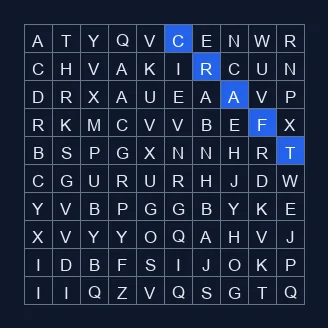
A diagonal highlight shows the usual word find mechanic on a festive board: one straight spelling (“CRAFT” here, as in holiday crafts), marked on the list, then back to scanning. The celebration theme shapes the word bank, not the rule that paths stay linear.
Varying Difficulty with Holiday Vocabulary
Difficulty tracks the list, not just grid size. Common holiday terms are quick wins; rarer or multi-cultural words—menorah, epiphany, luminaria—stretch visual search and spelling memory. Long proper nouns from religious or national calendars can slow scans even on a medium grid.
Designers tune level by mixing short festive staples with a few obscure items, varying allowed directions (horizontal and vertical only versus diagonals and reversals), and choosing denser fill. A “hard” Christmas puzzle might keep the same 12×12 frame but add uncommon saints’-day labels or vintage decoration terms.
Educational Aspects of Holiday Word Searches
Holiday word search puzzle games double as light teaching tools. Younger players pick up spellings and symbols; older solvers rehearse attention and steady eye paths while learning names they might not see in everyday reading.
Classrooms use seasonal puzzles for vocabulary before a unit, family nights use them as quiet introductions to other traditions, and adult groups use them as warm-ups before trivia or gift exchanges. None of that requires different mechanics—only a word list aligned with the lesson or party.
Encouraging Seasonal Play
Rotating holiday themes through the year keeps word find practice from feeling stale. A new list each observance gives solvers something to anticipate: spring festival vocabulary after winter holidays, summer picnic words, back-to-school sets, then the autumn spike many publishers see around Halloween and year-end celebrations.
Short sessions fit real calendars: a ten-minute board after decorating, a printable handout at a community event, or a timed round on a phone during travel. Seasonal rotation trains scanning habits while the vocabulary changes with the calendar.
Frequently Asked Questions
What counts as a holiday word search puzzle game?
Any word search or word find where the listed entries center on a specific celebration, season, or cultural observance. Grid rules stay standard: find each whole word along straight allowed paths in the letter field.
Are holiday-themed puzzles easier than generic ones?
Often they feel easier when words match widespread cultural exposure—the same grid settings can play faster in December or October because spellings are familiar. Niche or multi-faith lists can flip that and feel harder.
Do holiday word searches teach different rules than crosswords?
No. They are not crossword fill-ins. You still match a provided list to hidden straight-line spellings; only the topical vocabulary changes.
Can one puzzle cover many holidays at once?
Yes—some “world celebrations” lists blend several observances. Scanning gets busier when themes overlap, so designers usually keep shared grids readable by limiting how many unrelated holidays share one board.
How do designers make a festive list harder without enlarging the grid?
Add less common terms, enable more directions, increase overlap between words, or shorten the list so each placement fights for space. Rare holiday jargon raises challenge faster than another two rows of letters.
Are holiday word searches only for children?
No. Adult solvers use them for nostalgia, party icebreakers, and calm focus. Difficulty scales with vocabulary choice and grid settings, not age labels on the cover.