





How Grid Size Affects Word Search Puzzle Games
Grid size is one of the strongest levers in word search and word find puzzles. Row and column count shapes how fast you can scan, how hard the board feels, and how long your eyes stay on one patch of letters.
Size is not just layout—it drives pacing, overlap, and which search habits actually work on a straight-line letter grid (not crossword-style clue fill-ins).
Small Grids: Fast and Beginner-Friendly
Compact boards are common on easy word search tiers and quick warm-up puzzles.
What you usually see
- Fewer rows and columns
- Shorter word lists
- Words clustered closer together
Everything sits in a smaller visual field, so a full pass takes less time. That makes small grids comfortable for beginners or a five-minute session.
Tight overlap can still bite: two short paths crossing in a corner may feel harder than a sparse large board.
Medium Grids: Balanced Search Space
Mid-size layouts are the everyday default in many word find games because difficulty and play time stay balanced.
Typical traits
- Enough letters that you cannot spot every word in one glance
- Moderate spacing between hidden paths
- A mix of short and medium list entries
You start needing structure—row-by-row sweeps, column bands, or finishing one quadrant before jumping away. Medium grids are the most flexible size for general practice.
Large Grids: Extended Scanning and Higher Challenge
Big boards raise the cost of every missed strip.
What increases with size
- More rows and columns to cover
- Longer lists, often with longer spellings
- Words spread far across the frame
Focus stretches across minutes, not seconds. Gaps between finds widen, so random eye jumps leave whole regions unchecked. Large grids reward patient, repeatable coverage over fast guessing.
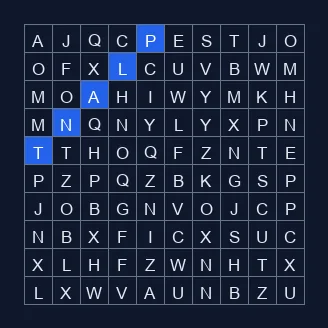
On a full-size letter grid, a hidden word may sit far from your last find along a straight or diagonal path—large puzzles punish skimmed corners more than tiny boards do.
Grid Density and Its Hidden Impact
Grid size ties closely to density: how many list words share space and how noisy the filler letters look.
- Small grids: often fewer words, but overlap can feel crowded
- Medium grids: steady balance between open filler and packed paths
- Large grids: may stay sparse—or pack many words if the designer pushes difficulty
High density stacks almost-matches on top of real words. Separating one clean path from clutter takes more visual work at any size.
How Grid Size Changes Scanning Strategy
As the board grows, casual spotting stops scaling.
- Small grids: quick whole-grid sweeps often suffice
- Medium grids: row, column, or zone passes pay off
- Large grids: systematic order (finish one direction family, then the next) reduces misses
Players move from “see it when it pops” toward fixed patterns. That shift is less about talent and more about matching method to footprint.
Grid Size and Cognitive Load
Bigger surfaces load working memory and attention.
- More letters to process per decision
- Longer paths between checks
- Easier to forget which bands you already cleared
Small grids feel lighter: faster finishes, less stamina drain, but also less room for deep challenge unless density is high.
Word Placement and Grid Size Relationship
Editors place paths differently at each scale.
- Small: paths hug each other; shared letters are common
- Medium: room for straighter runs with some cross-over
- Large: words may sit in opposite corners or along every allowed direction
Placement rules—not row count alone—set how “big” a puzzle feels in your hands.
Why Bigger Is Not Always Harder
A tall grid with few list words and only horizontal paths can play easier than a dense 8×8.
Difficulty still comes from:
- Word length and how familiar spellings look in noise
- Which directions are allowed (horizontal, vertical, diagonal, reverse)
- How tightly words overlap
Area is one variable among several.
Choosing Grid Size Based on Skill Level
Match the board to today’s goal.
- Small: new players, kids, or a short break
- Medium: steady skill-building and themed lists
- Large: long sessions when you want endurance and focus
Stepping up one size when medium boards feel routine beats jumping from the smallest preset to the largest.
Grid Size Shapes the Entire Experience
In word search puzzle games, grid dimensions define behavior more than decoration. They steer solve speed, perceived difficulty, search habits, and how engaging the list feels start to finish.
Once you know how size and density interact, you can pick boards on purpose instead of guessing from square count alone.
Frequently Asked Questions
Does a larger grid always mean a harder word search?
No. A big grid with a short list, few directions, and low overlap can feel mild. A small but densely packed board is often tougher than an empty-looking large one.
What grid size is best for beginners?
Start small or medium with limited directions. You learn list-and-grid mechanics without losing minutes to unchecked corners on a huge frame.
How is grid size different from difficulty labels?
App labels like “easy” or “hard” usually blend size with vocabulary, direction rules, and density. Row count is one signal, not the whole story.
Why do I tire faster on large word find puzzles?
You process more letters and hold more “already searched” zones in mind. Systematic passes help; random hopping burns attention without improving coverage.
Can density make a small grid surprisingly hard?
Yes. Tight overlap and long words in a compact space create many false trails. Always weigh density, not just dimensions.
Is word search the same as a crossword?
No. Crosswords fill blanks from clues. Word search hides whole words along straight paths in a letter grid for you to find and mark.