





How to Challenge Yourself in Word Search Games
Word search and word find puzzles feel relaxing by default—but they also scale up cleanly when you want a sharper mental workout. Size, time pressure, vocabulary, and scanning rules all turn the same letter grid into a deliberate training session. The goal is not to burn out; it is to pick constraints that stretch focus, observation, and stamina while the core game stays straight-line finding, not crossword fill-ins.
Increase Puzzle Size
Larger boards are the most obvious difficulty knob.
What Changes on a Big Grid
- More letters and list entries increase how much ground each pass must cover
- Longer or less familiar words show up more often on dense lists
- Pattern recognition takes longer, which rewards patience over frantic hopping
Step up grid size one notch at a time. Jumping from a small warm-up board to the largest preset on day one usually hurts accuracy more than it builds skill.
Try Timed Challenges
A clock turns comfortable scanning into a paced sprint.
How Timers Help
- They force quicker first-pass decisions without freezing on one row
- They expose habits that only appear under mild pressure—skipping diagonals, stalling on short words
- Even a self-imposed stopwatch on an untimed puzzle counts; you do not need a built-in mode
Pair timers with a size you already solve reliably. Speed drills on an unfamiliar huge grid mostly train frustration.
Focus on Uncommon Words
Themed or specialist lists raise the bar without changing the rules.
Vocabulary Levers
- Scientific, geographic, or hobby vocabulary slows recognition in a good way
- Less frequent spellings make you verify paths instead of guessing from shape alone
- Foreign loanwords or holiday names stretch memory when they still fit the puzzle language
Pick themes you care about. Obscure lists you never revisit feel like homework; niche lists you enjoy feel like level-ups.
Limit Your Scanning Methods
Habit is efficient until you need a new edge. Temporary rules break autopilot.
Self-Imposed Scan Rules
- Complete one full diagonal pass before horizontal rows, or the reverse, on a familiar board
- Delay “easy” list words until harder anchors are checked
- Ban revisiting a quadrant until every allowed direction there got one honest sweep
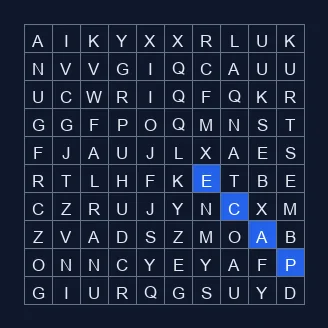
A single highlighted path on the board shows what a restricted scan practices: following one direction on purpose instead of drifting. “Pace” on a diagonal is a small stand-in for the discipline—steady coverage before you switch angles.
These drills work best on puzzles you could already finish; the constraint is the lesson, not the word list itself.
Increase Puzzle Density
Some word search puzzle games pack letters tighter with fewer obvious gaps between entries.
Why Density Feels Harder
- Filler and target letters blend, so fewer cells look “empty” at a glance
- Overlapping words share cells, which tightens how many valid paths exist nearby
- Your eyes cannot skip to blank-looking zones as easily
Dense grids train careful confirmation: mark a word only when the whole straight path matches the list.
Multi-Puzzle Sessions
Endurance matters when you want challenge beyond a single board.
Session Ideas
- Chain two or three puzzles with a short break between—not one marathon blur
- Alternate themes so pattern habits from puzzle one do not hypnotize puzzle two
- Note rising error rates; stop while focus still feels learnable, not sloppy
Stamina challenges mirror real play: many people open word find games for “one more” round. Practicing controlled chains builds that muscle without mindless grinding.
Experiment with Variations
When your app or book offers twists, they are ready-made difficulty layers.
Variants to Try
- Overlapping entries that share letters along different lines
- Hidden phrases or second-step reveals after the main list clears
- Themed packs that mix word lengths in one grid
Each variant asks you to adjust order-of-operations—list first, corners first, or phrase last—without changing the basic hunt along straight paths.
Keep Track of Your Performance
Measurement turns vague “I feel faster” into goals you can hit next week.
Simple Metrics
- Completion time on the same grid size and theme
- Missed words on a final recheck pass
- How many self-imposed rules you completed without cheating mid-puzzle
Log one or two numbers per session. Steady trends matter more than beating yesterday by luck.
Final Thoughts
Challenging yourself in word search games is less about heroic solves and more about choosing the right friction: bigger boards, honest timers, richer vocabulary, tighter density, scanning constraints, linked sessions, and the occasional variant. Stack one or two levers at a time so progress stays visible. When you want fresh grids and themed lists to test those habits, browse categories on word-search-puzzles.com and pick a size one step above your comfort zone.
Frequently Asked Questions
What is the easiest way to make word search harder?
Increase grid size or add a self-set time limit on a puzzle size you already finish clean. Both raise demand without new rules.
Should I time myself on every puzzle?
No. Mix untimed solves for accuracy with occasional timed rounds. All-timer play often trades precision for speed you cannot keep.
Does restricting how I scan actually help?
Yes, for short training blocks. Forcing an uncommon pass order exposes blind spots—often diagonals or corners—on boards you thought you had mastered.
Are dense grids unfair?
Not if every list word has a valid straight path. Density makes visual search harder; it does not break word search puzzle rules.
Can kids use the same challenge ideas?
Scale down: slightly larger kid-friendly themes, gentle timers, or one scanning rule at a time. Skip obscure vocabulary lists meant for adults.
Is word search the same as a crossword?
No. Crosswords fill blanks from clues. Word search places whole words along allowed straight paths in a letter grid for you to find.