





How to Find Long Words in Word Search Games
Long answers in word search and word find puzzles occupy more cells, cross more filler, and tend to sit in directions you skim on a fast first pass. That is why six- and seven-letter list entries often linger while short words disappear early. The fix is not raw speed alone: you anchor on distinctive letter runs, trace every allowed straight path, and work the list in chunks that match how spellings actually hide on the grid—not crossword-style fill-ins, but straight-line finds from a word list.
Start by Scanning for Unique Letter Patterns
Length buys recognizability. Longer spellings carry letter pairs and endings that rarely appear at random in filler.
What to Look For
- Uncommon bigrams such as qu, tion, ph, or ing at the end of a verb form
- Double letters: ee, ll, ss, tt
- Striking opening or closing letters when the list names a proper noun or specialty term
When a pattern matches, treat it as a hook: scan outward along each permitted direction before you restart a blind row-by-row sweep.
Search the Grid in Multiple Directions
A long word may run horizontally, vertically, or diagonally. If your first pass only favors one orientation, you are effectively hiding half the list from yourself.
Common Directions
- Horizontal, left to right or reversed when rules allow backward reads
- Vertical, top to bottom or bottom to top
- Diagonals in both slants when the puzzle permits angled paths
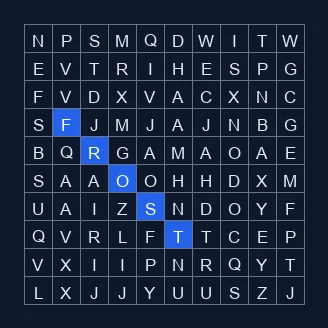
A single highlighted path on the board shows what multi-direction scanning is after: one continuous line of letters long enough to read as a full list entry, verified cell by cell along the angle the rules allow.
Flexibility matters most on dense boards where long entries share cells with shorter overlaps.
Focus on the First and Last Letters
Endpoints cut the search space. Once both ends sit on a valid straight path, the middle is mostly confirmation.
How It Helps
- Locking the first letter narrows which directions are even plausible from that cell
- Matching the last letter on the same line confirms length before you celebrate a partial
- Connecting both ends traces the full path without guessing through unrelated crosses
This anchor habit scales well on large grids where a seven-letter target could otherwise sprawl across half the board.
Break Large Words Into Smaller Parts
You do not have to see the whole spelling at once. Mentally split long list words and hunt each piece.
Example Strategy
- Divide by syllables or familiar prefixes and suffixes (un-, re-, -ness)
- Search for the strongest chunk first—the one with rare letters or doubles
- When a segment aligns on a line, extend in the same direction for the rest of the spelling
Chunks turn an intimidating entry into two or three smaller pattern jobs.
Use Edge and Corner Areas Strategically
Designers often park longer words along borders because there is less room for competing overlaps.
Why This Works
- Edge bands expose longer straight runs with fewer crossing list words
- Corners give you a fixed start or end cell that is easy to revisit
- You finish a bounded strip faster than re-scanning the chaotic center
Give outer rows, columns, and diagonals their own pass before you assume the middle is “clean.”
Scan Slowly and Systematically
Rushing favors short hits. Long spellings reward coverage you can trust.
Better Approach
- Move row by row or column by column with a fixed rule; finish the band before you jump
- Avoid skipping wide rectangles because they “look done” from a distance
- Keep a steady rhythm so your second pass can change direction, not reinvent the route
Structured sweeps reduce the classic miss: you saw two letters of a six-letter word but never completed the line.
Train Your Peripheral Vision
Long letter chains sometimes register at the edge of your focus while you stare at a different zone.
How It Helps
- You may notice an elongated diagonal run without stopping every cell
- Unusual shapes—tall vertical stems or wide horizontal bars—stand out in side vision
- Peripheral cues are leads; you still trace the full straight path before marking the word found
The skill complements slow scanning; it does not replace verifying each letter on the path.
Prioritize Unusual Letter Sequences
Rare letters and awkward clusters are magnets on a crowded grid.
Examples
- x, z, j, and q in combinations that English filler seldom mimics
- ck, gh, or triple consonant runs in themed vocabulary
- Long proper nouns with a capitalized first letter when the puzzle shows caps
Spotting one rare cell can drag your eyes along an entire long answer.
Recheck Unexplored Areas
Long words are prime candidates for a second-pass miss—especially after a fast horizontal-only sweep.
Effective Habit
- Revisit zones you marked “scanned” with a different primary direction
- Rotate the grid mentally: bottom-up columns after top-down rows, for instance
- Pair rechecks with remaining list entries by length so nothing long waits until frustration sets in
Consistency beats luck on puzzles that hide multiple seven-letter answers on one board.
Practice Pattern Recognition Over Time
Long-word skill is partly memory: you recognize shapes faster after repeated play.
Long-Term Benefits
- Faster reads of multi-cell paths that used to need spelling out loud
- Better recall of which directions you tend to neglect on timed rounds
- Less total scanning time once anchors and chunks become automatic
Regular practice on themed or larger grids trains the same visual habits without changing the rules.
Final Thoughts
Finding long words in word search games blends patience, pattern hooks, and disciplined coverage. Lean on distinctive letter runs, hunt every allowed straight direction, split intimidating spellings into chunks, and give edges and second passes the respect long entries deserve. Over time, those habits turn lengthy list words from grid hogs into reliable wins—without confusing the game with crossword fill-ins or chasing speed at the cost of a verified path.