





How Word Lists Are Created for Word Search Puzzles
A word search puzzle starts with a word list—the vocabulary players hunt along straight paths in a letter grid. In word search and word find games, that list sets difficulty, theme, and how satisfying the solve feels long before anyone draws a single row of filler letters. Designers treat lists as products: themes for cohesion, length mixes for challenge, and test grids to catch words that fight the layout.
This is list-and-grid word search, not crossword-style clue fill-ins.
Selecting a Theme
The first pass is choosing a theme that ties every entry together.
A nature set might lean on forest, river, and mountain; a science set on atom, gravity, and experiment. Clear themes help players guess likely spellings and make each find feel on-topic instead of random.
Strong themes also guide editorial judgment: if a word does not belong, it probably should not stay on the list even when it fits the grid.
Balancing Word Length and Difficulty
Length and familiarity shape how hard a list plays.
Short, common words are quick wins; longer or rarer terms stretch scanning time. Most published word search puzzle games mix both so newcomers get momentum while experienced solvers still work for the last few entries.
Difficulty here is vocabulary plus path length, not grammar tricks—every word is hidden whole along allowed directions.
Ensuring Variety and Relevance
Good lists avoid near-duplicates and filler that only pads the count.
oak, oaks, and oaktree in one set add little variety; distinct lemmas keep the player list readable. Every entry should still earn its place under the theme so predictions and payoffs stay aligned when someone marks a word off.
Variety also reduces accidental overlap in the grid: too many shared stems force designers to swap or trim entries before placement.
Checking Word Compatibility
Before final layout, editors check how candidates pack together in a straight-line grid.
Shared prefixes, suffixes, and letter runs can create clusters that look like false paths—or help placement if letters align cleanly. Words that refuse to fit without breaking solvability get replaced early rather than after the whole board is filled.
Overlap is normal; the goal is a solvable puzzle without words that only work at the cost of confusing crossings.
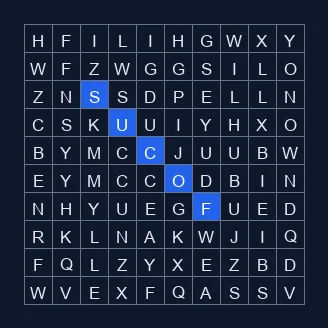
Prototype grids turn an abstract list into something concrete: each entry must still read as a full hidden path among filler letters—the same check players perform when they trace a find before crossing it off.
Incorporating Seasonal or Special Words
Holiday and seasonal editions swap vocabulary while keeping core rules.
Halloween lists might favor candy and costume; harvest sets might use pumpkin and wheat. The list still must respect theme boundaries—one spooky word does not justify unrelated entries—and seasonal tone usually pairs with slightly easier length mixes so casual players can finish in one sitting.
Testing and Refining
Lists are rarely “done” on the first draft.
Designers drop words into a sample grid, play or auto-check placement, and note words that are too easy, too obscure, or awkwardly buried. Iteration swaps terms, shortens the list, or shifts length balance until difficulty and fun match the intended audience.
That loop is standard for straight-path word find puzzles: the list and the grid co-evolve until every listed word has a fair hiding spot.
Putting It Together
Thoughtful word lists make word search puzzle games feel intentional—theme first, then length mix, variety, compatibility, and playtesting. Readers notice the difference when vocabulary matches the promise on the title card and when no entry feels like padding.
Frequently Asked Questions
Is the word list more important than grid size for difficulty?
Both matter. A tough list on a small grid can still sting; a large grid with easy vocabulary may feel mild. List choice sets vocabulary and average path length; grid size sets how much territory you search.
How many words belong on a typical list?
There is no single rule—it depends on grid dimensions, allowed directions, and overlap tolerance. Designers aim for full coverage without crowding so every word remains findable along a straight path.
Can the same theme use different lists for easy and hard tiers?
Yes. Easy tiers favor shorter, familiar terms; harder tiers add length, niche vocabulary, or denser overlap on the same topic.
Why would a themed word be removed from a list?
It may clash with solvability, duplicate another entry, fall outside the theme, or use spelling that does not match the puzzle’s language settings.
Do seasonal lists follow different rules?
Seasonal sets emphasize timely vocabulary and often skew slightly easier, but they still need cohesion, variety, and a test pass in a real grid.
Is word search the same as crossword construction?
No. Crosswords are built around clue-driven blanks. Word search starts from a word list and hides those whole words in a preset letter grid for players to find along straight lines.