





How Word Search Puzzle Games Are Generated
Word search and word find puzzles look effortless on the page, but building one is a sequence of deliberate choices: themed vocabulary, a grid that fits, straight-line placement, filler letters, and a quality pass before anyone plays. This guide walks through that pipeline—the same list-and-line format players know, not crossword grids built from definitions.
Understanding generation explains why some boards feel roomy and beginner-friendly while others pack long words, heavy overlap, and every direction at once.
Step 1: Selecting the Word List
Generation starts with the word list. Themes group entries (ocean, kitchen, space), difficulty sets average length and familiarity, and the audience decides how obscure vocabulary may get.
Beginner word search games often favor short, everyday terms; advanced sets add longer spellings or niche theme words. The list is the contract: every entry that ships should later appear intact on an allowed straight path inside the grid.
Step 2: Defining the Grid Size
Once the list is fixed, the builder picks grid dimensions.
Small boards suit quick games and short lists; medium sizes cover most daily puzzles; large grids host dense expert layouts. The grid must be big enough for the longest word plus enough lanes for the rest—without cramming so tightly that placement becomes impossible or unfair.
Grid size and list length move together. Shrinking one without the other is a common reason generators retry or drop words during layout.
Step 3: Placing Words in the Grid
Placement is the core step. Each list word is embedded along straight paths: horizontal, vertical, and diagonal when rules allow, often including reverse reading along those same lines.
Builders manage overlap on purpose—shared letters at crossings are normal—and avoid accidental clashes that would truncate a word or block a required path.
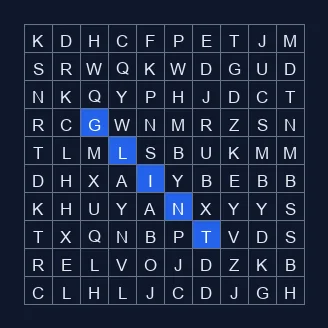
A finished placement shows the outcome generators aim for: “GLINT” sits on one allowed straight path while filler letters fill the rest of the board. Players hunt those embedded paths; builders insert them before random fill.
Step 4: Algorithm-Based Placement
Most online and app word search collections rely on software to place words.
Typical generator logic scans free space, tries allowed directions in some order, backs off when a word will not fit, and may shuffle word order or restart placement when the layout stalls. Overlap checks keep intentional crossings while preventing broken spellings.
Automation scales to thousands of themed puzzles; the same rules apply whether a human sketches the first draft or a script runs overnight.
Step 5: Filling Empty Spaces
After placement, empty cells receive filler letters—usually random or weighted toward common characters in the puzzle language.
Fill letters hide answers in visual noise, keep the grid readable, and reduce “empty rectangle” tells. Good pipelines also spot-check for accidental extra words that match real vocabulary, trimming or re-rolling when a decoy sequence looks too convincing.
Filler does not change the answer set: only list words count as solutions.
Step 6: Adjusting Difficulty
Difficulty tuning happens at list and layout level.
Easier boards often use shorter words, smaller grids, fewer entries, and simpler direction sets (for example, horizontal and vertical only).
Harder boards add length, more words per cell, diagonal and reverse paths, and tighter overlap so scanning takes longer.
Theme and audience still matter—a “kids animals” set should not inherit expert density just because the engine supports it.
Step 7: Testing the Puzzle
Before release, builders or tools verify the puzzle.
Checks include confirming every list word is present and fully spelled, paths respect direction rules, the grid is solvable under those rules, and overall density feels fair for the labeled difficulty. Failed validation usually triggers a resize, word swap, or full regen rather than shipping a broken board.
That pass is what separates polished word find games from one-off sheets that leave a word off the grid.
Manual vs Automated Generation
| Approach | Strengths | Tradeoffs |
|---|---|---|
| Manual | Fine creative control, custom themes, irregular artistic layouts | Slow; hard to scale large libraries |
| Automated | Fast, consistent rule enforcement, easy themed batches | Less hand-tuned “personality” unless editors curate lists |
Many publishers blend both: algorithms produce candidate grids; editors swap words or reject layouts that feel off-brand.
Why the Generation Method Matters
Well-generated puzzles feel logical—each find ties back to the list and direction rules. Weak generation shows up as missing words, clipped spellings, or grids that feel arbitrary rather than challenging.
Balanced placement and honest filler keep word search puzzle games fun without crossing into crossword-style clue work. The hidden structure—list, grid, paths, fill, test—is what keeps play consistent across themes and difficulty tiers.
Frequently Asked Questions
Do word search generators always use the same placement order?
No. Implementations differ in word sort order, direction priority, and retry strategy. The shared goal is placing every list word on an allowed straight path before filling blanks.
Can words overlap in the grid?
Yes. Shared letters at crossings are intentional. Each word should still read correctly along its own line.
Why fill with random letters instead of leaving cells blank?
Blanks would make answers obvious and break the standard letter-grid format. Filler mimics natural letter noise while list words stay the only true solutions.
Are diagonal and reverse paths always included?
That depends on puzzle rules. Many games allow eight directions; others restrict to rows and columns. Generators follow the rule set baked into that puzzle type.
Is word search generation the same as building a crossword?
No. Crosswords interlock words through shared definitions and blank cells. Word search hides whole list words along straight paths in a preset grid, then fills the rest with letters.
What happens when a word will not fit?
Sound pipelines retry placement, shrink or grow the grid, swap a problematic entry, or drop it from the list—rather than publishing a partial board.