





How Word Search Puzzle Games Help Language Learning
Word search and word find puzzles sit comfortably beside textbooks and flashcards: a letter grid, a word list, and the job of spotting each spelling along a straight path. That is list-and-line play—not crossword-style clue solving—yet the format still gives learners extra looks at vocabulary in a low-pressure hunt.
Because every theme groups related words and every solve repeats those spellings in a noisy field of letters, word search puzzle games work as a supplement for many ages and levels—not a full course on their own, but a practical add-on when you want language contact that feels like a game.
Vocabulary Expansion Through Word Search Games
Vocabulary growth is the most obvious payoff. You read the list, then search the grid until each entry clicks—often many times per puzzle if overlaps or tricky directions slow you down.
Exposure to New Words
- Unfamiliar items appear beside known neighbors on the same themed list
- Repeated passes build recognition before you need to produce the word in speech
- Topic sets (food, travel, school) introduce batches of related lexicon at once
That rhythm feels less like memorizing tables and more like pattern matching words you care about for the lesson or trip ahead.
Reinforcement of Known Vocabulary
Word search games also stabilize words you have already met elsewhere.
- You spot the same spelling in different grid positions and orientations
- Each find confirms letter order, not just a vague shape
- Light repetition without drill pressure helps retention stick
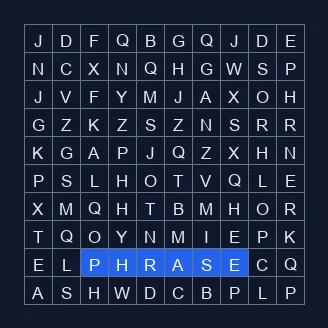
On a themed language grid, a highlighted straight path shows the core loop: the list names a target (“PHRASE” here), you trace the matching letters through filler noise, and move on—exposure and spelling check in one pass.
Improving Spelling Skills
Spelling matters in every stage of language learning, and word search naturally rehearses it. You cannot mark a word until the letters on the path match the list entry.
- Learners compare candidate sequences character by character
- Similar spellings (shared prefixes, one-letter swaps) force careful distinction
- Attention to detail rises because a half-match in the grid is never enough
Seeing correct forms again and again in context tends to beat isolated copy-work for learners who tire quickly on repetitive worksheets.
Enhancing Word Recognition Speed
Regular word search practice trains how fast familiar vocabulary pops out of text-like noise.
- Known words register sooner during horizontal or vertical sweeps
- Eyes learn efficient paths across dense letter fields
- Hesitation drops when the same roots appear in reading passages later
Faster recognition supports reading fluency; it does not replace comprehension work, but it removes friction on the way there.
Supporting Visual Learning Styles
Many language learners retain material better when it is spatial and visual. Word search puzzle games lean into that by design.
- Words hide in multiple directions on the same board (per puzzle rules)
- Letter patterns become easier to “see” as wholes
- Visual memory links spelling to a remembered path on the grid
Visual learners often prefer this format over audio-only drills, especially when paired with a theme they enjoy.
Encouraging Focus and Attention
Language study needs sustained concentration. A word search offers a bounded task: one list, one grid, clear progress as entries disappear from the hunt.
- Scans must stay deliberate to avoid missing short or reversed spellings
- Filler letters tempt false starts that patience must ignore
- Focus lasts longer when breaks and difficulty match the learner
Those habits transfer to listening and reading tasks that also punish half-attention.
Learning Vocabulary in Context
Themed word search puzzle games group words the way real topics do—meals with kitchen tools, airports with transport terms, classrooms with school objects.
Common Themes
- Food and daily routines
- Travel and transportation
- School and education
- Nature and environment
Learning in clusters helps learners guess meaning from neighbors and remember how native materials organize lexicon—not random alphabetical lists.
Building Confidence in Language Learning
Word search provides a forgiving on-ramp. There are no open-ended grammar traps or timed oral responses—only findable spellings and visible wins.
- Complexity stays at the level you chose (grid size, directions, list length)
- Each found word is a concrete success
- Beginners can participate without fear of “wrong answers” in conversation
Confidence from small wins makes heavier skills—dialogue, writing paragraphs—easier to approach next.
Supporting Classroom and Self-Study Learning
Word search puzzle games fit both structured lessons and solo review.
In the Classroom
- Warm-ups before new vocabulary units
- Review after a themed reading or culture segment
- Pair work (split the list) or quiet individual seats
At Home
- Independent vocabulary refresh between classes
- Parent-child play with holiday or hobby lists
- Self-paced repetition when energy for grammar study is low
Teachers and learners can scale difficulty by list choice and direction rules without changing the core mechanic.
Limitations to Keep in Mind
Useful as they are, word search puzzle games do not cover the full language stack.
- They stress recognition and spelling, not free speaking or open writing
- Grammar and sentence building stay outside the puzzle
- Production practice still needs dialogue, composition, and feedback
Treat them as reinforcement—strong for lexicon and orthography, narrow for discourse skills.
Why Word Search Puzzle Games Are Effective for Language Learners
Effectiveness comes from simplicity plus repetition wrapped in engagement. Vocabulary practice feels like solving a small visual puzzle instead of rehearsing a table.
Combine visual recognition, themed grouping, and steady scanning, and word search puzzle games offer a practical, enjoyable support layer—best alongside reading, writing, listening, and speaking work that pushes production.
Frequently Asked Questions
Can word search replace a language textbook?
No. It supplements vocabulary and spelling exposure. Grammar, productive speaking, and structured progression still need other materials and practice.
Are word search puzzle games good for ESL and other second-language learners?
Yes, when lists match level and theme. Themed grids expose grouped lexicon with repeated spellings and low anxiety—useful in class warm-ups or solo review if paired with richer input elsewhere.
Do word search games teach the same skills as crosswords?
No. Crosswords lean on definitions and intersecting fills. Word search uses straight paths through a letter grid and a visible word list—better for scanning and spelling rehearsal than clue-based recall.
How often should language learners use word search puzzles?
Short, regular sessions often beat rare marathons. A few themed grids per week can reinforce a unit’s word bank without crowding out conversation or reading homework.