





How Words Are Hidden in Word Search Puzzle Grids
A word search grid looks like a wall of letters, but every answer follows the same placement rules. Knowing how words are tucked into horizontal, vertical, and diagonal lines—and how filler and overlap disguise them—helps you scan with a plan instead of staring randomly.
Fair word find puzzles hide answers well yet keep each one traceable along a single straight path. Nothing bends mid-word, and nothing depends on crossword-style clues.
Words Are Placed in Straight Lines
The core rule of word search puzzle games is simple: each list word occupies one unbroken straight line.
Allowed paths usually include:
- Horizontal rows (left to right or right to left)
- Vertical columns (top to bottom or bottom to top)
- Diagonal runs across the grid
Words never curve or change direction halfway through a spelling. That constraint makes every hidden answer logically followable once you spot its first or last letter.
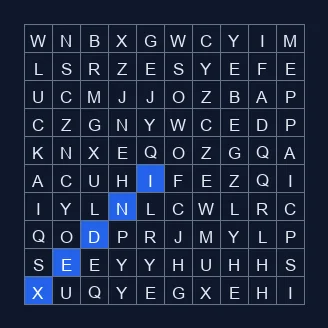
One answer—“INDEX” in this sample—rides a single diagonal line while other letters fill the rest of the board. That straight-path rule applies to every direction, including reverse reading along the same line.
Multiple Directions Increase Difficulty
To keep word search and word find boards engaging, builders mix directions in the same puzzle.
You might see:
- One word read normally from left to right
- Another spelled backward on the same row
- A third running diagonally up or down
Mixed directions force you to switch scan patterns instead of treating the grid like ordinary reading text.
Words Can Be Forward or Backward
Reversed placement is standard in many word search puzzle grids.
For example:
- “TRAIN” might appear as “NIART” along a row
- You check both reading directions on each line you trace
- Backward spellings count the same as forward ones
Reverse words add time, especially on large grids where several answers overlap the same letters.
Overlapping Letters Are Allowed
In most word search grids, one cell letter can belong to more than one answer at once.
Common patterns include:
- A horizontal word crossing a vertical one
- Diagonal answers sharing letters with row or column words
- Several list words meeting around one central cluster
Overlap is deliberate: it packs more vocabulary into a fixed grid size and raises visual noise without breaking the straight-line rule.
Random Letter Fill Creates Disguise
After target words are placed, empty cells get filler letters—usually random or weighted toward common characters.
Filler serves two jobs:
- It buries word outlines in surrounding noise
- It stops players from guessing answers from blank shapes alone
Good filler distributions look like ordinary letter soup, so real words do not stand out until you trace them.
Word Placement Is Carefully Balanced
Designers aim for a middle ground:
- Answers should not glare out on the first pass
- They should still be findable without guesswork
When placement is too sparse, the puzzle feels empty; when it is too crowded and obscure, frustration wins. Balanced overlap, direction variety, and filler density keep word find games challenging but fair.
The Role of Grid Size in Word Distribution
Grid dimensions change how hidden words feel.
- Small grids: fewer cells, tighter spacing, quicker overall scans
- Large grids: more room, more direction mixes, longer hunts
On bigger boards, answers can sit farther apart, which breaks repeating patterns and stretches search time even when the word list length stays similar.
Theme-Based Word Placement
Themed word search games use categories—animals, travel, food, school topics, holidays—to shape the list before layout begins.
Placement mechanics stay the same; themes change which letters appear often. Related words may share prefixes or letter pairs, which can create accidental-looking clusters even when placement is random.
Why Word Placement Feels Challenging
Difficulty rarely comes from exotic rules. It comes from visual load:
- Dense letter fields
- Overlapping answers
- Mixed forward and reverse paths
- Filler that mimics real spellings
Your brain alternates between pattern matching (“does this row spell something from my list?”) and disciplined line-by-line scanning.
Understanding the Design Behind the Puzzle
Behind every grid is one idea: hide list words in plain sight, but keep each one on a traceable straight path.
Once you expect straight lines, overlaps, optional reverse reading, and filler noise, word search stops feeling like luck. You know what shape each answer must take—then you hunt for that shape in the noise.
Frequently Asked Questions
Do hidden words ever bend or zigzag?
No. Standard word search and word find rules require each answer on one continuous straight segment—horizontal, vertical, or diagonal.
Can the same letter belong to two answers?
Yes. Shared letters at crossings are normal and help fit longer word lists into smaller grids.
Why not leave empty cells after placing words?
Empty gaps would outline answers. Filler letters preserve the full grid and keep solutions visually blended with decoys.
Does grid size change how words are hidden?
Size changes spacing and how many directions you juggle at once; it does not change the straight-line rule itself.
Are diagonal and backward words always included?
That depends on the puzzle’s stated rules. Many games use eight directions; some limit play to rows and columns only.
Is hiding words the same as a crossword layout?
No. Crosswords interlock words through clues and blank cells. Word search embeds whole list words on straight paths in a letter grid, then fills the rest with noise—no definition grid required.