





Can Word Search Puzzle Games Be Infinite?
Classic word search and word find puzzles are finite by design: one letter grid, one word list, one finish line. Procedural generators and large theme libraries changed the pitch—players can tap “new puzzle” forever and rarely see the same layout twice. “Infinite” here means an endless supply of distinct list-and-line boards, not one sheet of letters that never ends and not mathematical infinity.
What “Infinite” Means in Word Search Puzzle Games
In practice, infinite almost always means unlimited unique puzzles, not a single endless grid scrolling off the screen.
Typical endless modes include:
- Fresh grids generated on demand
- Random picks from large themed vocabularies
- Difficulty that scales with settings or progress
- No final level or story gate
Each new board still follows the familiar rules: locate every listed spelling along allowed straight paths on a preset grid, then stop when the list is clear. That is the same format as print dailies—not clue-driven crossword fill-ins.
How Infinite Word Search Games Are Generated
Endless word search collections lean on the same pipeline as one-off puzzles, run in a loop: pick a list, size a grid, place words along straight lines, fill leftover cells, validate, ship.
Common techniques:
- Random word selection from large theme pools
- Dynamic placement so paths, overlap, and directions change each run
- Constraint-based layout so listed words stay complete and legal
- Difficulty scaling via grid size, list length, and direction sets
Together, those steps produce a practical river of new boards rather than one recycled static file.
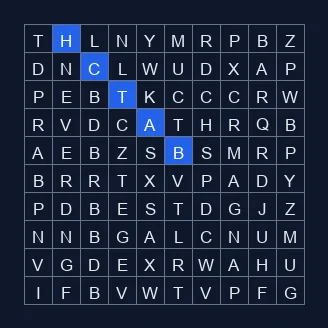
Each automated pass can embed a different spelling on an allowed straight path—“BATCH” on a diagonal here—while filler letters change around it. That is why procedural word find modes feel inexhaustible even though no single grid is literally endless.
The Role of Word Libraries
How “infinite” play feels depends heavily on the word library.
A tiny list cycles fast; players notice repeats even when letter noise changes. A deep, themed catalog stretches novelty: animals this session, travel the next, holidays after that.
Designers watch:
- Thematic breadth and freshness
- Mix of short and long spellings
- Balance between common words and niche theme entries
Healthy libraries keep casual endless modes from sounding like the same dozen answers on shuffle.
Limitations of True Infinity
Generators can output astronomical numbers of puzzles, but true infinity is not on the table.
Real limits include:
- Finite vocabulary databases
- Placement patterns that eventually rhyme with earlier layouts
- Algorithm habits that favor similar density or overlap
- Device performance and memory caps
Veteran players may sense familiarity long before the math runs out. Good endless products lean on library growth and rule variety, not the illusion that randomness never repeats.
Player Experience in Endless Word Search Games
From the player side, endless word search modes trade a finale for steady novelty—a relaxed loop of scan, find, check off, next grid.
Common draws:
- Replay without memorizing one answer key
- Gradual gains in scanning rhythm and pattern spotting
- Sessions that shrink or stretch with your schedule
That rhythm fits casual play and light mental warm-up better than competitive chase modes, especially when timers stay optional.
Final Thoughts
Word search puzzle games can be effectively infinite: procedural generation, strong theme libraries, and dynamic straight-line placement keep fresh boards coming. Mathematical infinity and zero repetition are not realistic; at extreme scale, patterns echo. For most players, though, well-built endless word find modes still feel limitless enough to return to daily—without turning the hobby into crossword-style clue work.
Frequently Asked Questions
Does infinite mean one grid that never ends?
No. Endless modes generate new finite puzzles on demand. You still solve one complete grid and list at a time.
Can two “random” puzzles ever match exactly?
Possible but rare when seed, list draw, and placement all vary. Small word pools make repeats more likely; large themed libraries spread them out.
Are infinite word search games harder than fixed levels?
Not automatically. Difficulty comes from grid size, word count, overlap, and which directions are allowed—not from the endless label itself.
Do endless modes use the same rules as printable word search?
Yes, when the product is honest: straight paths through a letter grid, list words only, filler in the rest. Variants exist, but endless does not imply a different core mechanic.
Is an infinite word search the same as an infinite crossword?
No. Crosswords grow from intersecting clue answers in blank cells. Word search hides whole list words along straight lines in a filled letter grid.
Why do I still notice repeats in “unlimited” play?
Finite lexicons, similar placement templates, and favorite themes you select often converge. Expanding categories or rotating themes usually refreshes feel faster than chasing a perfect never-repeat algorithm.