





Letter Patterns in Word Search Games: Prefixes, Word Shapes, and Speed
In word search and word find puzzles, the fastest solvers rarely read every cell in order. They notice letter patterns—familiar prefixes, endings, and pairs—that jump out from random filler. On a straight-line path from the word list (not crossword-style clues), that habit shrinks search time and cuts false stops.
Understanding Letter Patterns in Word Search Games
Letter patterns are repeated or recognizable chunks of spelling that show up across many list words.
Common examples
- Prefix openings such as re, un, and pre
- Endings such as ing, tion, and ed
- Frequent pairs like th, ch, and sh
Spotting these chunks lets your eyes treat a band of cells as one unit instead of six separate letters.
Why Letter Patterns Work So Well
Your brain is built to match familiar shapes faster than it decodes strangers one symbol at a time.
Cognitive advantage
- Patterns register in a single glance while isolated letters need more fixations
- Known endings narrow which directions are worth tracing on a line
- Repeated play makes high-frequency chunks feel automatic
That is why the same grid feels easier on day ten than on day one—not because the letters changed, but because recognition got quicker.
Spotting Word Shapes Instead of Individual Letters
Skilled players often see the outline of a word—a straight streak or a diagonal band—before they confirm every letter.
What that means in practice
- A target spelling forms a clean line or curve inside the grid
- Longer list entries read as blocks that stand out from noise
- Common structures break the “all letters look alike” blur on big boards
Shape reading is especially useful on large word search grids where filler would otherwise slow every pass.
Using Beginning and Ending Patterns
Many finds start and end with anchor letters that are easy to hunt on a single allowed path.
How anchors help
- The opening letter suggests which rows, columns, or diagonals to open first
- The closing letter confirms you are on the right line before you celebrate
- Middle letters are faster to verify once both ends agree
First-and-last habits pair naturally with prefix and suffix recognition on themed lists.
Recognizing High-Frequency Letter Groups
Some chunks appear often enough that they deserve their own micro-scan.
Useful groups to notice
- ing, ed, er, and ly
- tion, ment, and able
- Simple vowel–consonant rhythms that repeat in English list words
When one of these groups fires on your scan line, pause long enough to trace the full spelling forward or backward as rules allow.
Pattern Matching Across Directions
Patterns are not locked to horizontal rows. The same ending can hide vertically, on a diagonal, or spelled backward along an allowed line.
Directions worth checking
- Horizontal rows, left to right and right to left when reverses count
- Vertical columns top to bottom and bottom to top
- Diagonal paths in both slants
- Reverse spellings along any permitted straight path
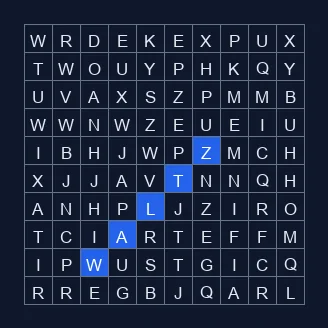
A highlighted diagonal path shows how a letter pattern can sit off the obvious row scan. Once you expect chunks in every orientation, prefixes and endings you spotted horizontally still pay off on slanted lines.
Run the same pattern checklist on each direction family so one slant does not stay invisible until the end.
Training the Brain to See Repetition
Regular puzzles teach your eyes which structures belong to the list versus accidental filler.
What improves over time
- Endings such as ing or tion trigger a second look without a full reread
- Full letter-by-letter decoding drops for words you have seen on past grids
- Hidden straight paths feel like recognition instead of search
Short, steady sessions beat rare marathons for building that automatic layer.
Breaking Complex Grids Into Visual Clusters
Big boards feel calmer when you give each zone its own pattern hunt.
Effective strategy
- Split the grid into quarters or bands before you wander the whole field
- Run prefix and ending scans inside one zone before you jump
- Move systematically so no band waits for a “later” pass that never comes
Clusters keep pattern work tied to coverage, not random peeks.
Combining Patterns with Scanning Techniques
Pattern sense works best on top of a finished pass order, not instead of it.
Recommended approach
- Scan row by row while watching for familiar chunks on the list
- Switch to columns or diagonals when a band is clear but patterns still hide
- Use a spotted prefix or ending to jump to the next zone that might share it
Hybrid habits—structure plus pattern cues—are what separate fast word find solves from slow letter hunting.
Final Thoughts
Letter patterns are among the strongest tools for faster word search play. Treating the grid as familiar structures—not isolated noise—lets your brain batch information. With practice, more finds feel like instant recognition, and puzzles stay challenging without feeling tedious.
Frequently Asked Questions
Which letter patterns matter most for beginners?
Start with th, ch, and sh pairs, plus common endings like ing and ed. They appear on many English lists and are easy to spot while you still learn scan order.
Do prefixes help on themed word search lists?
Yes. Holiday, food, or nature themes often repeat the same openings. Noticing re-, un-, or theme-specific starts can surface several words from one cluster.
Should I look for patterns before finishing a full grid scan?
Patterns guide where to look next; they do not replace coverage. Finish your current pass band, then let a spotted chunk send you on a focused trace along one allowed line.
Do patterns work on diagonal and backward words?
The same chunks appear on every straight path the rules allow. Training on rows first is fine, but apply the same endings and pairs when you open diagonal and reverse passes.
Is pattern skill different from crossword or logic puzzles?
Word search stays list-driven search in a letter field. Pattern work here is about straight-path recognition, not filling blanks from definitions.