





Why You Keep Missing Words in Word Search Games
You clear most of a word search or word find list, feel done—and then three answers were never marked. That gap is rarely bad luck. It usually traces to how you scanned the letter grid: skipped bands, habits that ignore certain paths, or fatigue near the end. Naming those habits is the first step toward cleaner finishes on straight-line list puzzles (not crossword clue grids).
Inconsistent Scanning Techniques
Missed words most often come from uneven coverage. Jumping to “interesting” patches or abandoning a row halfway leaves whole strips of cells without a careful read.
Tips for Consistent Scanning
- Move systematically—row by row or column by column—and finish each band before you relocate
- Run additional passes in other orientations when the puzzle rules allow them
- Resist skipping sections that look empty; short list words hide in quiet corners
Steady sweeps give every cell comparable attention, which is how stray entries finally show up.
Overlooking Diagonal and Reverse Words
Many solvers mentally expect left-to-right rows only. On word search puzzle grids that allow diagonals and backward spellings, those paths stay invisible until you look for them on purpose.
How to Catch Hidden Words
- Trace each allowed diagonal with the same discipline you use for rows and columns
- Read rows and columns in both directions along the same line
- Watch overlap zones where one found word shares letters with another still on the list
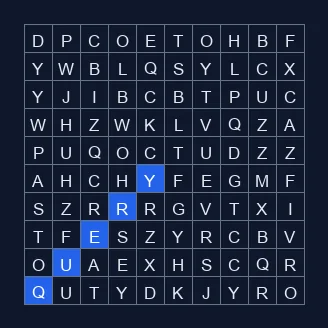
Diagonal and reverse paths are easy to skip when every pass feels “forward only”; the highlighted example shows a straight-line word crossing the grid on a slant—a shape worth its own sweep.
Closing orientation blind spots removes a large share of surprise leftovers at the end.
Rushing Through the Puzzle
Impatience narrows what your eyes register. Under time pressure—or when only a few words remain—you may skim past subtle letter runs that hold real list entries.
How to Slow Down Effectively
- Work one small zone at a time instead of sweeping the whole board in one blur
- Pause briefly if your eyes feel strained or your focus drifts
- Revisit a “finished” corner with a slower second pass before you close the puzzle
Deliberate pacing trades a minute of calm for fewer invisible words in word search games.
Difficulty with Dense or Large Grids
Bigger boards and heavier filler raise the cost of any gap in coverage. Short or uncommon list words can vanish inside long runs of random letters.
Strategies for Dense Grids
- Anchor on longer list entries first to mark busy regions, then hunt what is left
- Use rare letters (Q, X, Z) or distinctive pairs as hooks for a targeted pass
- Split work by word length—one round for long words, another dedicated to short ones
Layered passes on dense word search puzzle grids keep small answers from hiding behind visual noise.
Mental Fatigue and Distraction
Concentration is the engine behind every scan. Tired eyes, a noisy room, or multitasking breaks the rhythm that coverage depends on.
How to Maintain Focus
- Play in a setting where you can trace lines without constant interruption
- Keep sessions short enough that the last words get the same attention as the first
- Move the gaze steadily along each path instead of hopping cell to cell at random
Better focus does not create new skills overnight, but it stops simple oversights from piling up.
Lack of Pattern Recognition Practice
Some misses happen because the board still looks like undifferentiated noise. Regular play trains you to spot prefixes, pairs, and familiar shapes before you read every letter.
Improving Pattern Recognition
- Solve easier grids often enough that common chunks feel automatic
- Notice repeated letter clusters that might belong to list words
- Watch how placements tend to line up on straight paths in your usual puzzle style
With practice, fewer words feel “invisible” because your eye recognizes candidates sooner.
Frequently Asked Questions
Why do I miss words even when I feel like I scanned the whole grid?
Feeling thorough is not the same as full coverage. Mental blind spots—usually diagonals, backward reads, or corners you marked done early—leave real cells unread. A final pass aimed only at your weakest orientations often catches what the first sweep missed.
Are diagonal words always allowed?
Rules vary by puzzle. Check whether diagonals and reversals count, then include those directions in every pass where they apply. Assuming forward-only rows is a fast route to leftover list items.
Should I hunt long words or short words first when I keep missing entries?
Either order works if you stay systematic. Many players clear long anchors first, then run a slow dedicated pass for short words and backward spellings—the types most often skipped on a rushed finish.
Is random searching faster than row-by-row scanning?
Random hops can feel lively, but they revisit easy zones and skip whole bands. Row-by-row or column-by-column coverage reduces holes and cuts down end-of-puzzle surprises.
Are word search puzzles the same as crosswords?
No. Crosswords ask you to fill blanks from clues. Word search puzzle games place complete words along straight paths in a letter grid for you to find and mark from a list.
When you pair consistent coverage, orientation-aware passes, layered rechecks, and steady focus, missed words stop feeling mysterious. Each grid becomes feedback on your scan—not proof that the answer was unfairly hidden.