





Overlapping Words in Word Search Puzzle Games
In a typical word search or word find puzzle, several list words can share the same cell letters at crossings. That overlap packs more vocabulary into a fixed grid and raises scanning difficulty without changing the core rule: each answer still traces along one straight line. Shared letters may look crossword-like, but the game stays list-and-line, not clue-based fill-ins.
How Overlapping Works
Overlap happens when two or more placed words use identical letters at the same grid positions. Those intersections follow the same path rules as any other answer—horizontal, vertical, or diagonal runs only, with no bending mid-word.
Common patterns:
- Horizontal and vertical crossings: A row word and a column word meet on one shared letter.
- Diagonal intersections: A diagonal answer can share cells with row or column words.
- Multi-way hubs: Busy layouts let one letter sit on three or more straight paths at once.
Designers plan overlaps to use space efficiently and to build denser boards that stay solvable when every list word is checked on allowed straight traces.
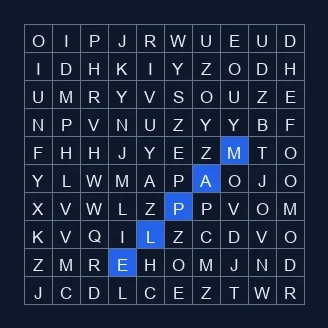
One answer—“MAPLE” on a single diagonal path in this sample—shows how a highlighted trace can pass through letters that also belong to other words on different straight lines. Overlap is normal; each list entry still has its own valid line.
Benefits for Players
Shared letters add challenge in ways straight, isolated words do not:
- Multi-direction attention: You may need to confirm whether a letter completes the word you are tracing or belongs to another path crossing it.
- Stronger pattern reading: Dense overlap rewards systematic sweeps instead of staring at one row.
- Surprise and depth: Crossing clusters keep advanced word search grids from feeling like a simple word hunt.
Those effects matter most on larger or themed puzzles where overlap is intentional, not accidental clutter.
Considerations for Puzzle Design
Overlap helps until it blurs the board. Authors usually aim for readable density:
- Avoid unreadable tangles: Too many intersections in one zone can make tracing feel like guesswork.
- Keep letters legible: Spacing, contrast, and list length should match the grid size.
- Test every path: Each list word must trace cleanly on published direction rules with no ambiguous duplicate claims for the same spelling unless the rules allow it.
Fair word find design treats overlap as a space-saving tool, not a trick that hides words off-list.
Overlap in Themed and Educational Puzzles
Themed builders often overlap related vocabulary—holidays, science units, or topic clusters—so connections feel natural while the grid stays compact. Educational sets may cross core terms to reinforce how ideas link, as long as players can still mark every required word on straight paths.
Players who notice shared letters early often finish faster on repeat grids; designers who balance hubs, direction mix, and filler keep overlap challenging rather than confusing.
Frequently Asked Questions
Is overlapping the same as a crossword puzzle?
No. Crosswords use definition clues and often interlock words by design rules that differ from word search. In word search, you work from a word list and highlight straight paths; shared letters are a placement choice, not a separate solving mechanic.
Can one letter belong to several words at once?
Yes, on most commercial grids. A single cell may sit on horizontal, vertical, and diagonal answers simultaneously as long as each spelling follows one unbroken straight line.
Do overlaps make puzzles unfair?
Not when the editor tests placement. Problems arise when overlap and filler make a list word hard to distinguish from a coincidental letter run, or when too many words crowd one region. Good QA keeps every list entry findable.
Should beginners avoid overlap-heavy grids?
Beginners can start on smaller boards with lighter crossing, then move to denser themes. Overlap itself is standard; difficulty comes from grid size, direction mix, and how many paths meet in one area.
How do I spot overlaps while solving?
When a promising letter sequence could belong to two directions, finish tracing one list word, mark it, then return with a different sweep pattern. Shared hubs often reveal the second path once the first crossing word is cleared.