





Pattern Recognition in Word Search Games: Shapes, Directions, and Fast Scanning
Pattern recognition is one of the skills that separates slow grid hunting from confident word search and word find play. The board looks like random letters, but experienced solvers read it in chunks—familiar prefixes, stretched silhouettes, and line directions their eyes classify before they spell every cell.
On a straight-line path from the word list (not crossword-style clues), that habit raises both speed and accuracy without trading one for the other.
What Pattern Recognition Means in Word Search Games
Pattern recognition is your brain matching a layout it has seen before instead of decoding letters one at a time.
What counts as a pattern on the grid
- Repeated letter runs such as ing, tion, or er on English list words
- The overall stretch or compact shape a spelling makes along one allowed line
- Direction cues—horizontal bands, vertical columns, or diagonal bands that stand off the row scan
Over time those cues feel like “seeing the word” rather than sounding it out cell by cell.
Recognizing Common Letter Groups
Many list entries share chunks that show up often enough to become visual shortcuts.
Examples worth training
- ing in longer verbs and participles
- tion and ment at the end of nouns
- er, st, and re near beginnings or middles
When one of these groups catches your eye, trace the full spelling along every direction the rules allow before you move on.
Word Shape Awareness
Skilled players often notice silhouette before they confirm each letter.
Shapes that signal a find
- Long list words read as extended lines across a zone
- Short words sit as tight letter clusters
- Doubled or rhythmic letters create a bump you can spot while scanning filler
Shape reading pays off on dense word search grids where filler would otherwise blur every pass.
Directional Pattern Recognition
Words hide on horizontal rows, vertical columns, and diagonals along straight paths. Training your eye to expect each family keeps slanted finds from waiting until the last review.
Directions to classify quickly
- Horizontal lines that follow natural left-to-right reading
- Vertical stacks that cut across row noise
- Diagonal bands that read slightly tilted against the surrounding cells
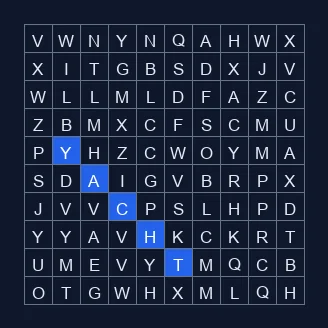
A highlighted example path shows how a word can sit off the obvious row scan. Once you expect patterns on every permitted line, the same letter chunks you noticed horizontally still guide you on diagonals.
With practice, direction becomes a first glance, not a second pass.
Spotting Reversed Patterns Instantly
When reverse spellings are allowed, pattern work still applies—you are matching a familiar contour, not mentally flipping each letter.
Reverse habits that help
- Treat a backward sequence as the same shape read from the other end
- Notice symmetry when doubled letters anchor the middle
- Compare forward and backward paths on the same anchor letter so one orientation does not stay invisible
Reverse skill matters most on puzzles that hide several list words spelled backward along permitted lines.
Using Repetition to Build Familiarity
Each puzzle teaches your eyes which structures belong to the list versus accidental filler.
What gets automatic with steady play
- Frequent word shapes trigger a second look without a full reread
- You anticipate where themed chunks are likely to land
- Clusters process faster because decoding drops for words you have met before
Short, regular sessions build that layer more reliably than rare marathon grids.
Filtering Out Visual Noise
Filler letters exist to break easy matches. Pattern skill includes ignoring combinations that cannot complete a list word.
How to narrow focus
- Skip clusters that do not match any list length or anchor letter
- Prioritize meaningful runs tied to words you still need
- Keep scan pace steady so noise does not pull you into random peeking
Filtering keeps pattern recognition tied to the word list, not every accidental string on the board.
Identifying Hidden Overlaps
Overlapping entries share cells, so one intersection can confirm two spellings.
Overlap cues pattern readers watch
- Shared letters where two straight paths cross
- A found word removing clutter that reveals the crossing line
- Second words that complete faster once the first path is marked
That chain effect—one recognition unlocking the next—is common on busy themed grids.
Speed Improvement Through Pattern Training
More pattern practice usually means fewer full decodes per solve.
Where time comes back
- Familiar structures register in one glance
- Letter-by-letter reading drops for chunks you know
- Wider scan bands stay accurate because cues are clearer
Word search starts to feel like rapid visual interpretation instead of slow spelling.
Developing a Long-Term Skill
Pattern recognition is not a one-puzzle trick. It is a long-term visual habit that grows with consistent play.
Signs you are leveling up
- Words pop as wholes instead of isolated symbols
- Likely placements feel predictable from theme and length
- Whole layouts process with less mental effort per line
That shift is what makes harder grids feel intuitive rather than overwhelming.
Frequently Asked Questions
Is pattern recognition the same as memorizing the word list?
No. You still match list entries to real paths on the grid. Patterns narrow where to trace; they do not replace checking each spelling along an allowed straight line.
Which patterns should beginners learn first?
Start with common endings like ing and tion, then th, ch, and sh pairs. They appear on many English lists and are easy to spot while you learn row-by-row coverage.
Do patterns work when words run backward?
Yes, when rules allow reverse spellings. Train on forward lines first, then run the same chunk checks when you open backward passes on the same anchor letters.
Should I rely on patterns instead of a full grid scan?
Patterns guide focused traces; they do not replace systematic coverage. Finish your current band, then let a spotted chunk send you along one permitted path.
How is pattern skill different from crossword solving?
Word search stays list-driven search in a letter field. Pattern work here is about straight-path recognition and scanning, not filling blanks from definitions.