





How Pattern Recognition Improves Word Search Solving
Pattern recognition turns word search and word find grids from letter-by-letter hunts into faster, more confident solves. Instead of treating every cell as a mystery, you learn to spot familiar chunks, stretched silhouettes, and thematic links from the list—then trace only the straight paths the rules allow.
On a standard list-and-grid puzzle (not crossword-style clues), that shift usually adds speed without giving up accuracy.
Understanding Pattern Recognition for Solving
Pattern recognition means your brain notices structures it has seen before instead of decoding one letter at a time.
What you are really matching
- Letter runs that repeat across English list words, such as ing, tion, or er
- The compact or stretched shape a spelling makes along one permitted line
- Clusters that look like plausible spellings rather than random filler
Strong solvers still verify each find along an allowed path; patterns tell them where to look first, not what to skip checking.
Spotting Common Letter Combinations
Prefixes, suffixes, and consonant groups appear often enough on themed lists to become shortcuts.
Groups worth noticing while you scan
- Openers like un-, re-, and pre- when the list has longer verbs or adjectives
- Endings such as -ing, -ed, and -tion on nouns and participles
- Tight consonant runs (st, ch, str) that break up filler noise
When a group catches your eye, follow it forward and backward along every direction the puzzle allows before you jump to a new zone.
Recognizing Word Shapes
Each list word has a visual footprint: short entries sit as tight clusters; long ones read as extended bands across a row, column, or diagonal.
Shapes that speed up solving
- Short words that hide on diagonals or as reversed spellings still form a recognizable bump
- Long words with distinctive opening letters stand out in a sea of unrelated cells
- Overlapping entries share cells, so one shape can hint at a crossing line you still need
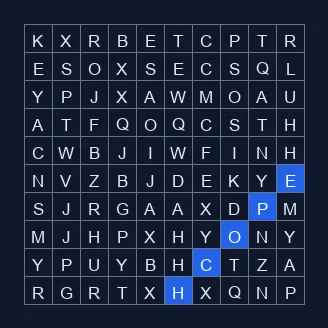
One highlighted path shows how a spelling can sit off the obvious row scan. Training your eye for compact diagonal shapes keeps those finds from waiting until a final pass.
Shape awareness matters most on dense grids where filler would otherwise blur every sweep.
Using Context Clues in Word Lists
Themed word lists are not random vocabulary. Shared topic and length often correlate with shared letter habits.
How the list helps pattern work
- Related words may reuse the same roots or endings, so you anticipate similar chunks
- Grouping list entries mentally by length or theme narrows which shapes to hunt
- Once you find one themed word, nearby letters often belong to neighbors on the same list
Context does not replace grid work—it prioritizes which patterns deserve the next trace.
Practicing Pattern-Based Scanning
Pattern skill grows through steady practice, not one lucky puzzle.
Habits that build automatic recognition
- Start on smaller grids and add diagonals or reverse rules as you stay accurate
- Mark finds promptly so leftover clutter does not hide the next shape
- Alternate between row bands and column passes so vertical silhouettes stay visible
- Note which chunks you miss repeatedly and drill those on the next board
Over time, familiar structures register in one glance, and solving feels like guided tracing instead of exhaustive search.
Frequently Asked Questions
Is pattern recognition the same as memorizing the word list?
No. You still match each list entry to a real straight path on the grid. Patterns narrow where to trace; they do not replace checking the full spelling along an allowed line.
Which letter patterns should beginners train first?
Common endings like ing and tion, then th, ch, and sh pairs, show up on many English lists and are easy to spot while you learn systematic row coverage.
Do patterns help when words run backward?
Yes, when reverse spellings are allowed. Learn forward traces first, then apply the same chunk checks when you read a cluster from the opposite end.
Should I rely on patterns instead of covering the whole grid?
Use patterns to launch focused traces after you finish the band you are scanning. Spotted chunks save time; they do not excuse skipping sections of the board.
How is this different from crossword pattern work?
Word search stays list-driven search in a letter field. Pattern recognition here means straight-path shapes and scanning—not filling blanks from definitions.
Pattern recognition changes how efficiently you solve word search puzzles: familiar letter chunks, silhouettes, and list context point your eyes at the right lines. With practice, that layered reading makes even busy grids feel manageable instead of endlessly random.