





How Randomness Affects Word Search Puzzle Games
Random placement and filler letters are built into most word search and word find puzzles. Each new grid shuffles where list words sit on straight paths and how the remaining cells are filled, so boards stay fresh without rewriting the vocabulary. That variability shapes replay value, felt difficulty, and fairness—provided generators keep randomness inside readable layout rules, not crossword-style clue grids.
Enhancing Replayability
Replayability is the clearest upside. When path order, overlap, and filler change between runs, players cannot coast on memorized coordinates. They have to scan again even when the theme and word list feel familiar.
Randomness supports replay by:
- Producing distinct letter layouts for the same theme or list
- Swapping which words feel “loud” on the board from one puzzle to the next
- Reducing predictability so each session still trains active search
Well-bounded randomness keeps casual word search habits engaging across many sittings instead of one solved-and-done sheet.
Balancing Difficulty
Random placement can swing how hard a puzzle feels, even when the official difficulty label and list stay fixed. Words bunched along one band of the grid are often spotted faster; the same entries scattered, reversed, or tucked on diagonals demand slower, more careful sweeps.
Designers use controlled randomness to:
- Tune density for beginner-friendly boards versus expert cram
- Mix orientations without rewriting the word list
- Spread letters so accidental “almost words” in filler do not dominate the visual field
When limits are set up front, randomness becomes a difficulty dial—not a coin flip that might ship an unreadable grid.
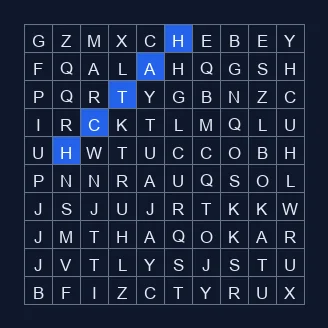
Each generation pass can land the same spelling on a different straight path—“HATCH” on a diagonal here—while filler letters shuffle around it. That is why two puzzles with identical lists can feel easier or tougher depending on placement, not just word length.
Preventing Monotony
Without layout variety, even strong word lists go stale. Static print editions can be delightful once; online libraries and daily modes need new geometry so veterans are not replaying the same map.
Effective randomness:
- Makes back-to-back puzzles diverge in letter noise and crossing patterns
- Pushes players to adjust scan order instead of autopiloting one path
- Preserves a small surprise in each word find session
The goal is novelty without chaos—fresh boards that still obey the same straight-line rules players expect.
Potential Downsides of Randomness
Unbounded randomness can frustrate. Clusters that look like one thick blob, paths that fight each other for space, or filler that creates distracting false trails can slow progress without teaching anything new.
To limit downside:
- Keep placement inside generator rules every board must pass
- Preserve legibility—balanced margins, no crushed spelling
- Match random spread to the labeled difficulty tier
Fair word search design treats randomness as a seasoning: enough to vary play, not enough to make outcomes feel arbitrary.
Randomness and Strategy Development
Because the map changes, players cannot win on memory alone. They lean on scanning habits, direction checks, and pattern sense—the skills that transfer to the next grid regardless of theme.
Players often grow by:
- Using systematic row, column, and diagonal passes
- Adapting when overlap hides short words beside longer ones
- Prioritizing list entries with rare letters or distinctive shapes
In that sense randomness rewards skill-first word search play: flexible methods beat memorized answer keys.
Conclusion
Randomness is a defining trait of modern word search puzzle games. It fuels replay, nudges difficulty through layout, and fights repetition—but only when generators bound placement and fill with tests players never see. Understanding that balance helps you pick puzzles that stay fresh and helps designers ship grids that feel varied yet fair.
Frequently Asked Questions
Does random mean every puzzle is equally hard?
No. The same word list on a different grid can feel easier or harder because of placement, overlap, and direction mix—not because the vocabulary changed.
Is memorizing one grid a good strategy online?
Rarely. Procedural and reshuffled layouts are meant to defeat answer-key memory. Scanning habits generalize better than remembering last week’s coordinates.
Can random placement break a word search puzzle?
Poor pipelines can fail validation—missing words, clipped spellings, or illegal paths. Shipping quality tools retry or resize until every list word fits on an allowed straight line.
Is filler randomness separate from word placement?
Usually yes. After list words are embedded, leftover cells get weighted or random letters. Both steps affect how “busy” the board looks, but only list words count as solutions.
Does more randomness make word search luck-based?
Only at the margins. A lucky early sighting may save seconds; consistent performance still comes from systematic search and pattern recognition on letter grids—not from guessing like a crossword clue.