





Relaxing vs. Challenging Word Search Puzzle Games
Word search and word find puzzles sit in an unusual spot in casual play: they can feel like a quiet break or a genuine brain teaser, often in the same session. You scan a letter grid and mark words from a list along straight paths—horizontal, vertical, or diagonal depending on the puzzle—not crossword-style clue filling. Understanding why the same format swings between calm and demanding helps explain why players of every age keep coming back.
The Relaxing Side of Word Search Games
At their core, word search puzzles are approachable and low pressure. The grid layout and simple goal—find each list word on a line—let you engage without scores, opponents, or mandatory time limits unless you choose them.
Relaxing aspects include:
- Predictable rhythm: Row-and-column sweeps repeat in a steady pattern that many players find soothing.
- Flexible pacing: You set the speed, pause anytime, and pick up where you left off.
- Casual engagement: Unlike twitch-heavy games, a word find session can stay process-focused instead of performance-focused.
For many people, that calm, almost meditative quality is the main reason they open another grid after work or before bed.
The Challenging Side of Word Search Games
Easy to start does not mean easy to master. As grids grow, word lists lengthen, or directions multiply, the same hunt asks for sharper scanning and steadier focus.
Challenging elements include:
- Pattern recognition: Spotting a spelling inside noisy filler takes visual discipline and attention to detail.
- Memory and focus: Tracking what you already cleared—and what you have not—loads working memory on dense boards.
- Complex layouts: Diagonal paths, reversed spellings, and overlapping words raise the effort without changing the basic rules.
Those layers turn word search into more than a passive pastime: a light mental workout that still rewards patience.
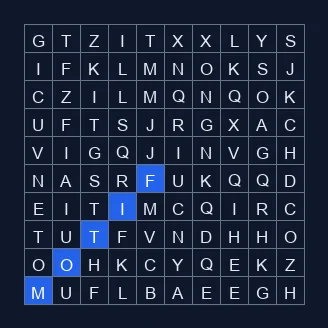
A diagonal highlight shows how challenge ramps up on the same grid: “MOTIF” here sits on a less obvious straight path than a row-only word, so you scan longer and test direction habits—not just relaxation.
Striking the Right Balance
The long-term appeal of word search is that both moods live in one format. Publishers and apps often offer difficulty tiers, themed lists, or daily puzzles that swing between gentle and brisk.
- For relaxation: Smaller grids, familiar vocabulary, and fewer direction options keep stress low.
- For challenge: Larger boards, longer words, tighter overlap, or timed modes push scan strategy and stamina.
When players can match the puzzle to the moment, the genre stays fresh instead of locking into only “easy” or only “hard.”
Why Players Keep Returning
Word search games flex with mood. Some days call for slow scanning; others call for beating a personal best or clearing a tough themed pack. That versatility—on phone, tablet, print, or desktop—keeps the format relevant where flashier games burn out quickly.
Whether you want a peaceful pastime or a subtle cognitive stretch, word search offers an accessible middle ground: engaging enough to hold attention, gentle enough to stop when you are done.
Frequently Asked Questions
Can the same word search feel relaxing one day and hard the next?
Yes. Grid size, word length, overlap, direction mix, and whether you use a timer change the felt load more than the genre label on the menu.
Are harder word searches still “casual” games?
They can be. Challenge usually comes from layout and list design, not from learning heavy rules. You still mark straight-line words from a list.
Do diagonals and backwards words make word search stressful?
They add work, not necessarily stress. Players who want calm can pick puzzles limited to horizontal and vertical paths; others enjoy the extra hunt.
Is word search mostly relaxation or mostly brain training?
Both, by design. Repetitive scanning supports calm focus; tougher boards train pattern sense and sustained attention without turning into a logic marathon.
How do I pick the right difficulty for my mood?
Match grid size and options to intent: unwind with a small familiar theme; push yourself with a large grid, longer words, or a timed run when you want stimulation.
Conclusion
Word search puzzle games balance relaxation and challenge in one familiar package. The same straight-line rules support a quiet break or a focused session depending on how the grid is built and how you play. Knowing that dial exists makes it easier to choose puzzles that fit the day—and to enjoy both sides of the format.