





Repeated Letters in Word Search Games: Spot Clusters and Find Words Faster
Doubles, triples, and rhythmic repeats jump off a word search grid faster than a string of all-unique letters. On straight-line word find puzzles (not crossword-style clue grids), those clusters act as visual anchors: your eye locks on repeat shapes, then traces the full spelling along an allowed path.
This guide explains how repeated letters stand out, why they speed scanning, and how to fold them into your usual row, column, and diagonal habits.
How Repeated Letters Stand Out
List words such as BALLOON, SUCCESS, or BANANA leave fingerprints in the filler—paired letters, echoes separated by one or two cells, or rare doubles like ZZ that barely appear in random fill.
Pattern types worth noticing
- Back-to-back repeats (EE, LL, SS) form tight blobs that read as one unit
- Spaced repeats (A _ A, N _ N) create a short rhythm your brain matches before you decode every cell
- Unusual doubles (QQ, ZZ) are scarce in filler, so each hit deserves a second look
When you scan for these shapes instead of every isolated consonant, you shrink the grid into zones worth tracing.
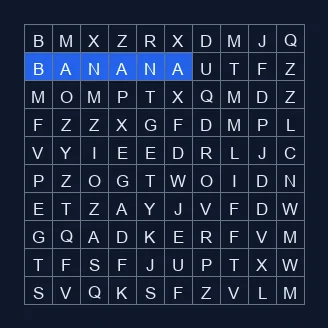
The sample word BANANA shows back-to-back and spaced repeats on one straight line. Spotting those shapes first narrows where you trace forward, backward, or vertical and diagonal paths on real puzzles.
Why Repeated Letters Improve Performance
Repeat cues do not replace a full grid pass—they tell you where to spend your next look.
Faster detection
Clusters break the “every cell looks the same” blur. One double can stand for two or three letters you do not need to hunt individually, so traces start sooner and finish faster.
Fewer misses
Easy words still hide when filler surrounds every letter evenly. Repeats give you a secondary hook: even partial coverage along a line may be enough to confirm a list entry before you move on.
Stronger pattern memory
The more you notice doubles on themed lists, the faster you connect a spotted chunk to the word list. That skill carries into diagonal, vertical, and backward spellings on the same grid.
Practical Tips for Using Repeated Letters
- Hunt clusters before singles: Scan for doubles and rare pairs, then read outward along the line.
- Cross-check the list: Before playing, note which entries contain repeats—you will know which shapes to expect.
- Pair with first-letter anchors: A repeat plus a matching opening letter often confirms direction before you read the middle.
- Work in zones: Finish one band for repeat shapes, then switch orientation so upright or slanted copies of the same spelling do not wait until the end.
- Mental rehearsal: Picture common doubles from your list (ING endings, OO in food themes) so they register in one glance during live play.
Combine repeat spotting with systematic row or column passes so coverage stays complete while your eyes favor high-signal cells.
Combining Repeats with Other Strategies
Repeated-letter work fits alongside the habits you may already use on harder boards.
Scan order
Run your usual horizontal or vertical pass, but let doubles trigger a pause—trace that line in every direction the rules allow before you leave the band.
Length and difficulty
Long list words often contain more repeats; short words may hide a single EE or LL. On dense grids, repeats help most when you are hunting the last few stubborn entries.
Themed lists
Holiday, food, or animal themes reuse the same doubles across several answers. One spotted OO or LL can surface multiple words if you fan out from the cluster.
Final Thoughts
Repeated letters are a low-effort, high-payoff filter in word search play. Treat doubles and rhythmic repeats as landmarks inside the noise, trace the full word on a straight path, and keep alternating scan directions so nothing hides behind orientation alone. With a little list prep and zone discipline, repeat spotting becomes automatic—and missing words becomes rarer.
Frequently Asked Questions
Do all words in a puzzle have repeated letters?
No. Many list entries use only unique letters. Repeats are a when you see them, lean in tactic, not a requirement for every find.
Which repeated letters are easiest to spot?
Common doubles such as LL, EE, and SS appear on many English lists. Rare pairs like ZZ or XX stand out in filler but show up less often on the list—both are useful anchors when present.
Should I search for repeats before finishing a full grid scan?
Use repeats to steer focused traces inside a pass you are already running. Finish the band or zone you started, then let a cluster send you along one line instead of hopping randomly.
Do repeated letters help on diagonal and backward words?
The same spelling keeps its doubles no matter which straight direction hides it. Spot the cluster, then check vertical, diagonal, and reverse paths from that neighborhood.
Is repeat spotting different from crossword pattern work?
Word search stays list-driven search along lines in a letter field. Here you are matching visible letter rhythms to list spellings—not filling blanks from definitions.