





Why Some Word Search Puzzle Games Feel Repetitive
Word search and word find puzzles earn their fans through simple rules and calm pacing. Yet the same format can start to feel samey after dozens of grids. That drag usually comes from design choices—word lists, themes, layout habits, and difficulty curves—not from the core idea of hunting list words along straight paths in a letter grid (not crossword-style clue filling).
Reused Word Patterns Across Puzzles
Overlapping vocabulary is one of the fastest ways a word search series goes stale. When back-to-back puzzles pull from nearly the same pool, you recognize answers before you finish scanning.
Common triggers include:
- The same thematic clusters recycled with only a title change
- Lists that never grow harder as you progress
- Familiar word bundles appearing under new skin
Even when filler letters shuffle, repeated list patterns shrink the sense of discovery.
Limited Theme Variety
Strong themes keep word find sessions fresh. Narrow or recycled topics make every board feel like the same chore.
Repetition often shows up when:
- Most puzzles lean on one category (basic household objects, generic animals, and the like)
- Themes never deepen into subtopics or surprising angles
- Seasonal or cultural variety is missing
Without thematic range, mechanical scanning stays the same even when the label on the menu changes.
Predictable Grid Structures
Random placement can still feel formulaic when generators lean on the same habits. Once you expect where words tend to land, tension drops.
Watch for:
- Placement that always favors the same directions or bands of the grid
- Unchanging grid sizes across long runs of puzzles
- Spatial patterns that read as copy-paste from one board to the next
Structural sameness is a design signal—not proof that word search itself is worn out.
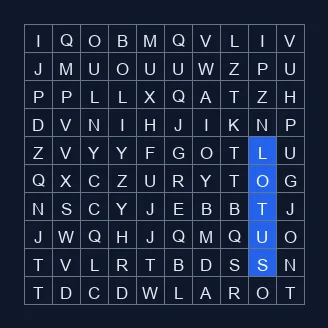
When every puzzle uses similar size, density, and path habits, even a valid find like “LOTUS” on a vertical line can feel routine—the letters change while the layout recipe does not.
Lack of Difficulty Progression
Flat difficulty breeds boredom. If every grid asks for the same effort, you stop sensing growth.
Typical gaps:
- Word length and rarity never step up
- Density stays identical puzzle after puzzle
- New directions or constraints appear rarely or never
Word search stays engaging longer when tiers clearly move from gentle lists to denser, trickier hunts.
Overly Familiar Vocabulary
Accessibility matters, but lists built only from ultra-common words blur together fast.
It becomes obvious when:
- Every theme reuses the same high-frequency terms
- Few puzzles introduce surprising or topic-specific terms
- Different titles mask nearly identical word sets
Vocabulary variety is cheap design leverage: it refreshes feel without rewriting core rules.
Minimal Gameplay Variation
The hunt mechanic is stable, but presentation and modes can still diverge. When timing, visuals, and interaction never shift, repetition stands out.
That hurt shows up when:
- There are no optional modes (untimed, themed packs, streak challenges)
- UI and pacing look identical every session
- Nothing nudges you to try a new scan strategy
Small presentation and mode tweaks can make familiar grids feel new again.
Lack of Contextual or Thematic Depth
Surface-level themes read as stickers. Without coherent word choice tied to an idea, puzzles feel interchangeable.
Shallow design often means:
- A title with words that barely relate to each other
- No narrative, lesson arc, or real-world hook
- Lists that could belong to any generic category
Deeper thematic pairing helps each word find puzzle feel distinct and memorable.
Repetition as a Design Limitation, Not a Concept Flaw
Boredom is not baked into word search. Straight-line marking, flexible directions, and themed lists can support years of play. Repetition is a production habit: recycled lists, flat progression, and predictable layouts.
When designers vary themes, vocabulary, structure, and difficulty, the format stays lively. The gap is creative puzzle building—not the genre itself.
Frequently Asked Questions
Why do themed word searches still feel repetitive?
Themes repeat when word lists overlap or stay shallow. A new banner on the same vocabulary does not create a new hunting experience.
Can bigger grids fix boredom?
Larger boards help only if lists, directions, and density change too. A bigger grid with the same words and placement habits still feels familiar.
Is repetition worse in apps than in print books?
Either can stall. Daily apps that reuse list templates feel samey quickly; print volumes that never escalate difficulty have the same problem. Variety in content beats delivery format.
Do diagonals and backwards words prevent monotony?
They add scan work, not automatic freshness. If lists and themes never change, extra directions just make the same vocabulary harder to spot.
Who is responsible for “stale” puzzles—the player or the designer?
Most repetition traces to design: list reuse, flat tiers, and layout habits. Players can switch themes or difficulty, but lasting variety usually needs better curated or generated content.
Conclusion
When word search puzzle games feel repetitive, look past the genre label. Overlapping word lists, narrow themes, predictable grids, flat difficulty, tired vocabulary, and identical presentation drain novelty long before straight-line hunting stops working. Variety in those layers keeps word find puzzles worth opening—whether you play for five minutes or fifty.