





Row-by-Row vs Random Search in Word Search Games
How you move your eyes across the letter grid shapes speed, accuracy, and how often you rescan the same cells. Two habits show up in almost every word search and word find session: row-by-row scanning with a fixed path, and random jumps that chase patterns wherever they appear. Both can land words; they differ in coverage, repeat work, and how predictable your routine feels.
What Is Row-by-Row Search?
Row-by-row search is a structured method where you examine the grid one horizontal line at a time before moving to the next band.
How It Works
- Start at the top row (or bottom, if you prefer a fixed anchor)
- Read steadily across that row left to right, or right to left on a return pass
- Drop to the next row only after the current line feels complete
- Continue until every row has had at least one deliberate pass
That path gives you a mental map of the board and cuts down on untouched stripes of letters.
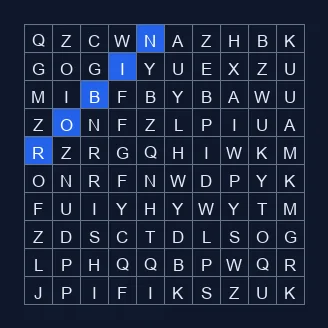
A highlighted example word shows what disciplined scanning is aiming for: follow a clear line through the grid, confirm a list match, then advance. Filler letters stay visible so you see how straight paths hide inside busy grids—row work uses the same idea along horizontal bands.
Strengths of Row-by-Row Search
- Encourages full horizontal coverage before you wander elsewhere
- Reduces accidental double-scanning of hot spots
- Builds a repeatable habit that scales to larger grids
- Pairs well with beginners who want a simple rule to follow
Because the route is predictable, row-by-row scanning is one of the most reliable ways to avoid “mystery gaps” near the edges.
What Is Random Search?
Random search means no fixed order: your eyes hop between regions based on hunches, standout letters, or words you think you recognize.
How It Works
- Attention jumps between distant cells or corners
- You chase familiar prefixes, doubles, or word silhouettes
- Direction and zone change whenever something looks promising
Many players fall into random jumps during timed rounds or on easy boards where words pop quickly.
Strengths of Random Search
- Can snag obvious list words in seconds
- Feels brisk on small grids with few entries
- Helps when you already picture a target word and hunt for its shape
The trade-off is control: without a backup plan, large zones may never get a calm, complete look.
Key Differences Between the Two Approaches
The split is less about talent and more about process.
Structured vs Unstructured
- Row-by-row search follows a route you could describe to someone else
- Random search follows moment-to-moment visual cues
Coverage vs Apparent Speed
- Row-by-row favors completeness over sprint starts
- Random search can feel faster early but often revisits the same clusters while skipping quiet rows
On denser word search grids, one missed band can mean minutes of backtracking at the end.
When Row-by-Row Search Works Best
Structured rows earn their keep when mistakes are costly.
Ideal Conditions
- Large or tall grids with many placements
- Boards where similar letters (I/L, O/Q) blur together
- Sessions where accuracy matters more than a fast opening burst
Row-by-row pacing keeps your sweep legible—you always know which rows are “done” and which still need a pass.
When Random Search Might Help
Unstructured jumps still have a place when the board is small or the target is already in mind.
Useful Scenarios
- Compact grids with only a handful of list words
- Hunting one word you are sure is visible somewhere
- A quick first glance to knock out easy horizontal or vertical hits
Treat random hops as a scout pass, not the only pass, once the grid grows or the list lengthens.
Combining Both Methods for Better Results
Strong solvers usually anchor on rows (or rows plus columns) and allow short intuitive detours.
Balanced Approach
- Use row-by-row scanning as the default backbone
- Break out briefly when a pattern or anchor letter pulls your eye
- Return to the structured path to finish any row or band you skipped
- Mark found words on the list so random tangents do not orphan the same zone twice
That blend keeps early speed without surrendering end-game coverage.
Improving Your Search Strategy
Habits change with repetition, not one lucky puzzle.
Helpful Tips
- Pick a start corner and stick to it for a week of practice
- Limit how long you stay in random mode before you rejoin your row track
- After a random find, scan the same row forward and back once before you jump again
- Pair row work with an occasional column pass on tough boards so upright words do not hide in finished rows
Over time, structured scanning becomes automatic—and random jumps turn into short, purposeful side trips instead of the whole strategy.
Final Thoughts
Row-by-row and random approaches each solve different problems. Random jumps can feel thrilling when a word leaps off the grid; row-by-row scanning buys the completeness that stops last-word hunts. The practical answer for most word search and word find play is a structured row routine with brief, intentional detours when your eyes catch a real pattern—not endless hopping with no map of what you have already cleared.