





What Is a Snake Word Search Puzzle Game?
A snake word search puzzle game is a word find variant where hidden words sit on one connected route through the letter grid—often bending in a zigzag or winding “snake” shape—instead of each answer living on its own isolated straight line. Players move step by step along that path: the end of one word segment often feeds into the start of the next, and order matters more than it does on a classic board where you may solve entries in any sequence.
The core idea is still word discovery in a grid, not crossword-style fill-in. Snake layouts add flow and sequencing on top of ordinary scanning skills.
How a Snake Word Search Works
Classic word search hides each list word on a continuous straight path—one row, column, or diagonal line of neighboring cells. You highlight that line and cross the word off; paths do not have to link to each other.
In snake-style puzzles, designers chain segments so the grid feels like one journey:
- Words (or letter runs) follow a single continuous track with turns allowed
- A later segment may reuse or adjoin cells from the segment before it
- Horizontal, vertical, and diagonal steps can mix along the same snake
You still read letters on the grid; you are not assembling unrelated fragments from random corners. The twist is where you are allowed to go next once a segment ends.
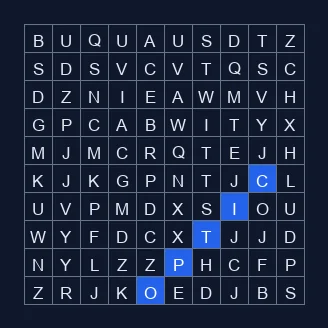
A standard word search shows each answer on its own straight highlight. Snake puzzles instead ask you to follow a longer linked route—this image is the familiar single-path case the variant builds on.
Basic Rules Players Usually See
- A defined start (or obvious entry) on the route
- No skipping intermediate cells when the rules say the path is fixed
- Sequential discovery—jumping ahead in the chain may count as wrong even if letters match a list word elsewhere
- The same spelling and neighbor-cell logic as normal word find on each segment
Always read the puzzle’s own instructions: some books use “snake” loosely for any winding shape; others treat it as a strict ordered chain.
Structure of the Snake Pattern
What marks this variant is the connected backbone running across the grid.
Common traits:
- One primary route, or a few parallel snakes on larger boards
- Curves and bends instead of only parallel straight highlights
- Shared transition letters where one word hands off to the next
- Limited branching so the path stays readable
That backbone changes how you read the grid: you hunt continuity and turns, not only independent straight matches.
How It Differs From Traditional Word Search
| Traditional word find | Snake word search emphasis |
|---|---|
| Each word on its own straight line | Words linked on one continuous path |
| Solve list items in any order | Often must follow the chain in order |
| Random area-to-area scanning works | Progression feels linear and guided |
| Overlaps are optional design flourishes | Overlaps and handoffs may define the puzzle |
Snake grids are not a different alphabet game—they reuse the same letter grid and list-crossing habit. The design layer is topology: linked motion through the board.
Why Designers Use the Snake Format
Snake layouts target a different pacing than “open field” word search:
- Logical sequencing instead of purely opportunistic finds
- Less aimless scanning when the route is clear
- A visible sense of progress from start to finish
- A puzzle that reads almost like a map across the cells
For classrooms, apps, or event pages, that structure can turn a familiar word find into a short guided trek without abandoning the genre.
Difficulty on Snake Grids
Difficulty usually tracks how obvious the route is, not just list length.
Easier snake puzzles
- Bold, easy-to-see paths with generous spacing
- Short segments and forgiving turns
- Few fake branches or dead ends
Harder snake puzzles
- Tight twists and similar-looking junctions
- Subtle handoffs between words
- Dense filler letters that mask the next turn
Hard snake boards reward steady tracing and patience more than a single fast sweep.
Skills Snake Puzzles Stress
Compared with standard word find, players often exercise:
- Path tracking through direction changes
- Sequential reasoning about what comes next
- Visual continuity across bends
- Attention to corners where many mistakes happen
Speed helps only after the route is understood; skipping ahead breaks the chain.
What the Play Session Feels Like
Many solvers describe snake word search as following a trail:
- Begin at the published entry point
- Advance cell by cell along the allowed route
- Treat each list word as a checkpoint on the same trip
The mood is closer to a light maze layered on letters than to a free-form highlight hunt—still calm, but more directed.
Strategy Tips for Snake Word Search
Tactics that transfer across print and digital versions:
- Find the mouth of the snake before you chase individual list words
- Trace with a finger or stylus through each turn before committing
- Mark direction changes mentally (or on paper) when the path doubles back
- Resist hopping to a tempting straight highlight off the main chain
If the puzzle mixes snake and classic words, separate chain words from standalone lines using the rules sheet first.
Why Players Enjoy the Variant
Snake word search stays popular because it:
- Feels fresh next to endless forward-only grids
- Offers a clear sense of direction without new notation
- Balances logic (order) with observation (spotting letters)
- Keeps the satisfying “found it” moment of ordinary word find
It is a small rule shift with a noticeably different rhythm.
Frequently Asked Questions
Is snake word search the same as a normal puzzle with diagonal words?
No. Diagonal placement is still one straight highlight per answer. Snake puzzles connect segments into a longer path and often require order. You might see diagonals inside a snake, but the defining feature is the chain, not any single direction.
Can I solve the word list in any order on a snake grid?
Usually not when the puzzle is a true ordered chain. Some hybrid pages include free-standing words plus one snake route—check the instructions. On strict snake designs, finding a list word off-route may not count.
Do snake puzzles allow curved paths that are not straight lines?
Often yes along the backbone: the route may turn every few cells while still moving only through orthogonally or diagonally adjacent cells, depending on the publisher. It is not a free-draw line through the grid; it is still a discrete cell path with bends.
Is snake word search harder than classic word find?
It depends. A short, obvious snake on a large grid can feel gentler than a dense classic board. Hard snakes with hidden junctions can frustrate strong scanners who prefer unordered sweeps. Judge path clarity, segment length, and how much the chain overlaps itself.
How is snake word search different from backward or hidden-message variants?
Backward puzzles keep straight lines but may reverse reading direction along each line. Hidden-message puzzles often add a second step after finds. Snake puzzles emphasize a linked route and sequence—straight segments may appear, but the puzzle is organized around the continuous path.
Final Thoughts
A snake word search puzzle game keeps the familiar find words in a grid loop but replaces scattered straight highlights with a guided chain through the letters. Learn whether your copy demands strict order, trace the backbone before you race the list, and treat each bend as part of one continuous solve. Once the path clicks, the variant feels less like a trick and more like word find with a plotted itinerary.