





How to Solve Word Search Puzzle Games Step by Step
Word search puzzle games (also called word finds) are simple on paper: a letter grid, a word list, and straight-line paths that hide every answer. Difficulty still shifts with grid size, allowed directions, and how densely words overlap. Whether you are opening your first puzzle or want a reliable routine instead of random scanning, these eight steps give you a repeatable solve path that works on print grids and digital word search games alike.
You are tracing letters already on the board—not filling blanks from clues like in a crossword. Each listed word runs in one unbroken line through adjacent cells.
Step 1: Understand the Puzzle Layout
Before you hunt, take ten seconds to read the instructions and skim the board.
What to Notice
- Grid dimensions and how crowded the letters feel
- Which directions count (horizontal, vertical, diagonal, forward, backward)
- Whether the list is themed or sorted by length, which can hint at tricky spellings
Knowing the rules up front keeps you from finishing a pass only to learn that backward or diagonal words were allowed all along.
Step 2: Scan for Unique Letters First
A practical word search habit is to let distinctive letters pull your eyes before you chase every short word on the list.
Why This Helps
- Rare letters such as Q, X, and Z stand out among filler
- Each hit gives you a small set of anchors to test in every legal direction
- Early finds build momentum while longer or common words are still waiting
Double letters and sharp endings (for example -ING or -TION) work the same way: they are easier to spot than a lone E in a busy row.
Step 3: Search One Word at a Time
Random jumps across the list scatter attention. Pick one word, finish it or rule out your best anchors, then move on.
How to Do It Efficiently
- Read the word on the list once; note its length and any unusual letters
- Search for a strong first letter—or the rarest letter in the spelling
- From each matching cell, trace every permitted direction until the full word matches or that start fails
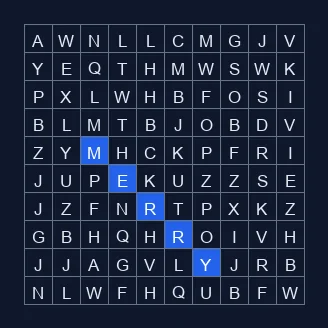
A valid find is always one continuous straight path; here the highlighted row shows how a single list word sits on the letter grid.
This one-word focus cuts duplicate effort and makes it obvious which list entries still need work.
Step 4: Check All Directions Systematically
In a full-rule word search, the same word might run left-to-right on a row, bottom-to-top in a column, or along a diagonal—even backward along that same line.
Directions to Test From Each Anchor
- Left to right and right to left along a row
- Top to bottom and bottom to top along a column
- Both diagonal slopes (up-right, down-right, up-left, down-left)
Some beginner puzzles limit the set to horizontal and vertical only. Treat the puzzle’s stated rules as final; do not assume all eight directions on every board.

Up to eight straight-line directions; easier word find puzzles often drop diagonals or reverse paths until you are comfortable.
Work through directions in the same order every time so reverse paths and diagonals do not get skipped on a tired pass.
Step 5: Mark Found Words Clearly
The moment you confirm a match, record it on the list and on the grid.
Common Methods
- Cross the word off the list so the remaining count stays honest
- Highlight, circle, or drag-select the full path on screen or paper
- If you play without marking, at least pause and fix the word in memory before starting the next
Clear marks prevent chasing the same answer twice and show which areas still matter for the words left.
Step 6: Look for Letter Clusters
When a full word does not jump out, look for chunks—shared prefixes, endings, and letter pairs that list words often repeat.
Useful Strategy
- Scan for common prefixes and suffixes your theme favors
- Notice repeated pairs (ST, CH, TH) that might start or continue a list word
- Use confirmed paths nearby: crossing words leave useful letter hooks in the grid
Cluster hunting pays off most on larger grids where single letters blur together.
Step 7: Revisit the Grid for Missing Words
After the obvious answers are marked, switch to a slower cleanup pass for stubborn entries.
Final Search Tips
- Ease your pace; rushed eyes skip thin diagonals and backward lines
- Focus on rows, columns, or corners that had little overlap with found words
- Re-test reverse and diagonal directions from fresh first-letter hits
A deliberate second sweep catches hideouts that felt invisible during the first fast scan.
Step 8: Practice for Faster Solving
Speed is a side effect of a stable method. Regular word search play trains the same skills:
What Improves Over Time
- Faster recognition of word shapes and letter pairs
- Scan paths that cover the whole grid without gaps
- Calmer attention when only two or three words remain
Short daily sessions beat occasional marathons for building that automatic flow.
Final Thoughts
Solving word search puzzle games step by step turns a busy letter square into a checklist you can trust: layout first, rare letters and one-word focus, full direction checks, clear marks, then a patient recap. Stack those habits and both accuracy and pace improve without turning the puzzle into a race.
When you want fresh grids and themed lists to practice on, explore official word search puzzles here or build a custom word find with a list that matches your mood or vocabulary goal.