





How to Balance Speed and Accuracy in Word Search Games
Word search and word find puzzles reward steady coverage: rush straight-line list work and you skim past hidden spellings; crawl through every cell twice and momentum dies. The useful middle ground is not one fixed tempo—it is matching pace to puzzle density, your current focus, and when you are willing to trade a fast mark for a verified path (line-on-grid marking, not crossword fill).
Understand Your Own Pace
Before you chase a faster clock, notice how you already solve. Some players sweep rows quickly but under-check diagonals and short words; others read carefully and rarely mis-mark but stall when the list grows. Naming that pattern lets you adjust on purpose instead of repeating the same bottleneck every session.
Use a Structured Approach
A repeatable route improves both speed and accuracy on letter grids:
- Start with obvious words: Long spellings, rare letters, or clean letter runs stand out first and clear visual clutter.
- Follow a consistent scanning pattern: Row-by-row, column-by-column, or fixed blocks so no band is “visited in your head” but never truly finished.
- Tackle complex orientations last: When rules allow diagonals or backward reads, save them for passes after horizontal and vertical coverage—fewer false starts on noisy filler.
Structured order cuts random hopping, which is where most speed-without-accuracy losses happen.
Combine Quick Scanning with Focused Checks
Fast play is not sloppy play. A two-phase habit works well on standard word search puzzle games:
- Quick pass: Mark list entries you see immediately along allowed straight paths.
- Focused verification: Revisit bands you skimmed—especially corners, overlapping paths, and short words you told yourself you would “catch later.”
Separating sweep from check keeps pace up while errors stay recoverable before the list balloons.
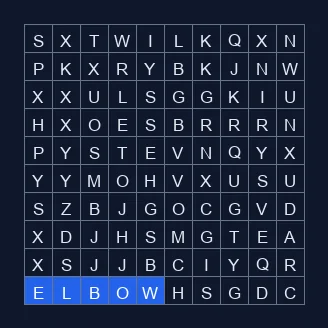
A single highlighted row is the kind of find you can safely mark on a quick pass—when you know the full spelling matches the list, momentum builds without skipping the verify step on trickier paths elsewhere on the grid.
Minimize Distractions
Small interruptions flip accuracy before they flip the timer. For timed or casual word find sessions:
- Mute notifications or pause between puzzles instead of mid-scan.
- Use clear lighting and comfortable zoom if you play on a screen.
- Mark found words clearly so your eyes stop re-hunting settled paths.
A calm environment keeps pattern recognition online; that is where “fast” actually comes from.
Practice Regularly
Rhythm shows up with repetition. Regular play sharpens scan paths, letter-shape recognition, and when to slow for a dense zone. Mixed difficulty—easy grids for flow, harder ones for deliberate pacing—trains you to shift speed without defaulting to panic or gridlock.
Adjust Based on Difficulty
Not every puzzle deserves the same tempo. Easy boards may tolerate brisk horizontal sweeps; large grids, long lists, or many allowed directions often need slower, orientation-specific passes. Scale speed to grid size, list length, and how many paths you still owe a finished band.
Frequently Asked Questions
Is it better to be fast or accurate in word search?
Accuracy on list words comes first; sustainable speed is what remains after coverage is reliable. A quick finish with misses usually costs more time in rescue scans than a slightly slower first pass.
How do I get faster without missing words?
Keep a fixed scan order, do one quick pass then a targeted recheck of weak zones, and pause briefly when the list is almost done. Speed grows when fewer cells need a third look.
Should timed word search modes change how I balance pace?
Timers reward focus, not frantic hopping. In timed play, protect your structure: finish bands, verify diagonals or reversals when rules allow, and accept a short slowdown on the last few stubborn entries rather than blind skimming.
When should I slow down on a word find grid?
Slow when coverage feels thin—after a long stretch without a find, on dense filler, or when diagonals and backward spellings are still unaccounted for. Ease up until one orientation pass completes cleanly, then resume your normal rhythm.
Balancing speed and accuracy in word search games is a learnable habit. Structure your scans, split quick finds from verification, cut distractions, practice across difficulties, and throttle pace when the grid demands it—you get challenges that stay engaging while your solve quality improves.