





Start with Long or Short Words in Word Search Games? A Practical Answer
On straight-line word search and word find grids, solvers often debate whether to chase long list entries first or clear short ones early. Neither rule is universal, but each choice changes how much visual clutter you keep, how fast the remaining count drops, and how confidently you can verify paths—not crossword-style clues, just ordered list work on a letter board.
The Case for Starting with Long Words
Long spellings stand out because they span more cells: a distinctive letter run is harder to mistake for random filler once you know what to hunt.
Why Long Words Help Early
- Distinct letter runs jump out when the same consonants or vowels repeat along an allowed straight path
- Grid anchors—one long match can fence a band of letters and hint where neighbors hide
- Fewer ambiguous overlaps on some boards, because a confirmed long path removes a wide strip of doubt
Starting long works well when you like structure: tackle the loudest list line first, then fan out from it.
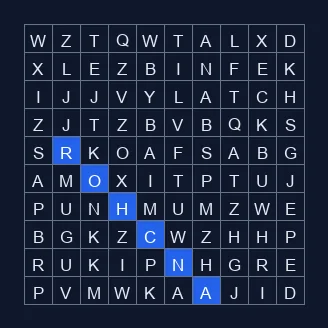
A highlighted anchor word like this is the kind of long find that orients the rest of the solve—once its cells are settled, short entries nearby are easier to confirm without re-scanning the whole grid.
Players who prefer a methodical open often grab one or two long anchors before a full row or column sweep.
The Case for Starting with Short Words
Short words hide in tight corners and overlap dense filler, yet they are cheap wins when you spot them quickly.
Why Short Words Help Early
- Quick clears shrink the list fast and build momentum on crowded boards
- Familiar shapes—two- and three-letter entries repeat across puzzles, so pattern memory pays off
- Opens tight zones where long paths would be hard to read until shorter neighbors are gone
Leading with shorts suits timed sessions or very dense grids where you want the count down before you commit to slow verification.
A Balanced Strategy
Most word search puzzle games reward a hybrid: neither “always long first” nor “only shorts” fits every list and board size.
How to Blend Both
- Scan for obvious long lines in an opening pass—rare letters or clean runs worth anchoring
- Switch to shorts along row, column, or edge bands where small words tend to tuck in
- Alternate by layout—after one long anchor, clear related shorts; after a short streak, hunt the next long line on calmer filler
The hybrid keeps coverage even: you avoid staring at one stubborn long word while easy shorts stay unmarked, and you avoid chasing only shorts while a single anchor would simplify the middle of the grid.
Practice Sharpens the Choice
Experience matters more than a fixed rule. The same player may open long on a spacious board and open short on a tight themed list.
What Repetition Teaches
- Pattern recognition for both lengths without over-focusing on one type
- Time sense for which entries deserve a slow verify versus a quick mark
- Adaptive switches when diagonal or reverse rules, list length, or density change the best opener
Regular play turns the long-or-short question into a habit you adjust per puzzle instead of debating it from scratch every time.
Frequently Asked Questions
Should I always start with long words in word search?
No. Long words anchor well when they are visually loud, but shorts clear noise faster on dense boards. Many steady solvers use a short opening burst, one long anchor, then return to shorts before harder orientations.
Are short words harder to find than long ones?
Often yes, late in the solve. Early on shorts can be quick wins; near the end, two- and three-letter lines hide in overlap and get skimmed. That is why hybrids pair long anchors with deliberate short-word passes.
Does grid size change whether to start long or short?
Yes. Large grids favor spotting a long run early to orient scanning; small crowded grids often reward clearing shorts first so cells open up. Theme and list length matter as much as dimensions.
When should I ignore the long-first advice?
When the list is mostly short entries, when long words share awkward overlaps, or when you are practicing speed on easy boards—opening with fast shorts may beat hunting one slow anchor.
Long words structure the grid; short words fuel pace. Most word find puzzles run best with both in rotation, tuned to the board in front of you. Keep practicing, notice which openers leave fewer rescue scans, and let that feedback shape your default—not a single rigid rule for every puzzle.