





Themed Word Search Puzzle Games Explained
Themed word search and word find puzzles use the same straight-line letter grid as classic formats, but every entry on the list belongs to one topic. That shared label lets you guess likely spellings before you scan, gives casual sessions a clear story, and helps classrooms bundle vocabulary without changing how paths work in the grid.
What Is a Themed Word Search Puzzle Game?
A themed word search puzzle game is any board whose hidden words all connect to a single subject. The grid still holds random fill letters; only the answer list is curated.
Typical theme buckets include:
- Animals and wildlife
- Food and cooking
- Nature and the environment
- Sports and recreation
- Travel and geography
Publishers pick words for relevance to the label, not because the grid needs unrelated filler entries.
How Themed Word Search Puzzle Games Work
The build steps mirror a standard word find:
- Choose a theme and audience (kids, travel fans, exam prep, and so on).
- Draft a word list where each spelling fits the topic.
- Place listed words along allowed straight directions inside the grid.
- Fill remaining cells with letters so the board looks uniform.
- Hand the list to the solver, who marks each word when a full path matches.
Because every answer should “belong,” you can often predict candidates—ocean on a sea-life list, spice on a kitchen list—before your eyes trace the letters.
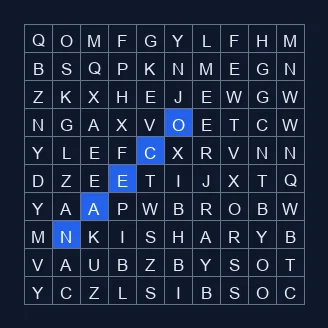
Theming changes what you expect on the list, not how you solve: one straight path (here “OCEAN”) still has to match a listed spelling. A nature label nudges you toward habitat vocabulary; the hunt itself stays line-based like any word search.
Why Themes Make Word Search Games More Engaging
Context shrinks blind guessing. On a food-themed word search puzzle game, solvers naturally look for ingredients and dishes—apple, bread, cheese—instead of treating the list as arbitrary trivia.
Themed design tends to boost:
- Faster first-letter guesses when vocabulary is familiar
- A sense of cohesion across the whole session
- Stronger links between spelling and real-world categories
- Clear pacing: easy wins and long entries often match the topic’s mix
Engagement rises because the puzzle “means something,” not because the rules change.
Common Types of Themes in Word Search Puzzle Games
Publishers reuse a handful of families; difficulty and tone shift with each.
Everyday Themes
Household items, colors, clothing, weather, and daily routines suit short lists and mixed ages. Words are usually short and culturally shared, so scans stay approachable.
Educational Themes
Science units, historical events, countries and capitals, and language-learning glossaries target classrooms. Lists may add longer or technical spellings on purpose.
Lifestyle Themes
Travel destinations, hobbies, fitness, music, and entertainment lean on personal interest. Familiarity varies: a sports fan flies through a league list; someone outside that fandom works harder for the same geometry.
How Themes Affect Difficulty
Grid size and enabled directions still matter, but theme steers how hard the solve feels.
Easier Themes
Broad, everyday vocabulary, short entries, and categories most solvers already know (animals, colors, common foods).
Harder Themes
Specialist jargon, abstract concepts, rare proper nouns, or niche fandom lists where recognition is uneven across players.
Two boards with identical settings can play very differently when one list is holiday greetings and the other is advanced chemistry terms.
Role of Vocabulary Familiarity
Themed word find puzzles reward topic knowledge as much as scanning skill.
- Familiar themes → quicker recognition and fewer “unknown” stalls.
- Unfamiliar themes → more list reading and slower confirmation passes.
- Mixed lists → some easy marks plus a few vocabulary stretches.
That blend is why themed sets work for both relaxation and deliberate study.
Visual and Cognitive Advantages of Themes
A clear label narrows what belongs on the list, which in turn narrows what your eyes hunt for.
- Focused search scope — you are not treating every possible English word as fair game.
- Less randomness — predictions cut wasted sweeps when guesses pay off.
- Pattern use — shared stems (
maple,mango) still need full paths, but first letters come from the theme, not luck.
Efficiency gains come from context, not from different placement rules.
Themed Word Search Puzzle Games for Learning
Schools and language apps use themed grids to reinforce sets tied to a unit.
- Vocabulary sticks when words sit in one category.
- Repeated exposure across puzzles builds spelling confidence.
- Interactive marking beats passive flashcards for some learners.
Language students especially benefit when themes mirror real topics—food, transport, family—while they still practice straight-line tracing on the board.
Strategy Tips for Themed Word Search Games
A little theme-first thinking speeds most sessions:
- Skim the list once and note long or similar entries.
- Predict likely words from the label before sweeping rows and columns.
- Group mental clusters (citrus fruits, winter sports, capital cities).
- Tackle familiar subtopics first, then return to outliers.
Those habits cut random jumps and improve your final accuracy pass.
Why Themed Word Search Puzzle Games Remain Popular
Themed puzzles keep the simple hunt loop everyone knows while swapping in fresh word lists. You get familiar mechanics, new content each topic, scalable challenge through vocabulary choice, and optional educational value—without learning a new puzzle type.
That balance suits quick mobile play and longer print volumes alike.
Final Thoughts
Themed word search puzzle games add meaning to a basic word-finding activity by tying every answer to one idea. Designers gain a clear editorial frame; players gain predictions, pacing, and variety. Whether you play for calm, travel names, or classroom review, the core stays the same: find whole listed words along allowed straight paths in the letter grid.
Frequently Asked Questions
Do themed word search puzzles use different rules?
No. Only the list and title change. You still find complete words along straight horizontal, vertical, and diagonal paths when the puzzle allows them—the same word find rules as a generic board.
What is an example of a themed word search topic?
Animals, holidays, kitchen ingredients, countries, sports teams, and movie titles are common. Each list should stick to one topic so predictions stay honest.
Are themed puzzles easier than random word lists?
Often yes when vocabulary is familiar to you. Niche or technical themes can feel harder than a random list on the same grid size if you do not know the words in advance.
Can one puzzle mix multiple themes?
Some publishers blend related labels (“beach and ocean”), but true multi-theme lists weaken prediction. Most clean designs keep a single primary topic.
How do themed puzzles help learning?
They group spellings by subject, so recall and pattern spotting happen in context. Students mark words while revisiting the same semantic field, which supports vocabulary without changing the game mechanics.
Is a themed word search the same as a crossword?
No. Crosswords use intersecting clues and letter slots. Themed word search games still hide full words on continuous straight paths in a fill grid—you mark paths, you do not fill blank squares from definitions.