





How Themes Affect Word Search Puzzle Difficulty
The same grid size and direction rules can feel easy on one puzzle and exhausting on another, largely because theme shapes the word list. In word search and word find games you still hunt whole words along straight paths in a letter grid—but whether you know the vocabulary, how long entries tend to be, and how many look-alike spellings sit side by side all shift how hard the solve feels.
Familiarity with the Theme
Familiarity is often the quiet difficulty knob. Everyday themes—animals, colors, food, sports—let you guess likely spellings before your eyes confirm them, which shortens blind scanning. Niche or specialist lists (advanced science, obscure history, industry jargon) add recall work: you may know the word exists on the list but still hunt the letters slowly.
That gap is why two “medium” boards with identical geometry can play differently. One solver’s easy nature puzzle is another solver’s struggle if they rarely read botanical names.
Word Length and Complexity
Themes steer average word length and spelling complexity. Food lists often mix short staples (rice, pear) with longer items (spaghetti, artichoke). Geography themes may lean on multi-syllable place names. Longer paths take more passes to verify; uncommon letter pairs (ph, double consonants) slow pattern matching even when the theme is familiar.
Difficulty here is not “harder grammar”—it is more letters per find and fewer instant shape matches in the grid.
Similarity and Confusing Patterns
Some themes pack words that share prefixes, stems, or endings. A plant list with maple, maize, and mango forces you to finish each path letter by letter instead of stopping at MA-. Technical sets full of cognates or abbreviations create the same visual noise.
When overlap is heavy, theme choice multiplies the almost-match problem: your eye locks onto the right opening letters, then the trail diverges.
Density and Word Placement
Theme design also influences how tightly words pack the grid. Lists built from many short, common entries invite denser placement and more shared cells—crowded boards fatigue scanning faster. Lists dominated by long or rare words may leave quieter zones, but each remaining find can demand a full directional sweep.
Designers often tune density per theme audience: kid-friendly animal sets stay readable; expert vocabulary sets compress overlap on purpose.
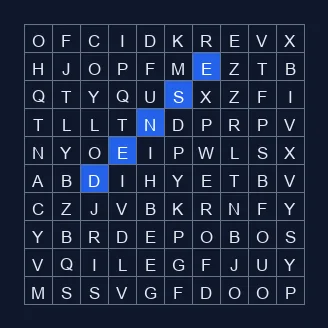
A single highlighted path on a compact board shows what themed density can feel like: many crossing letters, one full word to confirm before you mark it off. “DENSE” here stands in for checking a complete line when the surrounding grid leaves little empty space.
Educational Themes and Learning Curve
Science, history, and language-learning themes add a memory layer on top of visual search. You may need to recall a term from class before you can search efficiently—or discover the spelling only after you trace it in the grid. That dual load makes educational sets feel harder even when grid settings match a casual puzzle.
The tradeoff is intentional: themed word search puzzle games can reinforce vocabulary while you practice scanning discipline.
Balancing Theme, Grid Settings, and Pace
Theme does not replace explicit difficulty labels—it interacts with them. A large grid with every direction enabled hurts more when the list is unfamiliar. A small grid can still sting if the theme packs similar spellings.
Practical approach:
- Warm up on familiar topics before specialist lists.
- Read the full list once; note long entries and easy-to-confuse pairs.
- On dense themed boards, slow the final pass instead of rushing the count.
Final Thoughts
Themes change word search puzzle difficulty through familiarity, word length, look-alike lists, and how full the grid looks—not through different core rules. Pick topics that match your goal for the session: relaxed recognition practice, vocabulary stretch, or a tough specialist list. When you want to compare how topic choice feels on similarly labelled boards, browse themed categories on word-search-puzzles.com and rotate a familiar theme against a new one at the same size.
Frequently Asked Questions
Does a theme make a puzzle hard even on an “easy” grid?
Yes. Small grids with only two directions can still feel tough when vocabulary is unfamiliar or entries look alike. Geometry sets the ceiling; the theme sets how fast you recognize targets.
Are holiday or pop-culture themes always easier?
Not always. A mainstream movie theme is easy if you know the titles; the same theme is hard for someone who has not seen the films. Familiarity is personal.
Why do plant or science lists feel visually noisy?
Shared letter patterns (chloro-, -ology, Latin roots) create clusters your eye wants to treat as one word. Theme drives that clustering as much as placement rules do.
Do longer words always mean a harder theme?
Long words add scan time, but short, dense lists can feel harder in practice because overlap hides quick wins. Length and density both matter.
Is themed word search different from crossword puzzles?
Yes. Crosswords fill clue-based blanks. Word search hides full words along straight paths in a preset letter grid for you to find and mark.
Can I practice unfamiliar themes without burning out?
Yes. Mix one challenging themed board with a familiar topic in the same week, use untimed mode, and skim the list before scanning so recall and search do not fight each other on every entry.