





How Time Limits Change Word Search Game Strategy
A countdown turns a relaxed word search or word find grid into a performance puzzle. You still mark list words along allowed straight paths on the letter grid—not crossword fill-in—but every second spent wandering costs coverage. Knowing how timers reshape scanning, word order, and focus helps you stay fast without racking up rescue passes.
Increased Focus and Speed
Timed word search puzzle games force a trade: move quickly, yet confirm each spelling before you mark it. Sloppy speed usually means more backtracking than a slightly slower, structured sweep.
Key adjustments
- Scan in clear bands so speed does not turn into random hopping.
- Grab high-confidence list words first to build momentum and visible progress.
- Cut needless backtracking—if a path fails, park it and finish the band you are in before restarting the same hunch elsewhere.
Players who keep rhythm under pressure treat accuracy as the guardrail and speed as what fits inside it.
Strategic Word Selection
Clock pressure changes which line on the list you chase next, not the basic rule that words hide on straight paths through the grid.
Effective approaches
- When time is tight, favor quick, obvious marks early so the remaining list feels smaller.
- Still jump on long or high-cross words when you spot a clean path—they can clear overlapping filler in one move.
- Notice shared letters between list entries so one find hints where the next straight path might run.
Deliberate ordering beats staring at the whole board while the timer ticks.
Adjusting Search Patterns
Timers reward finished passes, not frantic eye darting. Most timed word find sessions still lean on horizontal and vertical coverage first; diagonals and reverses get their own pass when rules allow.
Practical tactics
- Run horizontal then vertical sweeps (or the reverse) so each row and column gets a real visit.
- Use distinctive letters—Q, X, Z, or a rare double—as anchors to start a targeted straight-line search.
- Switch between row-by-row discipline and point checks on dense corners once the open bands are thinner.
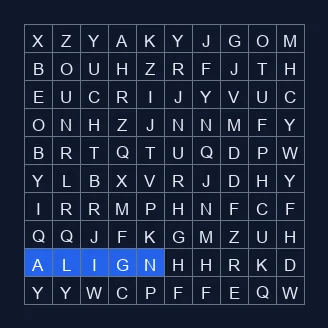
A clean horizontal find is the kind of mark you want early in a timed round: one confirmed straight path, list word settled, attention free for the next band—not a half-guess that sends you back through the same letters.
Flexible scanning keeps coverage complete when the clock is loudest.
Minimizing Distractions
Under time pressure, a five-second interruption can cost a whole orientation pass.
Tips for focus
- Clear visual clutter around the screen or printed page.
- Avoid multitasking mid-grid; pause between puzzles instead of mid-scan.
- Mark found words decisively so your eyes stop re-hunting settled paths.
A calm setup protects pattern recognition—the real source of timed speed.
Learning from Experience
Timed strategy improves with repetition on mixed grids, not one heroic sprint.
How practice helps
- Learn which letter shapes and stems show up often in your usual difficulty band.
- Shorten the gap between seeing a cluster and confirming a full list spelling.
- Review where you lost time last session—missed band, slow diagonal pass, or over-chasing one stubborn word.
Experience turns panic into a familiar rhythm: sweep, confirm, move on.
Time Pressure and Cognitive Skills
Timed word search games train more than vocabulary. They stress visual processing, quick prioritization, and holding partial grid state in working memory while you finish a pass.
Those skills transfer when you return to untimed play—you simply spend the saved minutes on harder lists instead of rescue scans.
Flexible Pacing in Casual Play
Not every word search session needs a timer. Alternating modes keeps practice sustainable:
- Untimed grids for thorough exploration and new orientation habits.
- Timed rounds as deliberate drills for scan order and decision speed.
- Mixed weeks so relaxation and challenge both have a slot.
Knowing when a timer helps—and when it only adds noise—lets you pick the right tool for each sitting.
Frequently Asked Questions
Do time limits mean I should skip diagonals and backward words?
No. Rules still govern which directions count. Under a timer, finish one orientation family per pass instead of blending them into a single rushed sweep.
Should I hunt long words or short words first when timed?
Start with marks you can verify quickly so progress and confidence rise. Take long or awkward spellings when the path is already clear; do not burn half the clock proving one stubborn entry.
How do I avoid panicking when time runs low?
Return to your fixed scan order, clear any band you half-finished, and leave at most one or two hard list lines for a final targeted pass. Structure beats blind skimming in the last minute.
Are timed word find games good for learning strategy?
Yes—if you treat them as training reps. Pair timed sets with untimed puzzles so speed drills do not replace careful coverage habits.
When a timer is on the board, strategy is about coverage with intent: ordered sweeps, smart list priorities, fewer distractions, and practice that makes the rhythm automatic. Swap timed and untimed word search games deliberately and the clock becomes a coach—not the boss of every session.