





Timed vs. Untimed Word Search Games
Word search and word find puzzles are the same straight-line hunt either way: you mark list words on paths through a letter grid, not crossword-style clue filling. What changes is whether a clock is running. Timed modes push faster scans and quicker commitments; untimed play leaves room for row-by-row checks and calm pacing. Knowing how each format shifts strategy, focus, and mood helps you pick the right mode for relaxation, practice, or a deliberate speed drill.
What Are Timed Word Search Games?
Timed word search games add a countdown (or stopwatch) to the usual goal of clearing the word list. Success still depends on finding every spelling on an allowed straight path—horizontal, vertical, or diagonal per the puzzle rules—but elapsed time becomes part of the score or the personal challenge.
Key characteristics
- A visible timer tracks how long you have or how fast you finish.
- Performance blends speed and accuracy: rushing without confirming spellings often costs more time than a steady sweep.
- Mistakes and hesitation feel costlier when the clock is loud.
Competitive leaderboards, daily timed challenges, and “beat your best” stats usually sit in this bucket. Quick pattern reads and disciplined scan order matter as much as vocabulary.
What Are Untimed Word Search Games?
Untimed word search puzzle games drop the countdown. You may still see a casual elapsed-time display, but nothing fails when you pause for coffee or study a dense corner of the grid.
Key characteristics
- No hard time pressure unless you opt in later.
- Emphasis on careful searching, experimentation, and comfortable pacing.
- Welcoming for beginners, low-stress sessions, and long themed lists.
Print grids, classroom packs, and many casual apps default here. Players can methodically finish each orientation pass without treating every second as a penalty.
How Strategy Changes Between the Two Modes
The presence or absence of a limit changes how you sweep the board, not the rule that words hide on straight lines through the grid.
In timed games
- Scans tend to be more aggressive: wider bands, fewer full re-reads of settled rows.
- Familiar word shapes get marked fast when the path is obvious; borderline clusters may wait.
- Verification is shorter—enough to avoid a wrong mark, not a leisurely double pass on every line.
In untimed games
- Row-by-row or column-by-column discipline is easier to keep without clock anxiety.
- There is more room for detail checks—tracing a spelling letter by letter before you commit.
- Trying alternate scan orders (columns first, diagonals in a dedicated pass) is less punishing.
The same puzzle file can feel like a sprint in timed mode and a mindful stroll untimed.
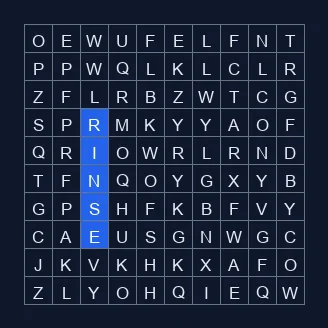
A vertical find such as “RINSE” on the column path illustrates the trade: timed players often confirm and move on in one pass; untimed players may linger on the same stripe to rule out overlapping list words before marking.
Cognitive and Emotional Differences
Timers do not just change tactics—they change how the session feels.
Timed play
- Raises arousal and focus; small interruptions hurt more.
- Rewards fast decisions and tolerates a bit more “good enough” verification.
- Can feel competitive even when you are only racing yourself.
Untimed play
- Supports relaxation and lower stress for many players.
- Allows deeper concentration on one tricky word without watching digits tick.
- Fits casual mental exercise—a break that still engages visual search.
Both formats engage attention and pattern skills; timed play stresses prioritization under pressure, while untimed play stresses coverage and patience.
Which One Improves Skills Faster?
Neither mode wins outright. They train different edges of the same word find habit.
Timed mode benefits
- Builds reaction speed and quicker spelling confirmation.
- Sharpens pattern recognition when the grid is noisy and the clock is on.
- Trains scan rhythm: ordered passes instead of random hopping.
Untimed mode benefits
- Strengthens careful observation and reduces false marks.
- Lets newcomers learn word paths without time shame.
- Supports long focus sessions without adrenaline fatigue.
Players who alternate—untimed for new strategies, timed to test whether those strategies stick—often improve both speed and steadiness.
Choosing the Right Style
Match the mode to your goal for that sitting, not to a permanent label as “a timed player” or “an untimed player.”
- Relax or wind down: untimed grids, familiar themes, optional shorter lists.
- Challenge or drill speed: timed rounds, slightly denser grids, or a personal time target.
- Balanced week: mix both so rush habits do not replace coverage, and slow habits do not block progress on quick marks.
Neither format is inherently better; each is a tool on the same straight-line word search rules.
Frequently Asked Questions
Does untimed mean the puzzle is always easy?
No. Grid size, word length, overlap, and direction mix set difficulty. Untimed only removes clock pressure—you can still face a demanding board.
Are timed word search games unfair to beginners?
They can feel harsh at first. New players often do better with untimed grids until scan order feels natural, then add short timed reps.
Can I use a timer on an otherwise untimed puzzle?
Yes. Many players self-time for practice without failing the run. Official timed modes usually lock scoring to the app or sheet rules.
Which mode is better for brain training?
Both help attention and visual search in different ways: timed for quick prioritization, untimed for sustained coverage. Variety beats overdoing one mode.
Should competitive players ever play untimed?
Yes. Untimed sessions are where you debug scan habits and learn new list orders without burning clock on experiments.
Final Perspective
Timed and untimed word search games differ in pressure, not in the core hunt. One rewards pace and decisive marking; the other rewards thorough sweeps and calm focus. Switching between them keeps practice fresh—quick breaks can stay untimed, while a timed round can turn the same letter grid into a focused drill. Pick the mode that fits the moment, and both stay useful parts of the same word find hobby.