





How to Train Your Brain with Word Search Puzzle Games
Word search and word find puzzles are often played for calm, but they can also serve as light mental exercise. They are not medical brain training and they are not crossword-style definition solving—yet steady play on a letter grid still trains attention, visual scanning, working memory for the word list, and pattern sense along straight paths (horizontal, vertical, or diagonal, depending on the rules).
Used regularly and with realistic expectations, word search puzzle games fit easily into an everyday routine that keeps the mind engaged without heavy pressure.
Stimulating Visual Processing Skills
Most of the cognitive load in a word search puzzle game is visual. Your eyes sweep rows and columns; your brain flags letter runs that might match a list entry.
What Happens During Play
- The brain tracks patterns across many cells at once
- Familiar spellings and shapes register before you spell every letter
- Filler letters fade into background noise while promising paths stay in focus
That loop keeps visual recognition active—especially when grids are dense or themed lists repeat similar spellings.
Strengthening Attention and Focus
Training the mind with word search is partly about staying with one task. A single distracted jump can mean rescanned rows or a missed short word.
How Word Search Helps
- Sustained attention to the grid and the remaining list
- Ignoring tempting but wrong letter clusters
- Staying on a scan path instead of hopping randomly
Those habits mirror what many people want from short, screen-based focus breaks: one clear job, not multitasking.
Supporting Working Memory Activity
Working memory holds information briefly while you act on it. During word search, that often means juggling the list while your eyes search.
Example in Gameplay
- Keeping which words are still unchecked while you scan
- Holding a candidate spelling in mind while you trace a line
- Updating tactics when a sweep fails (try another direction or anchor word)
The load is moderate—enough to stay alert, not enough to feel like a memory exam.
Encouraging Pattern Recognition
Pattern recognition is one of the clearest skills sharpened by repeat play. Experienced solvers spot prefixes, rare letters, and word silhouettes faster over time.
What the Brain Learns
- Common letter pairs and triples jump out against random fill
- Word shapes are recognized before every cell is read
- Overlaps and shared cells become easier to parse
Regular word search play trains that kind of quick visual match again and again in each grid.
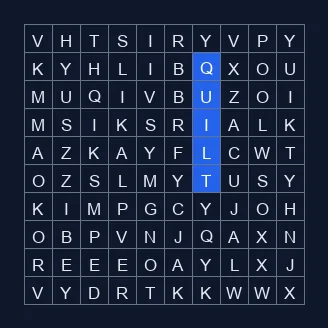
Pattern practice in action: a vertical highlight shows how the brain learns to treat one straight spelling (“QUILT” here) as a single traceable shape amid surrounding letters—repeated across hundreds of cells per puzzle.
Improving Mental Flexibility
Mental flexibility is the ability to shift attention and tactics when the first approach stalls.
How It Develops
- Switching from one list word to another without losing the sweep rhythm
- Changing scan direction when a row-first pass comes up empty
- Adapting when overlap zones hide the last few entries
Word search puzzle games reward that flexibility in small, low-stakes steps—no timer required.
Building Cognitive Endurance
Even short bouts of focused scanning can extend how long you stay with a mental task before fatigue sets in.
Benefits of Regular Play
- Longer comfortable focus during a single puzzle
- Less drift when only a handful of words remain
- Smoother recovery after an interruption because the list gives you a clear checkpoint
Endurance here means steady engagement, not grinding through exhaustion.
Creating Healthy Mental Habits
Brain-friendly routines are as much about repetition as about raw difficulty.
Positive Habits Formed
- Short, scheduled periods of deliberate thinking
- Calm, structured problem-solving instead of endless passive scrolling
- A clear finish line when the word list empties
Those habits make word search an accessible entry point for anyone who wants mental activity without a formal program.
Limiting Factors to Keep in Mind
Word search games support everyday skills; they do not replace clinical or intensive cognitive training.
What They Do Not Provide
- Deep cognitive restructuring or diagnosis
- Advanced memory protocols designed by specialists
- Complex reasoning drills on par with heavy academic or professional study
Treat them as enjoyable maintenance—helpful, modest, and easy to combine with other activities.
Suitable for All Ages
Simple rules and scalable grid sizes keep word search puzzle games open to many players.
Different Benefits by Age
- Younger players: letters, spelling exposure, and sustained attention on manageable boards
- Adults: focus breaks, pattern speed, and low-pressure vocabulary from themed lists
- Older adults: light engagement, routine, and familiar spelling recognition
Difficulty should match the player: smaller grids and shorter lists for beginners; larger packs when skills and interest grow.
Final Thoughts
Training your brain with word search is less about heroic difficulty and more about consistent, attentive play. The same grid mechanics—scan, match, trace straight paths—exercise visual processing, focus, working memory for the list, and pattern sense in a format most people already enjoy.
If you want a steady habit, rotate themed packs or vary grid size so each session feels fresh. For themed and custom line-grids online, word-search-puzzles.com is one place to practice without turning play into homework.
Frequently Asked Questions
Can word search puzzle games train your brain?
They can support everyday skills such as visual scanning, sustained attention, light working memory for the list, and pattern recognition along straight paths. Effects are gradual and modest—not a substitute for medical or clinical brain training.
How often should you play for mental exercise?
Consistency matters more than marathon sessions. Many players benefit from short, focused rounds several times a week rather than one rare all-day binge.
Are word search games the same as brain-training apps?
No. Commercial brain-training apps often target specific drills and progress tracking. Word search puzzle games offer open-ended search on a letter grid—useful mental activity, but not a prescribed treatment or clinical program.
What grid settings work best for cognitive practice?
Match the board to your goal: smaller, untimed grids for calm focus; slightly larger or denser grids when you want more visual challenge. Keep paths along straight lines per the puzzle rules—still word search, not crossword fill-ins.
Can children use word search for brain activity?
Yes, with age-appropriate themes and grid sizes. Kids practice letters, spelling exposure, and attention the same way adults do—at a gentler pace.
Do harder word searches train the brain more?
Harder grids add letters, directions, or overlap—but only help if you still play attentively. A focused easy puzzle often trains more than a rushed hard one.