





Uncommon Letters in Word Search Games: Rare Anchors and Faster Finds
On straight-line word search and word find puzzles, most filler cells are vowels and high-frequency consonants. Letters such as Q, X, Z, and J show up far less often—so when you spot one, it is usually worth a targeted trace before you grind through another full row pass. This guide covers which rare letters matter in English grids, how to tie them to your word list, and how to combine anchor hunting with the scan habits you already use.
Why Uncommon Letters Are Useful
Rare letters break the visual monotony of the grid. Each hit is less likely to be meaningless filler, which narrows where list words can hide along allowed horizontal, vertical, and diagonal paths (not crossword-style clue fills).
Because English lists lean on common spellings, a lone X or Z often belongs to one of the remaining entries—or to a corner of the grid you have not finished yet. Hunting anchors first turns a big board into a short set of “trace from here” zones instead of endless uniform scanning.
How to Spot Uncommon Letters Efficiently
Step 1: Identify rare letters in the word list
Before you touch the grid, scan the list for words that carry Q, X, Z, J, or other low-frequency letters for your language. Mentally rank those entries: they are usually faster wins than hunting every short word from scratch.
Note doubles or pairs as well (QU, ZZ) so you know which shapes to expect when you reach the matching letter on the board.
Step 2: Scan the grid for those letters first
Train your eyes on angular or distinctive forms instead of reading every cell in order.
- Q often sits beside U on English lists—look for that pair even on diagonal lines.
- X may stand alone or inside familiar chunks (EX, AX).
- Z and J read as sharp corners compared with rounder vowel blobs.
Once you lock a rare letter, pause long enough to trace outward along every direction the puzzle rules allow before you leave that cell.
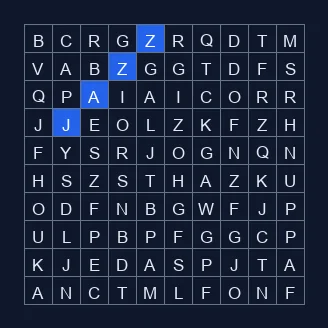
The sample word JAZZ carries two uncommon letters on one slanted path. Spotting J or Z in filler first gives you a fixed point to trace forward, backward, or across other orientations on real puzzles.
Step 3: Trace possible word paths
From each anchor, run straight lines through neighboring cells. Word search puzzle games still place answers on continuous paths; uncommon letters rarely solve the word alone, but they tell you which line deserves the next few seconds.
If the path fails, mark the dead end mentally and return to rare-letter hunting rather than restarting a random row from the opposite side of the grid.
Combining Techniques for Faster Solving
Rare-letter work pays off most when it slots into a wider plan.
- First-letter anchoring: Match an opening letter with a rare interior letter to confirm direction early.
- Pattern recognition: Words that share Q, Z, or X often share chunks—one find may hint at a neighbor on the list.
- Grid segmentation: Finish one band for rare shapes, then rotate orientation so diagonal copies of the same spelling do not wait until the last pass.
Layering anchors on top of systematic sweeps keeps coverage complete while your eyes spend more time on high-signal cells.
Advantages of Using Uncommon Letters
- Efficiency: Fewer full-row rereads when anchors shrink the search field.
- Accuracy: Less chance you scroll past a stubborn word buried in common-letter noise.
- Transferable skill: The same habit helps on themed lists, timed rounds, and larger grids where filler density rises.
Over time, rare-letter spotting becomes automatic—you notice the odd shape, trace once, and move on.
Practical Tips
- Clear list words with the rarest letters first when several remain—they tend to pop before all-vowel short entries.
- Drill quick recognition of Q, X, Z, and J in different orientations so slanted or backward spellings do not delay you.
- Keep a mental checklist of which rare letters are still unplaced on the list so you do not stop hunting after the first Q find.
Pair this filter with a finished horizontal or vertical pass so no orientation stays invisible.
Frequently Asked Questions
Which letters count as “uncommon” in English word search lists?
Q, X, Z, and J are the usual suspects; V and K appear less often than E, T, or S. Your exact list matters—scan for whatever shows up least on the entries you still need.
Should I hunt rare letters before doing a full grid sweep?
Use rare letters as a parallel track: run your normal band pass, but let uncommon shapes trigger an immediate trace on that line. Do not skip systematic coverage entirely.
Do uncommon letters help on non-English word search puzzles?
Yes, but the rare set changes by language. Learn the low-frequency letters for your puzzle’s alphabet and apply the same list-first, anchor-second workflow.
Can two list words share the same rare letter in one grid?
Often yes—overlapping paths are common. Finding one anchored word does not always retire that letter everywhere; check other directions from the same cell before you move on.
Final Thoughts
Uncommon letters are small visual events in a sea of familiar filler. Treat Q, X, Z, J, and their language-specific cousins as invitations to trace, not as decoration. Pair anchor hunting with orderly row, column, and diagonal passes, and rare shapes will pull you to more list words with less random roaming.