





How to Use First Letters to Find Words Faster in Word Search Games
On straight-line word search and word find puzzles, speed often comes from where you look first, not from reading every cell in order. Treating each list word’s opening letter as an anchor lets you sweep the grid for a small alphabet set, then trace only the paths that might complete a full spelling—horizontal, vertical, or diagonal, never crossword-style fills.
Why First Letters Matter
The brain locks onto starts faster than mid-word letters buried in filler. In a dense board, a sea of vowels and common consonants look alike until you filter by which letter opens the entry you still need.
Grouping the list mentally by first letter also shrinks mental load: instead of holding twelve unrelated words, you might run one pass for S words and another for T words. That structure beats random hopping between list lines and grid zones.
How to Apply the First-Letter Strategy
Step 1: Identify the starting letter
Before scanning the grid:
- Read the word list and note each opening letter.
- Cluster list entries that share the same start so one grid hunt can serve several targets.
- Mark which starting letters are distinctive (Q, Z, X) versus crowded (S, T, E) so you know whether one hit might belong to multiple list words.
Step 2: Scan for the letter
Sweep rows, columns, or bands with that letter in mind—not the whole word yet.
- Watch for clusters of the same start letter; answers often sit on or near those cells.
- Use short, rhythmic eye movements so you recognize the shape of the letter instead of spelling filler aloud.
- On large grids, section the board and finish one zone for that letter before jumping away.
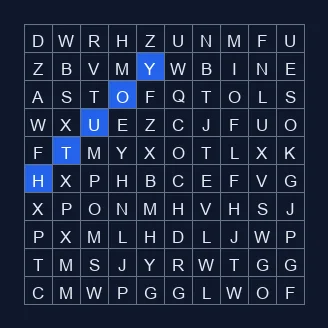
The sample word YOUTH begins with Y—a useful anchor on dense boards where you can hunt that shape first, then read the next four cells along the slanted path to confirm the full list entry.
Step 3: Check neighboring letters
Once a promising start is in view, verify the path the puzzle rules allow.
- Read straight lines from that cell through horizontals, verticals, and diagonals.
- Compare each candidate path to the remaining letters of the list word, not just the first match you hope for.
- Mark or select only after the full spelling matches; a shared opening letter can mislead if you stop one cell too soon.
Confirming end-to-end before you mark cuts false positives, especially when two list words share the same first letter.
Combining First Letters with Other Patterns
First-letter hunting works best as one layer in a wider solve plan.
- Prefixes and suffixes: After you fix the start, common chunks (UN-, -ING, -TION) speed the rest of the trace.
- Word shape: The length of the list entry tells you how far the line must run before you abandon a dead path.
- Rare-letter pairing: Match a common opener with an uncommon interior letter from the list to pick the right direction early.
Together, anchors plus pattern reading turn word search puzzle games from blind scanning into short, repeatable hunts.
Advantages of Using First Letters
- Time-saving: You filter the grid through a few letters instead of re-reading every cell for every word.
- Less frustration: Each pass has a clear goal—find all M anchors, then all P anchors—instead of vague wandering.
- Better accuracy: You trace only after a start matches, which reduces partial matches and misread diagonals.
Regular practice makes the habit automatic: list glance, letter cluster, line verify, mark, next anchor.
Tips for Maximum Efficiency
- On mixed lists, prioritize longer words whose opening letters are easy to spot in clutter, then clear related shorts from the same anchor zone.
- When many words share a common start, use second-letter or length cues from the list to separate them before you chase the wrong line.
- Pair first-letter passes with a finished orientation sweep (rows, then columns, or the reverse) so no direction stays invisible.
Train the opener-first reflex on themed and timed grids alike; the workflow stays the same even when density changes.
Frequently Asked Questions
Should I always solve in alphabetical order by first letter?
No. Order by what is left on your list and which starts are rare or distinctive. Alphabetical grouping is a memory trick, not a mandatory sequence.
What if several list words start with the same letter?
That is common. Narrow each hit using word length, the second letter, or a rare letter inside the spelling before you commit to a path.
Does first-letter strategy work for backward or diagonal words?
Yes. The anchor is still the first letter as you read the word on the list; once found, trace along every straight direction the puzzle allows, including reversed lines if the rules permit them.
Can I use first letters on very small grids?
Even on compact boards, grouping by opener reduces duplicate scanning. Short lists simply need fewer letter passes.
Final Thoughts
Using the first letter as a fixed starting point is a simple, high-leverage habit in word search games. It organizes the list, focuses each sweep, and pairs cleanly with systematic scanning and pattern skills you build on harder grids. Stay patient through each verification step—accurate anchors beat rushed marks—and your solves will feel faster without feeling frantic.