





What Is a Word Search Puzzle Game?
A word search puzzle game (also called a word find) gives you a grid of letters and asks you to locate every word on a list. Each answer sits on one straight line of adjacent cells—horizontal, vertical, or diagonal, forward or backward when the rules allow. You are not filling blanks from definitions like in a crossword; you trace letters that are already printed in the grid.
People have enjoyed this format for decades in newspapers, classrooms, and apps. It works as a quick break or a longer session, and it suits everyone from kids learning spelling to adults who want a calm mental workout.
How a Word Search Puzzle Game Works
Every standard puzzle has two visible parts:
- A letter grid, usually square or rectangular, filled with uppercase letters (including filler letters that are not on the list)
- A word list showing what you must find
Hidden answers share cells when paths cross; overlapping letters make dense grids harder to read, but the mechanic stays the same: one spelling, one unbroken line.
Typical rules allow up to eight directions: left-to-right, right-to-left, top-to-bottom, bottom-to-top, and the four diagonals. Easier sets often limit placement to horizontal and vertical words only; harder puzzles add diagonals and reversed spellings. Words do not snake through corners unless a rare variant explicitly says so.
When you spot a match, you mark it—circle or highlight on paper, or drag-select in a digital word search interface—then cross that word off the list.
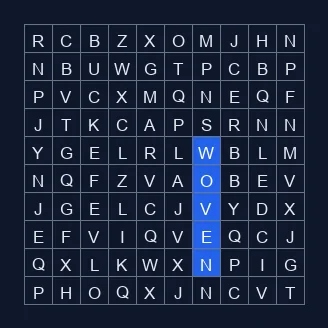
A valid find always covers a single straight path through the grid; marking the full line shows what is solved and what remains.
What Makes It a “Game”
A word search becomes more than a static worksheet when challenge, feedback, and choice enter the picture.
Common game-like layers include:
- Optional timers or score targets that reward speed
- Difficulty tiers driven by grid size, word count, and direction mix
- Themed word lists (animals, travel, holidays, and similar)
- Progress tracking and streaks in apps
Those options turn a simple grid into something you can replay, compare, and gradually improve at—without changing the core rule of straight-line finds.
Common Features of Word Search Puzzle Games
Most word search puzzle games share the same building blocks:
1. Letter Grid
The grid is the playing field. Larger boards hold more filler and usually take longer to clear; smaller grids feel gentler for beginners.
2. Word List
The list tells you what to hunt. Some variants hide the list until you discover words on your own, but classic word finds always supply targets up front.
3. Multiple Directions
Allowing diagonals and backward spellings multiplies how many orientations each anchor letter can start. Direction rules should appear in the puzzle instructions once before you scan.
4. Themed Content
Themes group vocabulary—food, sports, science—so unfamiliar words still feel connected. Themed packs use the same straight-line rules as neutral grids.
5. Difficulty Levels
Designers tune difficulty with grid dimensions, average word length, how many words sit on the board, and how many directions are legal. None of that changes the basic contract: listed words, straight paths.
Why Word Search Puzzle Games Are Popular
Word search games stay popular because the rules take a minute to learn and the payoff is immediate. A new player can finish a small grid without a tutorial; experienced solvers can chase faster scans and sharper pattern recognition on the same format.
Flexibility helps too. You can play for five minutes on a phone, print a page for a classroom, or work through a large board at a desk. Solo play is the default, but sharing a tough word or comparing times still fits the same simple setup.
Skills Involved in Playing
Luck rarely decides a fair puzzle. Steady skill matters more:
- Visual scanning: covering rows, columns, or blocks without skipping cells
- Pattern recognition: spotting familiar prefixes, doubles, and word shapes
- Attention to detail: catching short words and overlaps tucked beside longer lines
- Focus: keeping pace calm on dense boards
Regular play builds personal habits—some solvers anchor on rare letters, others march row by row. Either approach is valid when it covers the whole grid.
Variations of Word Search Puzzle Games
Not every word find follows the classic rectangle-plus-list model:
- Hidden message puzzles: leftover letters spell a phrase once all list words are cleared
- Listless or discovery modes: find as many valid words as you can under local dictionary rules
- Themed or shaped grids: topic lists or irregular outlines that change how you scan, not how a line must run
- Snake or path variants: only when rules explicitly allow non-straight paths; most commercial word searches stay linear
These twists keep the genre fresh while preserving the idea most players know: read the list, trace straight lines, mark every match.
A Simple Idea with Lasting Appeal
At bottom, a word search puzzle game is one reliable question—where do these spellings hide in the grid?—wrapped in a format that scales from kid-friendly 8×8 boards to expert timed marathons.
The mix of simple rules, optional challenge, and portable play is why word search and word find puzzles still show up in apps, books, and classrooms worldwide. Pick a list, choose your difficulty, and the grid is ready whenever you are.
Frequently Asked Questions
Is a word search the same as a crossword?
No. Crosswords use clues and empty cells you fill letter by letter. Word search puzzles hide complete spellings along straight paths; every cell already shows a letter.
Can words go backward or diagonally?
Many puzzles allow it; beginner sets often do not. Check the puzzle directions once so you know which orientations count.
Do I need to find words in list order?
No. Work in whatever order keeps you organized—short words first, rare letters first, or row-by-row scanning are all common.
What happens when two words share letters?
They overlap at shared cells. Mark each full path separately; overlap is normal, not an error.
Are word search puzzle games educational?
They reinforce spelling and vocabulary, especially with themed lists. They train visual focus too, though they are entertainment first—not a replacement for structured lessons.
Can I play without a printed list?
Only in special variants designed for free discovery. Standard word search puzzle games always give you (or imply) a target list so every puzzle has a clear finish line.