





What Should You Do When Stuck in a Word Search Game?
Getting stuck mid-puzzle is normal—even strong solvers hit stretches where every find feels blocked. On a typical word search or word find grid, that stall is usually about how you are looking, not whether the list words exist. Straight-line paths hide list entries across rows, columns, and allowed diagonals; this is letter-grid tracing, not crossword clue work.
The fix is rarely “stare harder.” A short reset, a different sweep, or one deliberate word from the list often unlocks the board again.
Pause and Reset Your Focus
When nothing new appears for several minutes, stop sweeping for a moment.
Why This Helps
- Eases visual fatigue before your eyes recycle the same bands
- Breaks mental tunnel vision on one corner or orientation
- Gives pattern memory a chance to surface when you return
Even a ten-second look away from a word search puzzle game can make a path you skipped stand out on the next pass.
Switch Your Scanning Direction
Many stalls come from repeating one habit—always left-to-right rows, or only horizontal bands—until the brain stops registering diagonal or vertical lines.
Try Changing Your Approach
- If you scanned left to right, try right to left on the same rows
- Trade row passes for column passes, or the reverse
- Hunt diagonals you treated as “later,” especially on denser boards
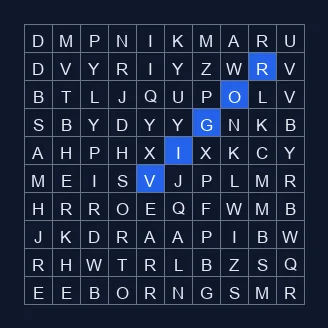
A diagonal example word shows how a single orientation change can reveal a straight path you had already skimmed horizontally. When stuck, rotate your default sweep before you widen the search.
That one shift often exposes words sitting in plain sight on word search games you have half-finished.
Look for Unfound Words Strategically
Random rescans burn time. Return to the list with one target at a time.
Useful Method
- Pick one unchecked entry and say its length aloud
- Picture its shape in each allowed direction before you touch the grid
- Anchor on the first or last letter and trace only paths that fit the spelling
Deliberate list-first work beats another unfocused tour of the whole word find board.
Break the Grid Into Smaller Sections
Large grids magnify the feeling of being lost because every open cell looks equally suspicious.
Section Strategy
- Divide the board mentally into quadrants or strips
- Finish one zone’s allowed orientations before you open the next
- Treat completed zones as “signed off” so unchecked areas stay obvious
Chunking lowers noise on dense word search puzzle grids and makes progress measurable again.
Search for Unique Letters First
Some letters and clusters jump out faster than others—and they can drag a stuck word into view.
What to Look For
- Rare letters such as Q, X, or Z when your language uses them in the list
- Double letters (LL, EE, SS) that repeat in a straight path
- Unusual pairs or triplets that match only a few list entries
Anchor sweeps on those hooks instead of rereading every cell on word search games when the list is almost clear.
Work Backwards From Difficult Words
Forward-only imagination fails when a word is short, reversed, or tucked against filler.
Reverse Strategy
- Read the last letter in the list entry and search for that letter first
- From each hit, trace backward along allowed straight paths
- Confirm the full spelling before you mark the list line
Backward tracing helps especially when rules allow reverse directions on word search puzzle games.
Avoid Fixating on One Area
Stuck feelings often grow from grinding the same block where you “know” the word must be.
Better Approach
- If a zone stays empty after an honest pass, move
- Schedule a second look later instead of forcing a third identical skim
- Keep the search moving so fresh bands get first-pass attention
Mobility beats stubborn staring on long word find sessions.
Use Peripheral Vision Instead of Detailed Reading
Spelling each cell aloud slows you down and deepens fixation when you are already stalled.
Instead, Try This
- Scan for word-shaped ridges of familiar letters rather than cell-by-cell reading
- Let your eyes glide in steady lines while the list word stays in working memory
- Notice motion and spacing—longer entries cast longer shadows across the grid
Shape-led passes complement careful reads and often break deadlocks on word search puzzle games.
Take Advantage of Word Length
Length is a filter: it tells you how much line to expect before you commit to a path.
Strategy Tips
- Long words can act as landmarks that narrow where shorter neighbors might align
- Short words need tighter passes and more orientation checks—tackle them after long anchors when you are stuck
- Match sweep width to length so you do not hunt a four-letter entry with a row-only habit
Using length as a guide reorients your plan without random hopping across the word search game grid.
Take Short Breaks When Needed
Sometimes the best move is to stop touching the board briefly.
Why Breaks Help
- Refreshes contrast sensitivity and scan rhythm
- Cuts frustration that pushes sloppy marks and false “done” zones
- Lets pattern recognition catch up after micro-rest
A drink, a stretch, or a look out the window often finishes a stubborn word search puzzle game faster than another angry minute on the same cells.
Frequently Asked Questions
Should I use a hint or keep searching when I am stuck?
Try a strategy reset first—new orientation, one list word, or a quadrant finish. Hints and reveal tools are fine for casual play, but on untimed puzzles the learning is in finding which scan habit left the word invisible.
Why do I only get stuck on the last few words?
Late-list entries are often short, backward, or diagonal. Earlier passes may have “cleared” a band mentally without marking every allowed direction. A slow final pass for short words and non-forward paths usually outruns frantic rescans.
Is it better to restart the whole grid or change method?
Restarting rarely fixes a habit problem. Change direction, chunk the board, or attack one list line with anchors before you abandon progress you already marked.
Are word search puzzles the same as crosswords?
No. Crosswords fill intersecting blanks from clues. Word search and word find games hide complete list words along straight paths in a letter grid for you to trace and mark.
Final Thoughts
Being stuck is an expected part of word search play—not a sign that the puzzle is unfair. Search differently: pause, rotate your sweep, work the list one word at a time, and use breaks before you fixate on one corner. Those resets usually bring the remaining straight-line finds back into view so you can finish with clearer focus.