





Why Are Some Words Hard to Find in Word Search Games?
Some list entries pop out the moment you glance at the grid; others feel invisible until you stumble on them halfway through a second pass. That gap is usually not random luck. In word search and word find puzzles, difficulty comes from how the grid is laid out, how the spelling is shaped, and how your eyes filter letter noise on straight-line paths—not from crossword-style blanks or clues.
Understanding those forces makes tough spots feel predictable instead of unfair.
Word Placement Is Designed to Create Challenge
Builders spread answers so the board does not read like a single easy sweep. Diagonals, reversals, overlaps, and corner placements all slow predictable scanning without enlarging the grid.
Common placement techniques
- Words on diagonal or backward paths along the same straight line
- Shared cells where two answers cross
- Entries tucked in corners or along edges you finish early
- Mixed directions inside one puzzle
Those choices are standard in word search puzzle grids when the goal is medium or hard play.
Longer Words Can Be Easier or Harder
Length changes visibility in both directions.
Why long words stand out
- They cover more cells, so the shape is easier to spot
- Uncommon letter pairs jump out against random filler
- Many solvers use long entries as visual anchors while hunting the rest
Why they can still hide
- A long spelling on an unexpected diagonal is harder to track than the same word in a row
- Segments can blend into crossing answers that share letters
- Once you fix on one direction, you may stop checking others along that line
On dense boards, long list words often work both ways—as a landmark and as a camouflaged path.
Short and Common Words Blend Into the Grid
Brief entries and everyday spellings are among the hardest finds because they lack a distinctive silhouette.
What makes them slip past you
- High-frequency letters (A, E, T, I) repeat everywhere in the filler
- Short patterns can appear in many locations at once
- Nothing in the spelling forces a double-take
Beginners especially spend extra time on these “quiet” words in word search games because every similar cluster looks like a false start.
Direction Changes Increase Complexity
Each allowed path is another scan habit you must switch on. When rules permit horizontal, vertical, and diagonal lines—and forward or backward reading along each—missing one orientation leaves real answers on the board.
Paths to check on each pass
- Horizontal rows, left to right and right to left
- Vertical columns, top to bottom and bottom to top
- Diagonal runs across the grid
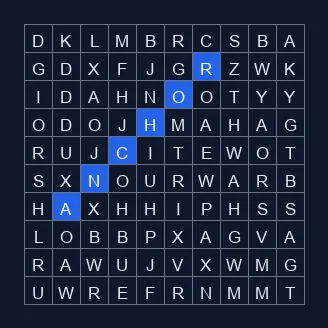
Diagonal placements are a common reason some words feel “missing”: the sample highlights “ANCHOR” on a slant while filler letters crowd the rest of the board—exactly the kind of path a forward-only row scan tends to skip.
If you only search the way you read prose, hidden words in other directions stay invisible until you trace them on purpose.
Letter Clustering Creates Visual Confusion
Heavy overlap and thick filler pack similar glyphs into the same region, which makes it harder to isolate one spelling.
Typical causes
- Repeated vowels or consonants in the random fill
- Several list words crossing one busy intersection
- Little visual “quiet space” between answers
That density is a deliberate difficulty lever in challenging word search puzzle grids, not a flaw in your eyesight.
Reading Habits Slow Detection
Daily reading trains you for left-to-right rows. Grids that bend rules across diagonals and reversals fight that default.
Habits that cost time
- Assuming every answer follows normal reading direction
- Stopping after the first plausible match in a cluster
- Hunting only from word beginnings and ignoring backward spellings
Closing that gap—by scanning each orientation you are allowed—is one of the fastest ways hard words start feeling findable.
Similar Letter Shapes Cause Mistakes
Quick sweeps confuse glyphs that look alike at a glance.
Frequent mix-ups
- M and N in a tight row
- O and Q in stylized fonts
- H, A, and R in dense layouts
Those near-misses add seconds per cell and can send you past a valid path without marking it in word search games.
Distractors Add Noise Without Being Answers
Fill letters are not random noise alone: runs of plausible-looking characters break the patterns your brain wants to lock onto.
Why builders use them
- They interrupt obvious letter chains
- They force you to verify each candidate against the list
- They raise difficulty without changing grid size
Advanced word search puzzle designs lean on that filler density so speed alone does not beat careful reading.
Grid Size and Density Matter
A small board limits hiding options; a large one multiplies places a short word can sit unread.
Smaller grids
- Faster full coverage with row or column passes
- Fewer directions and overlaps competing for attention
Larger grids
- More filler between list entries
- Higher chance that one orientation never gets a dedicated sweep
- Longer sessions before mental fatigue shows up
Most word search puzzle sets scale difficulty by grid size and allowed directions together, not by size alone.
Practice Improves Recognition Speed
Design makes some words stubborn, but experience still moves the needle. Regular play trains direction awareness, chunk spotting, and calmer pacing.
Skills that build over time
- Noticing prefixes and letter pairs before you read every cell
- Running the same grid with a second pass aimed at diagonals or short words
- Pacing sessions so late-list entries get the same focus as the first
With enough reps, even dense word search puzzle grids feel more like structured searches than random hunts.
Frequently Asked Questions
Are hard-to-find words always placed on purpose?
Usually, yes. Good puzzle design hides answers fairly along allowed straight paths while using overlap, direction mix, and filler to slow careless scans. When a word still feels impossible, check whether reverse or diagonal paths are in play before assuming an error.
Why are short words harder than long ones?
Short spellings match many accidental patterns in random letters, so your eye lacks a strong shape to grab. Long words occupy more cells and often include rare letters that stand out—unless they sit on a path you rarely check.
Do diagonal words make every puzzle harder?
They add one more orientation to verify, which raises difficulty for players who default to row-only sweeps. If diagonals are allowed, treating them as mandatory on every pass removes a large share of “vanished” list words.
Can overlapping words make one entry harder to see?
Yes. When two answers share cells, one path can look like fragments of noise until you trace the crossing line. Finding one overlapping word often unlocks the neighbor.
Are word search puzzles the same as crosswords?
No. Crosswords use clues and blank squares. Word search puzzle games place complete words along straight paths in a letter grid for you to find and mark from a list.
Some words resist you because the grid is doing its job: mixing directions, sharing letters, and flooding the background with look-alikes. When you name those mechanics—and scan every path the rules allow—tough entries stop feeling like bad luck and start feeling like the next skill rep on a straight-line list puzzle.