





Word Placement Rules in Word Search Puzzle Games
How list words sit inside a letter grid drives both fairness and difficulty. Whether you build puzzles or hunt answers faster, the same placement rules apply: each word on a straight path, inside the borders, with optional overlaps that stay readable.
This is word search and word find territory—straight-line answers from a list—not crossword-style clue grids.
Basic Directions
Each answer occupies one continuous line. Allowed orientations depend on the puzzle’s stated rules, but most word search games use some mix of:
- Horizontal: left to right or right to left along a row—the easiest orientation for many players.
- Vertical: top to bottom or bottom to top along a column.
- Diagonal: any diagonal ray across the board; harder to spot than rows and columns.
- Mixed layouts: combining directions in one grid raises scan workload without changing the straight-path rule.
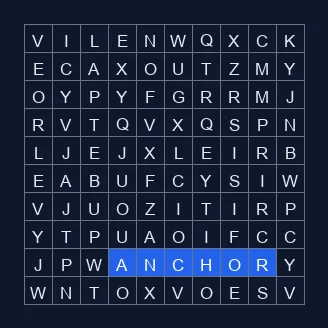
In this sample, “ANCHOR” runs horizontally along a single row. The same straight-line rule applies to vertical and diagonal placements; only the angle changes.
Words do not bend, branch, or switch direction mid-spelling. Reverse reading along the same line counts when the rules allow backward answers.
Spacing and Overlaps
Placement density must stay legible:
- Shared cells: One letter can serve two or more words when paths cross. Overlap saves grid space but should not blur which spelling belongs to which list entry.
- Adjacent runs: Back-to-back words on neighboring lines should not create misleading fragments that look like extra answers unless that is an intentional variant.
- Visual balance: Even spread of long and short words across the board helps players scan without fixating on one corner.
Strategic overlap is a design tool; careless overlap turns a fair grid into guesswork.
Boundary Considerations
Every placement must respect the outer frame:
- Grid limits: Start and end letters of each word stay inside the defined width and height. Nothing hangs off an edge.
- Edge answers: Words that hug a border can feel trickier because there is less padding around them; still, the full spelling must fit.
- No wrap-around: Standard word search rules do not continue a word from one edge to the opposite side. Wrap puzzles exist as rare variants and should be labeled clearly.
Boundary discipline keeps automated generators and hand-built layouts solvable on the same terms.
Randomization vs. Strategy
Builders choose how much planning goes into each grid:
- Algorithmic placement: Programs try positions in random or weighted order, retry when a word fails to fit, then fill leftovers with filler letters. Fast for volume play; occasional awkward crosses still appear.
- Hand-tuned layout: Editors place theme clusters, stagger lengths, or reserve open rows for teaching sets. Slower, but easier to match a lesson or difficulty label.
Both approaches obey the same straight-line and in-bounds rules; the difference is intent and polish, not physics.
Player-Focused Design
Good word search puzzle design keeps the solver in mind:
- Difficulty tiers: Shorter words, fewer directions, and lighter overlap suit beginners; longer lists with reverse and diagonal paths suit advanced players.
- Readability: Consistent cell size, clear type, and enough contrast reduce eye strain during long scans.
- Stable rules: When direction sets and overlap style stay predictable within a mode, players build habits instead of relearning layout tricks every round.
Fair placement hides answers without trapping them in ambiguous letter soup.
Frequently Asked Questions
Must every word use the same directions?
No. A puzzle can allow only rows and columns, or all eight straight directions including diagonals and reverse paths. The rule sheet—not guesswork—defines what counts.
Can two words share every letter on the same line?
They cannot occupy identical cells on the same path unless the puzzle uses a special duplicate-line variant. Normal grids allow crossing at shared letters, not stacked spellings on one segment.
Does overlap make a puzzle unsolvable?
Not when overlaps are intentional and each list word still has a unique valid path. Problems appear when overlap is so dense that multiple list entries could claim the same letter chain.
Is random placement less fair than hand placement?
Fairness comes from solvable paths and clear rules, not from manual vs. automatic layout. Random generators should verify that every list word fits before publishing.
Do placement rules differ for themed puzzles?
Themes change the vocabulary, not the geometry. Animals, holidays, or classroom topics still hide on straight lines inside the same grid frame.
Is word placement in word search the same as crossword construction?
No. Crosswords interlock answers through numbered clues and black squares. Word search embeds whole list words on straight paths in a full letter grid, then fills the rest—no per-clue grid required.