





Word Search Game vs Crossword: Key Differences
Word search and word find puzzles hand you a letter grid plus a word list: you trace straight paths to mark every listed word. Crosswords hand you numbered clues and a lattice of white and black squares: you infer answers and spell them so crossing letters match. Both reward word lovers, but the pace, skills, and barriers to entry diverge sharply—and they are not interchangeable formats.
Basic Structure of Each Puzzle Type
The clearest split is what sits on the page before you solve anything.
Word Search Structure
- A grid filled mostly with letters (often with random filler between list words)
- A published list of hidden words to find
- Words placed on straight lines—horizontal, vertical, diagonal, and sometimes reversed along those lines
Your job is to locate words that are already embedded in the grid.
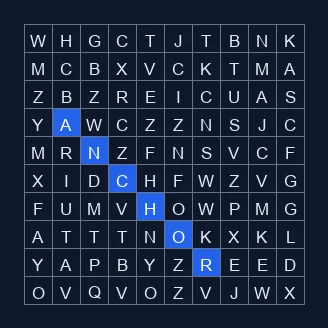
A word search looks like this: dense letters, one highlighted path such as “ANCHOR,” and a list telling you what to hunt. Nothing asks you to invent a new answer from a definition—you scan until a straight line spells a list word.
Crossword Structure
- A grid with blank answer cells and black blocking squares
- Clues for across and down entries
- Answers you must compose and fit into intersecting slots
Crosswords require deduction and spelling; the grid stays incomplete until you fill it.
Core Objective Differences
Both formats use words, but the win condition is different.
Word Search Objective
- Find and highlight every word on the list
- Lean on visual scanning and pattern recognition
- No clue interpretation and no guessing unpublished answers
Difficulty usually rises with grid size, list length, allowed directions, and overlapping letters—not with cryptic wordplay.
Crossword Objective
- Solve clues to determine each entry
- Make crossing letters agree at every intersection
- Draw on vocabulary, wordplay, and sometimes general knowledge
Progress feels like unlocking a lattice one clue at a time, not sweeping a field of letters.
Skill Requirements
Each type trains a different mix of mental habits.
Skills Used in Word Search
- Systematic visual scanning
- Letter-pattern and direction awareness
- Attention to detail and steady pace
- Quick eye movement across rows, columns, and diagonals
Strong word search players spot shape and repetition fast; they rarely pause to parse a definition.
Skills Used in Crosswords
- Vocabulary depth and spelling precision
- Logical reasoning from partial fills
- Clue-type literacy (anagrams, charades, trivia hooks, and more)
- Working memory for letters already in the grid
Crosswords lean linguistic and analytical; scanning alone will not finish a blocked diagram.
Difficulty and Learning Curve
How fast a newcomer feels “fluent” differs a lot.
Word Search Difficulty
- Rules are easy to explain in one minute
- If you can read the language, you can start finding short list words
- Challenge scales with grid density, word length, and direction set
Word search stays approachable for kids, classrooms, and casual adult play.
Crossword Difficulty
- Beginners may stall on clue conventions and sparse crossings
- Hard puzzles assume large vocabulary and puzzle literacy
- Difficulty swings widely by constructor, publication, and day of week
Many people grow into crosswords over months; word search rarely needs that ramp.
Time and Gameplay Style
Session rhythm and mindset diverge.
Word Search Style
- Often brisk and visually driven
- Many grids finish in one short sitting
- Players may chase speed, accuracy, or a calm “clear the list” loop
Word find fits coffee-break length unless the board is huge.
Crossword Style
- Slower and more reflective
- Clues reward pausing, testing letters, and revisiting tough definitions
- Multi-session solves are normal on ambitious grids
Crosswords feel like sustained reasoning; word search feels like sustained looking.
Cognitive Benefits Comparison
Both can support mental fitness; the emphasis differs.
Benefits of Word Search
- Sharpens visual attention and coverage habits
- Reinforces pattern spotting in noise
- Builds concentration during repetitive scans
Benefits of Crosswords
- Expands active vocabulary and recall
- Strengthens inference from partial information
- Exercises language processing and flexible thinking
Rotating between them can cover both “see it” and “think it” skills.
Final Thoughts
Word search and crosswords share a love of language, but they ask different things of you. Word search is list-and-line: trace hidden words in a letter field. Crossword is clue-and-fill: spell answers that lock together. Choose word find when you want fast visual challenge; choose crosswords when you want deeper linguistic puzzles—or alternate both if you like variety without confusing the two rule sets.