





Algorithms Behind Word Search Puzzle Game Generation
Players see a calm grid of letters; generators see a constrained search problem. Software must place every list word on allowed straight paths—horizontal, vertical, and diagonal when rules allow—resolve overlaps, back off when a layout stalls, fill the rest with noise letters, and prove the board is fair. This guide explains those algorithmic pieces for classic word search and word find puzzles, not crossword-style clue grids.
Fair generation is why themed libraries can ship thousands of boards without missing words or clipping spellings mid-grid.
Core Idea of Word Search Algorithms
At the simplest level, a generator takes a word list and a target grid size, then assigns each entry to a line of cells inside a two-dimensional letter matrix.
Main Objectives
Typical pipelines aim to:
- Place every list word without breaking spelling along its path
- Respect allowed directions and grid boundaries
- Use overlaps only when shared letters match
- Fill remaining cells so the board looks like a normal word search game
Those goals drive placement order, retries, and the final quality check.
Grid Representation in Algorithms
Most engines store the puzzle as a 2D character array: one letter per cell, addressed by row and column.
That layout makes collision checks cheap: before writing a word, the code can test each cell along a candidate path for empty space or a matching letter. The same structure supports later solvability scans and filler passes.
Word Placement Algorithms
Placement is where most CPU time goes. For each word, the algorithm samples candidate starts and directions, validates the path, and commits or tries again.
Common Placement Directions
Depending on puzzle rules, allowed paths often include:
- Horizontal (left to right and sometimes reverse)
- Vertical (top to bottom and sometimes reverse)
- Diagonal lines when the rule set permits them
The engine walks the list in some order—longest-first is a frequent heuristic—and stops only when every word is embedded or a retry policy kicks in.
Collision Checking
Before committing letters, placement logic usually verifies:
- Cells on the path are empty or already hold the same letter needed for an overlap
- The full spelling fits inside the grid
- Direction flags match the puzzle type (for example, “rows and columns only” versus full eight-way search)
When a path fails, the algorithm tries another start, flips direction, or backtracks to an earlier word.
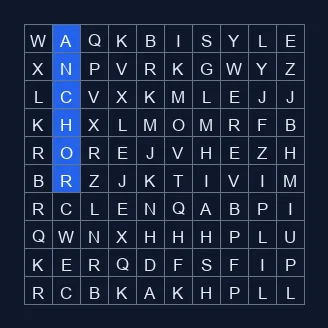
A single committed placement: “ANCHOR” runs on one allowed straight line while filler letters occupy the rest of the board. Generators repeat this step for each list word before the random fill pass.
Backtracking Algorithms in Word Search Games
When forward placement dead-ends, backtracking is a standard recovery tactic.
The engine places word A, moves on to B, and if a later word cannot fit, it unwinds B (and sometimes A) and tries a different position. Depth-first search with undo stacks is common; some tools cap retries or restart with a new shuffle to avoid infinite loops on tight grids.
Backtracking is what lets dense expert boards still fit long theme lists without manual editing.
Randomization Techniques
Randomness keeps libraries from feeling cloned.
Areas of Randomization
Useful random inputs include:
- Word processing order (after any fixed heuristics)
- Which direction is tried first at each anchor cell
- Starting coordinates when multiple slots are valid
- Filler letter draws after placement completes
Seeded random number generators help reproducible builds for QA while still varying player-facing puzzles across sessions.
Heuristic Methods for Better Placement
Pure brute force works on tiny boards; production generators lean on heuristics to cut failures.
Common Heuristics
Widely used shortcuts include:
- Long words first to reserve scarce straight runs
- Favoring crossings so several words share anchors
- Spreading placements instead of packing one corner
- Biasing toward central cells when the grid is large and sparse
Heuristics trade perfect optimality for speed—exact placement of many long words on a fixed grid is already a hard combinatorial problem.
Optimization in Word Search Puzzle Generation
Beyond “all words fit,” good algorithms tune how the grid feels to scan.
Optimization Goals
Designers often want:
- Reasonable letter density without unreadable clutter
- Natural crossings instead of isolated single-letter islands
- Even difficulty across the word list for a given tier
- Minimal leftover empty lanes before filler runs
Those targets are soft constraints—implemented as scoring functions or rejection rules—not strict mathematical proofs.
Filling Remaining Spaces
After placement, empty cells receive filler letters.
Fill Strategy
Common approaches:
- Uniform random A–Z draws for simple pipelines
- Frequency-weighted letters in the puzzle language for a more natural look
- Spot checks that trim accidental real words formed only by filler
Filler does not add hidden answers: only the original list counts for the player.
Difficulty Control Through Algorithms
Difficulty is mostly parameter tuning on the same core engine.
Easy Puzzles
Easier settings often use shorter words, smaller grids, fewer overlaps, and restricted directions (for example, horizontal and vertical only).
Hard Puzzles
Harder settings add longer entries, tighter overlap, more diagonal and reverse paths, and denser letter noise.
Those knobs ship as config—grid size, direction bitmask, max retries—rather than separate code paths.
Solvability Verification
Before publish, tools confirm the board matches the word list.
Verification Process
Checks typically include:
- Every list word appears in full along at least one allowed path
- No partial placements or truncated spellings
- Optional automated scans that mirror player direction rules
Failed validation triggers resize, list edits, or a full regeneration instead of shipping a broken puzzle.
Computational Complexity Considerations
Runtime grows with grid area, list length, direction count, and overlap density. Backtracking on large expert grids can spike CPU use, which is why heuristics, retry limits, and asynchronous generation matter in apps and websites.
Players never see that cost, but it shapes how fast fresh themed word search games can appear in a catalog.
Why Algorithms Matter in Word Search Games
Without structured generation, puzzles would be inconsistent—missing words, unfair density, or boards that cannot be solved under the advertised rules. Algorithms standardize list placement, filler, difficulty, and verification so libraries scale.
They are the hidden layer that keeps word find games reliable whether you play on paper or online.
Frequently Asked Questions
Is word search placement the same algorithm as crossword construction?
No. Crosswords interlock words through clue-driven blank cells. Word search embeds whole list words on straight paths in a preset grid, then fills the rest with letters.
Do generators always use backtracking?
Not always, but many do when placement order matters and overlap is tight. Simpler grids may use greedy placement without deep undo.
Can the same highlight word appear in two puzzles with identical filler?
Only if seed and list match exactly. Production systems vary seeds and placement so backgrounds differ even when a theme word repeats.
Why place long words first?
Long entries need uninterrupted straight runs. Placing them early reduces the chance that short words consume the only viable lanes.
Are diagonal paths mandatory in every word search algorithm?
No. Direction sets are a product rule. Some generators hard-limit to rows and columns; others enable full eight-way paths including reverse along those lines.
What happens if no layout satisfies the list?
Robust pipelines enlarge the grid, drop or swap an entry, reshuffle order, or abort and log the failure—rather than publishing a partial board.