





Word Search Puzzle Game Rules Explained
A word search puzzle game (often called a word find) is built around one idea: match every word on the list to a hidden straight path in a letter grid. The rules are simple, but knowing them up front saves confusion—especially around directions, reversed spellings, and overlapping words.
This guide walks through the standard rules most print and digital word search games share. Variants add timers, themes, or stricter direction sets; the core stays the same.
Basic Structure of a Word Search Puzzle Game
Every puzzle rests on two parts:
- A grid filled with letters (including filler letters that are not on the list)
- A word list of entries you must locate inside that grid
The goal is to find every listed word along a valid path. When the list is cleared, the puzzle is complete. Most versions score by completion only—there are no crossword-style clues or empty squares to fill.
How Words Are Placed in the Grid
Hidden words are not scattered at random. Each one occupies one continuous line of adjacent cells along a fixed direction.
Common placements:
- Horizontal — left to right or right to left along a row
- Vertical — top to bottom or bottom to top along a column
- Diagonal — along one of the four diagonal slopes through the grid
Straight-line placement is the default. Specialty formats exist, but classic word search rules assume a single unbroken path per word.
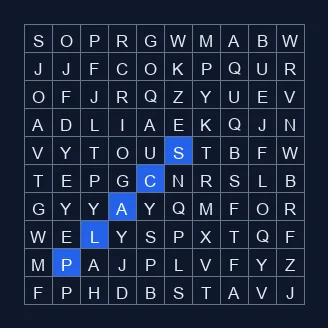
Each answer is one continuous line of cells; the highlighted example shows how a single word can run on a diagonal.
Full-rule puzzles often allow up to eight directions—the four cardinals plus four diagonals, each readable forward or backward along that same line. Easier sets may allow only horizontal and vertical words until you are comfortable with diagonals and reverse reading.
The eight straight-line directions; always read the puzzle instructions so you know which ones are allowed on that board.
Words Can Overlap
Words may share letters where their paths cross. One cell can belong to a horizontal word and a vertical word at the same intersection.
That overlap is normal, not a mistake. It packs more words into the same grid and makes you read each line carefully instead of assuming every letter belongs to only one answer.
Words May Be Reversed
On many puzzles, a word may read backward along an allowed line—not only left-to-right or top-to-bottom.
For example, APPLE might appear as ELPPA along a row you read from right to left. When backward words are allowed, check both orientations on every line you trace.
Reversed entries show up more often on larger grids and in harder difficulty settings.
No Strict Order for Finding Words
There is no required solve order. You may:
- Find words in any sequence
- Skip a stubborn entry and return later
- Work from the list or from the grid—whichever feels natural
That freedom is intentional; it lets you use personal scanning habits instead of a fixed walk through the board.
Marking Found Words
Once you confirm a word, mark it so you do not hunt it twice or miss a neighbor that shares letters.
- Print puzzles: circle or underline the full path
- Digital word search games: highlight, drag-select, or tap to confirm the line
Marking matters because filler letters and crossing words create look-alike fragments. A clear highlight shows what is already solved.
Words Are Always Hidden in Straight Lines
Standard rules do not allow bent paths. A single list word cannot zigzag, turn corners mid-spelling, or curve through the grid.
If a letter sequence changes direction partway through, it is not one valid word—it is coincidence among filler letters. Even themed or advanced word finds usually keep this straight-line rule so every puzzle stays fair and checkable.
Grid Size Affects Difficulty
Grid size is not a separate “rule,” but it changes how the same rules feel in play.
- Smaller grids — fewer cells, quicker scans, gentler overlap
- Larger grids — more filler, longer lines to trace, more directions to test per anchor letter
A longer word list on the same grid also raises difficulty, because paths compete for space and crossings multiply.
Time Limits Are Optional
Some word search games add a timer; many do not.
- Timed play rewards speed and quick pattern spotting
- Untimed play favors accuracy and a relaxed pace
A clock changes how you approach the board, not what counts as a legal word or a finished puzzle.
Core Rule Summary
At heart, every word search puzzle game asks the same thing: find all listed words on straight paths through a letter grid, in whatever directions and overlaps that puzzle allows.
Themes, grid sizes, timers, and direction restrictions add variety—but they do not replace the grid-plus-list, straight-line foundation. Once that is clear, you can jump into themed puzzles or custom boards on the site with confidence about what “found” means.